


Ministry of Defence
Aberporth fears raised after Russian claims and spy ship incidents off Welsh coast


CONCERNS are being raised in West Wales after a community meeting was announced over claims that Aberporth has previously been identified as a potential Russian military target.
Campaign groups have circulated material stating that the Ceredigion site was included on a list of UK locations referenced by a senior Russian political figure in 2022, prompting calls for discussion about the risks associated with defence-related activity in the area.
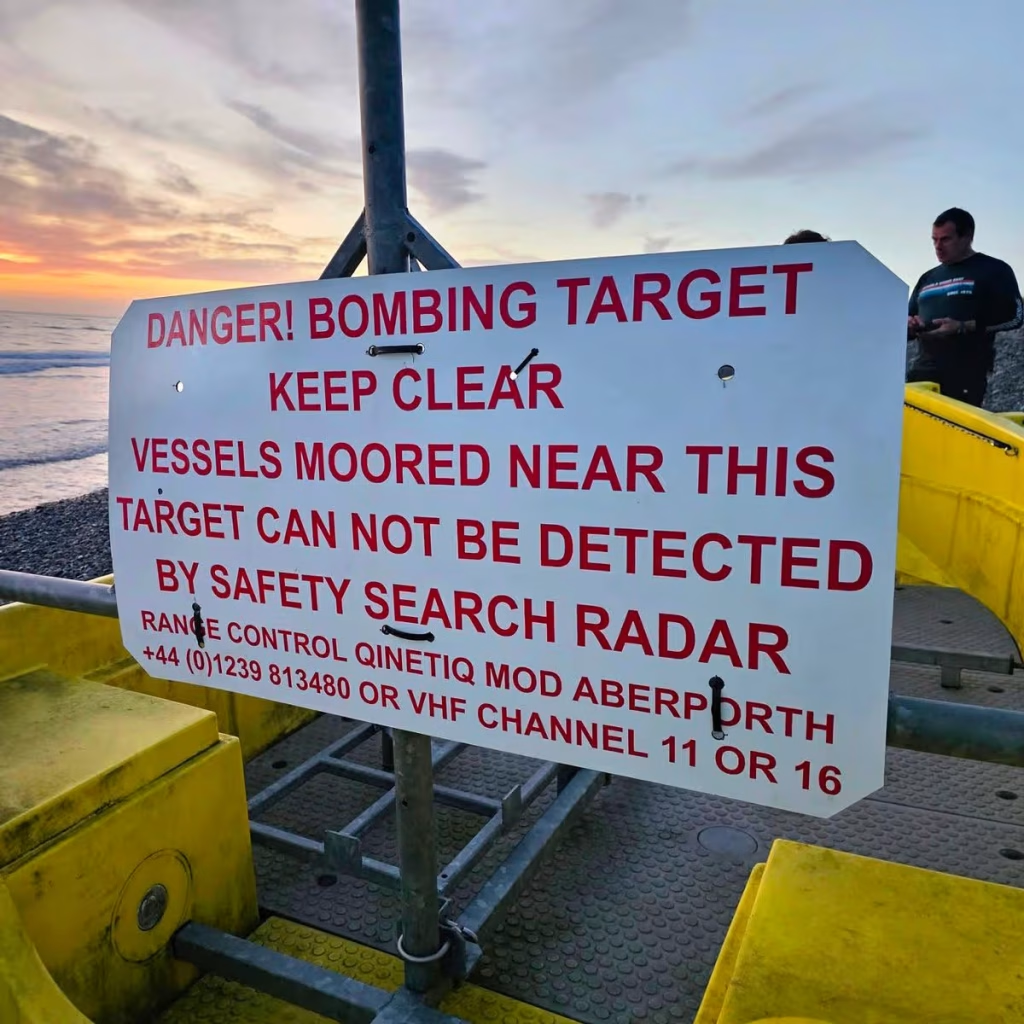
Aberporth is home to West Wales Airport and a major unmanned aerial vehicle (UAV) testing range, where defence contractors operate alongside civilian aviation projects. The site has long been linked to UK drone development programmes.

The issue has resurfaced amid wider geopolitical tensions and follows previous incidents in Welsh waters involving suspected Russian military activity.
In November last year, The Pembrokeshire Herald reported that a suspected Russian sonar device had been recovered off the coast near Skomer Island, just months after a Russian intelligence-gathering vessel was monitored operating off the Pembrokeshire coastline. RAF surveillance aircraft and a Royal Navy warship were deployed to track the vessel during that incident.

While there is no evidence of any specific threat to Aberporth, defence analysts have warned more broadly that modern conflicts increasingly involve long-range precision weapons and infrastructure targeting.
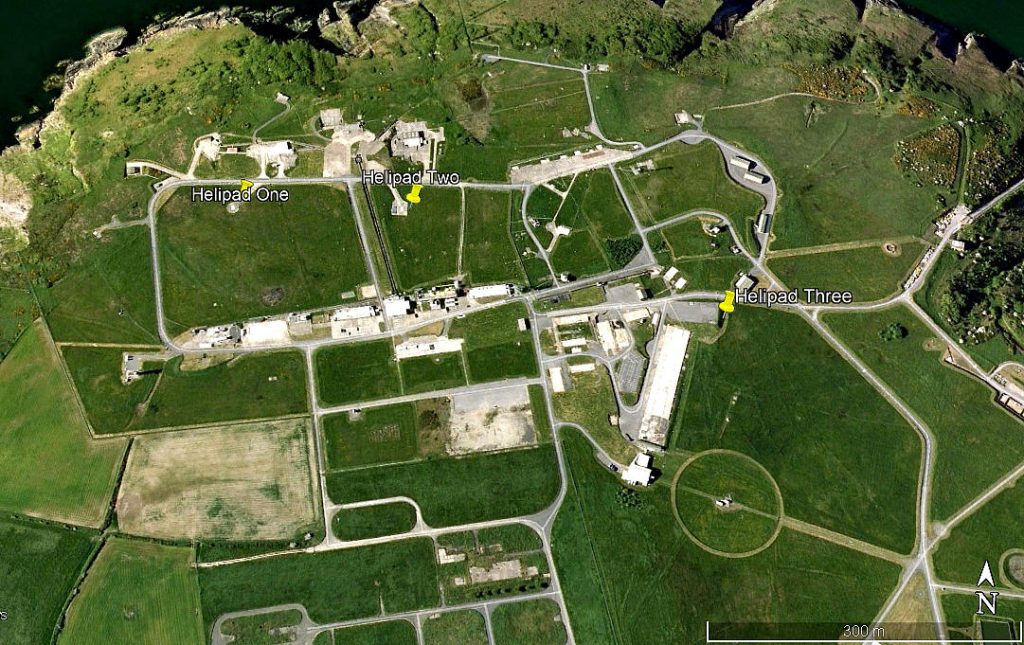
In December 2022, Dmitry Rogozin — a former deputy prime minister of Russia — published a map on social media naming a number of UK defence-related locations in response to British support for Ukraine. Among the sites referenced was Aberporth, due to its links with drone testing and defence contractors.
Security experts note that such statements are often political rhetoric rather than operational military targeting plans.
Nevertheless, the presence of defence-related infrastructure in rural communities can raise concerns locally, particularly when international tensions are high.

Campaigners argue residents should be fully informed about the implications of military-linked development in the region and the potential risks it could bring.
A public meeting organised by campaign groups is scheduled to take place at Aberporth Village Hall on Friday evening.
The Ministry of Defence does not comment on specific security arrangements but has previously stated that the UK maintains robust measures to protect national infrastructure and works closely with NATO allies to monitor threats.

Government defence policy documents also acknowledge that long-range missile threats and hybrid warfare — including intelligence-gathering activity near critical infrastructure — are increasing challenges for Western nations.
The debate comes as defence and security are expected to feature prominently in political discussions ahead of the next UK Strategic Defence Review.



A MAJOR new childcare support scheme for Armed Forces families will be rolled out across Wales from September 2026, the UK Government has announced.
The initiative is expected to save eligible families up to £6,000 per child each year, providing a significant boost to household finances amid ongoing cost-of-living pressures.
The scheme will be delivered through the Ministry of Defence’s existing Early Years childcare reimbursement system and will bring Wales in line with the level of support already available to forces families in England.

Ministers say the move is part of a wider effort to improve recruitment and retention in the Armed Forces, with childcare costs identified as a key pressure affecting morale.
The new support will cover children from nine months old until they reach three years of age in Wales and Scotland, and up to four years old in Northern Ireland.
Defence Secretary John Healey MP announced the scheme during a visit to Dreghorn Barracks in Edinburgh.
He said: “Our Armed Forces families are at the heart of our nation’s security. As the demands on defence increase, it is right that we step up our support for those who serve.
“This offer will ensure more military families get the childcare support they need, wherever they are posted.”
Secretary of State for Wales Jo Stevens added: “Service families in Wales make huge sacrifices and deserve the best possible support.

“They contribute not only to our national security but also to the Welsh economy. This scheme delivers meaningful help with the cost of childcare.”
The scheme will reimburse the difference in early years childcare costs for eligible working families. To qualify, both parents must be in employment and meet the income thresholds required for a Tax-Free Childcare account.
Hundreds of families across Wales are expected to benefit.

The announcement forms part of a broader package of support introduced since July 2024, including improved military housing, the largest Armed Forces pay rise in two decades, and plans to strengthen the Armed Forces Covenant in law.
Further details will be provided in the coming months, with families encouraged to begin considering childcare arrangements ahead of the scheme’s launch.
Ministry of Defence
Could Milford Haven be a target? Are we exposed as UK relies on US for missile defence?

Cold War fears resurface as Iran’s reach grows and Britain admits it has no independent shield
PEMBROKESHIRE has long been considered a strategic target — and during the Cold War, the county’s energy infrastructure and Atlantic access placed it firmly on the radar of military planners.
Today, those same strengths are raising uncomfortable questions once again.
As tensions rise following Iran’s attempted strike on a UK–US base at Diego Garcia on Saturday (March 21), the debate has shifted sharply: not whether Britain is under immediate threat — but whether it would be protected if that ever changed.
Strategic target
Milford Haven is home to some of the UK’s most critical energy assets, including major LNG terminals and oil infrastructure that supply a significant share of the nation’s gas.
In strategic terms, such facilities would rank among the most valuable economic targets in any high-level conflict.
For many in Pembrokeshire, that reality is nothing new. During the Cold War, the area was widely regarded as a potential target due to its importance to Britain’s energy security.
Lessons from Diego Garcia
The attempted strike on Diego Garcia has become a defining moment in the current crisis.
The joint UK–US base is a heavily defended military installation, supported by advanced radar systems and US naval assets. Reports indicate that one of the incoming missiles was intercepted before it could reach its target, while another failed.
But that success raises a more troubling question.
If a missile can be intercepted over a fortified base in the Indian Ocean, what happens when the target is a civilian energy hub in west Wales?

No shield over Britain
The UK has no dedicated system to intercept long-range ballistic missiles over its own territory.
While RAF Fylingdales provides early warning and tracking, it cannot stop an incoming threat.

Britain’s air defence network is designed to deal with aircraft, drones and cruise missiles — not high-speed ballistic weapons travelling through space.
In practical terms, if a missile were ever heading toward a location such as Milford Haven, there is no British-operated system that could reliably stop it at the last moment.
Reliance on the United States
Instead, any interception attempt would fall to the United States and wider NATO systems.
These include:
- Aegis Ashore missile defence bases in Eastern Europe
- US Navy warships equipped with SM-3 interceptors
- Integrated NATO tracking and command networks
These systems are capable of striking a missile in space during its midcourse phase — but only if the missile passes within range.
If it does not, there may be no interception at all.
Even when an attempt is made, success is not guaranteed. Analysts estimate that such systems have a probability of success of between 50 and 80 per cent under test conditions, meaning multiple interceptors are often fired at a single target to improve the odds.
Europe now “within range”
The debate has intensified following warnings from Israel that Iran’s latest missiles could reach far beyond the Middle East.
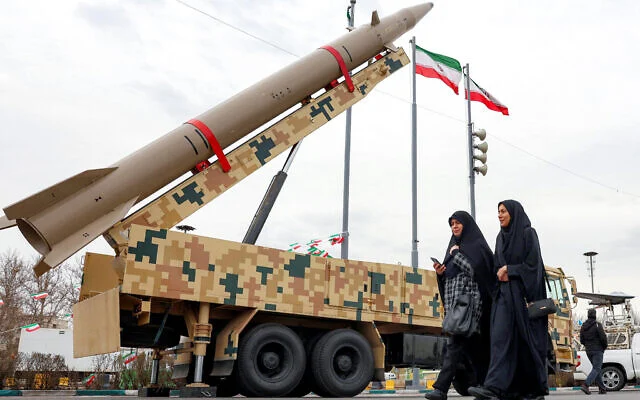
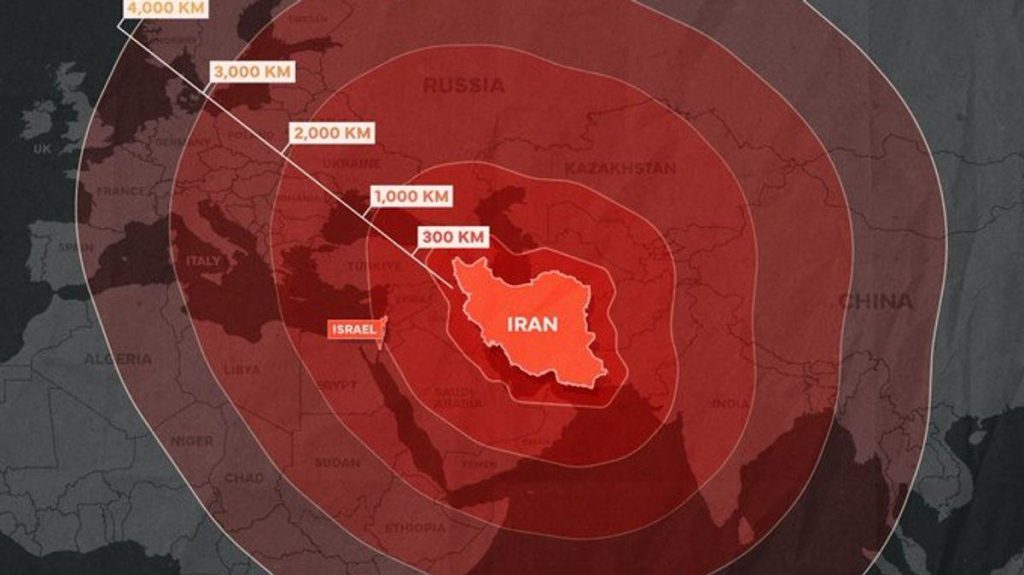
Israeli officials have claimed that the system used in the Diego Garcia attempt was a two-stage ballistic missile with a range of around 4,000 km — potentially placing parts of Europe within reach.
Cities such as London, Paris and Berlin have been cited as falling within the outer limits of that range, although experts stress that range on paper does not necessarily translate into reliable, repeatable strike capability.
Experts divided
Defence analysts remain split.
Some say the attempted long-range strike marks a clear step forward in Iran’s capabilities, moving the threat from theoretical to credible.
Others caution that Iran’s operational missile arsenal has historically been limited to around 2,000 km, suggesting that any longer-range capability may still be experimental rather than deployable.
UK Government response
Ministers have sought to calm fears, insisting there is no current evidence that Iran has either the intent or the capability to strike the UK mainland.
At the same time, the government has condemned Iran’s actions as “reckless” and emphasised that Britain will work with allies to protect its interests.
That response reflects a broader reality.
Deterrence, not defence
Britain’s primary protection is not interception — it is deterrence.
Any successful strike on UK soil would almost certainly trigger a major NATO response, making such an attack extraordinarily risky for any adversary.
But deterrence does not eliminate vulnerability.
The bottom line
Pembrokeshire’s strategic importance has not changed — but the conversation around long-range threats has.
The UK can detect a missile. It can track it. It can coordinate with allies and attempt an interception at distance.
But when it comes to stopping it over Britain itself, there is no independent shield — only reliance on US and NATO systems being in the right place at the right time.
For communities built around critical infrastructure like Milford Haven, that raises a stark and uncomfortable question:
If the unthinkable ever became reality, who — if anyone — would be able to stop it?

Reliance on US interceptors leaves gaps as Iran’s reach grows
BRITAIN would struggle to defend itself against a long-range ballistic missile attack and would instead rely heavily on American systems based in Eastern Europe and at sea — with no guarantee of success.
That is the stark reality emerging after Iran’s attempted strike on a UK–US base at Diego Garcia on Saturday (March 21), a move that caught many world leaders off guard and marked a significant escalation in capability.
Concerns are further heightened by Iran’s development of larger space launch vehicles, including the Simorgh, Zuljanah, Ghaem-100 and Qased systems, which on paper demonstrate ranges of between 2,200 km and up to 6,000 km, with payload capacities of up to 1,000 kg. While these rockets are officially designed to place satellites into orbit rather than deliver warheads, they use the same multi-stage technology and propulsion systems found in long-range ballistic missiles. Defence analysts have long warned that such programmes provide a clear pathway to intercontinental strike capability, raising the prospect that parts of Europe — and potentially even the UK — could fall within reach if these technologies are adapted for military use.
No UK shield over Britain
The UK has no dedicated system to shoot down long-range ballistic missiles over its own territory.
While RAF Fylingdales provides early warning and tracking, it cannot intercept incoming threats. Britain’s air defence network — including RAF jets and ground systems — is designed for aircraft, drones and cruise missiles, not high-speed ballistic weapons.
In simple terms, if a missile were heading toward a target such as Milford Haven’s energy facilities, there is no British-operated system that could reliably stop it at the last moment.
America would have to act
Instead, any interception attempt would fall to the United States.
Key assets include:
- Aegis Ashore missile defence bases in Romania and Poland
- US Navy warships equipped with SM-3 interceptors
- Wider NATO tracking and coordination systems
These systems are capable of striking a missile in space during its midcourse phase, long before it reaches the UK.

But there is a crucial limitation: they can only engage if the missile passes within range of those systems.
If the trajectory falls outside that envelope — or if no US ship is positioned correctly — there may be no interception at all.
A probability, not protection
Even when an intercept is attempted, success is far from certain.
Testing data for the SM-3 system suggests success rates of roughly 50 to 80 per cent per engagement, depending on conditions. In practice, multiple interceptors are often fired at a single target to improve the odds.
That still leaves a significant margin for failure.
In a real-world scenario involving countermeasures, technical faults or multiple missiles, the chances of at least one getting through rise sharply.
Gaps in coverage
The NATO missile defence network is not a continuous shield.
It is a patchwork of coverage zones tied to specific systems:
- Romania and Poland provide fixed land-based interception capability
- US warships offer flexible but limited coverage depending on deployment
There is no permanent protective umbrella over the UK itself.
If a missile does not pass through one of those defended zones, Britain would effectively be relying on luck and geometry.
Deterrence, not defence
Ultimately, the UK’s primary protection is not interception — it is deterrence.
Any successful strike on British soil would almost certainly trigger a major NATO response, making such an attack extraordinarily risky for any adversary.
But deterrence does not equal defence.
A growing concern
Iran’s attempted long-range strike on Diego Garcia has shifted the debate sharply.
The use of a missile capable of travelling thousands of kilometres surprised many Western leaders, who had not expected Tehran to demonstrate that level of reach in the current crisis. Although one missile failed and another was intercepted, the incident has raised fresh questions about how far Iran’s capabilities have advanced.
For years, the idea of a missile threat to Europe — let alone Britain — was largely theoretical. Now, defence analysts are treating it as a credible future risk, even if capability remains limited today.
The bottom line
The UK can detect a missile, track it, and coordinate a response — but when it comes to actually stopping it, the country would be dependent on American systems operating at distance, with no certainty of success.
If a missile ever did get through, there would be little standing between it and its target.
And that is the uncomfortable truth behind the headlines.



Crime49 minutes ago
Drug and weapon charges after Pembroke Dock arrest
Man remanded in custody following Diamond Street vehicle search A MAN has been remanded in custody after appearing at Swansea...


Crime1 hour ago
Woman fights order taking four dogs from her
Swansea Crown Court hears appeal after long-running barking dispute in Trefin A PEMBROKESHIRE woman has told Swansea Crown Court that...


News3 hours ago
Former county councillor Paul Dowson to stand in Ceredigion Penfro
Ex-Pembrokeshire member says he will offer voters a straight-talking independent alternative at the Senedd election FORMER Pembrokeshire county councillor Paul...


News18 hours ago
Plaid Cymru sets out childcare, NHS and child poverty pledges in 2026 manifesto
Rhun ap Iorwerth’s party says plan is radical and fully costed as it bids to lead next Welsh government PLAID...


Community22 hours ago
Police intervene after post raises fears of planned Pembroke Dock fight
Extra patrols launched after social media alert in aftermath of Tenby stabbings POLICE intervened after an online warning raised fears...

Crime24 hours ago
Man arrested after alleged child sexual assault in Haverfordwest
Police enquiries ongoing after incident in Castle Square A MAN has been arrested after an alleged sexual assault of a...


Crime3 days ago
Four youths stabbed at Tenby railway station as two arrested
British Transport Police lead investigation after serious disorder involving group of youths FOUR youths suffered stab wounds during a major...


News3 days ago
Major emergency response in Tenby after incident near train station
Witnesses report injuries as police and ambulance crews remain at scene on Warren Street POLICE and ambulance crews remain at...


News3 days ago
Haverfordwest County AFC faces High Court winding-up threat from HMRC
Chairman says issue has been dealt with, but winding-up notice is still listed ahead of High Court hearing HAVERFORDWEST County...


Local Government3 days ago
Food hygiene checks have not been carried out in parts of a Welsh county since 2019
FOOD hygiene checks have not been carried out in parts of a Welsh county since 2019 due an inspection backlog,...
-
Crime3 days ago
Four youths stabbed at Tenby railway station as two arrested
-

 News5 days ago
Eluned Morgan targets Haverfordwest as Welsh Labour fights to hold its ground
-

 Community5 days ago
Johnston FC pays tribute after sudden death of Rhyan Nolan, 27
-

 Local Government3 days ago
Bridge works on Neyland-Burton road to continue into late April
-
News3 days ago
Haverfordwest County AFC faces High Court winding-up threat from HMRC
-

 News7 days ago
Carol Vorderman urges Welsh voters to reject Reform UK ahead of Senedd election
-

 Business6 days ago
Harbwr Brewery plans for Saundersfoot Old Chemist pub
-

 Sport5 days ago
Haverfordwest County Under-13 girls shine at final FAW festival