


Education
New teachers begin training for Welsh schools



Looking for people with energy, enthusiasm, and determination’: Teach First
EDUCATION charity Teach First Cymru has announced it will be placing over 30 new teachers in schools serving low income communities across Wales in September 2016.
Teach First recruits, trains and supports teachers specifically for schools in disadvantaged areas to tackle educational inequality by closing the attainment gap between the wealthiest and poorest students.
Educational inequality remains a persistent challenge in Wales where less than a third of pupils from low income backgrounds (31.6%) left secondary school in 2015 with five good GCSE’s, compared to 64.1% of their peers from non-free school meals backgrounds.
Teach First Cymru was launched in 2013, initially placing participants to teach English, Maths, Modern Foreign Languages (MFL) and Science in secondary schools. Last year the charity expanded across the country and began recruiting Welsh language teachers. From September 2016, Teach First will be working with 38 schools towards a shared vision of a day when no child’s educational success is limited by their socio-economic background.
Today’s announcement comes during Teach First’s 2016 Summer Institute – an intensive six week training residential which prepares incoming participants to teach in school and marks the start of a two year Leadership Development Programme. The Teach First programme combines a salaried teaching role with ongoing training and support from schools, a university tutor and Teach First, leading to a Postgraduate Certificate of Education (PGCE).

Summer Institute combines learning the theories of education at University of Wales Trinity St David with practical days spent in schools. The training was recently inspected by Estyn who concluded that: “The university-based training… provides participants with a wide range of useful experiences to start to develop their knowledge and understanding of teaching .”
Last month, applications to join the Teach First Leadership Development Programme in 2017 were opened, and the charity is calling on those seeking a challenge with significant rewards to join thousands of others in England and Wales who have committed to ending educational inequality.
Jennifer Owen-Adams, Teach First Cymru Director, said: “Sadly it’s still too often the case that if you grow up in a low-income community you are less likely to do well at school, find a decent job and lead a happy, healthy life.
“Some of the UK’s most challenging education inequalities are seen in our country and while we’re narrowing the gap, there’s still so much more for us to do with our partner schools and communities to help give young people the best start in life.


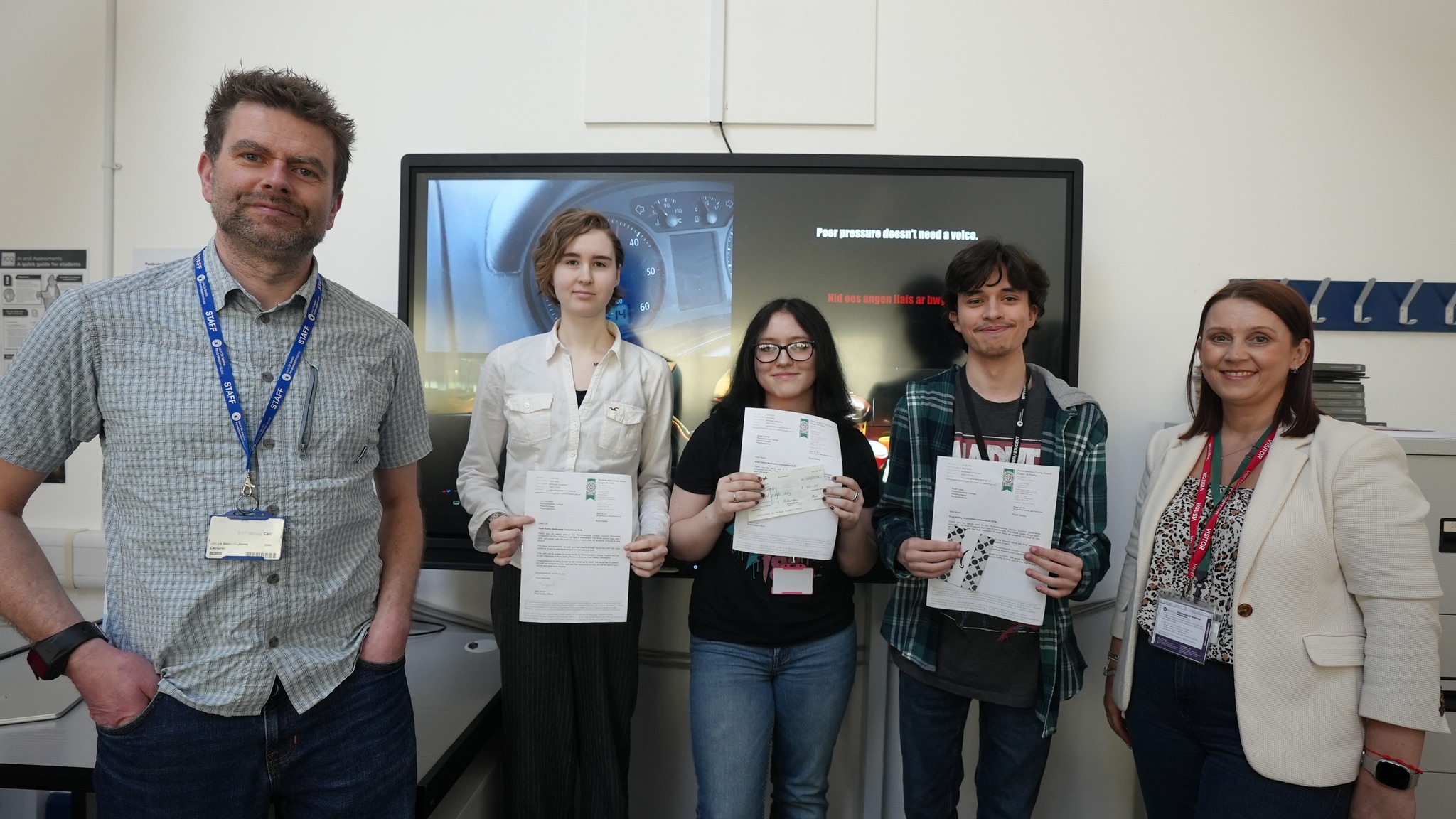
Creative Media learners recognised after producing hard-hitting videos to warn young drivers about the dangers of peer pressure
PEMBROKESHIRE COLLEGE has praised its Creative Media learners after students produced a series of powerful short films as part of an annual road safety competition run in partnership with Pembrokeshire County Council.
The project challenged learners to create short social media videos highlighting one of the main causes of serious road traffic collisions, with this year’s theme focusing on the dangers of peer pressure. The films were designed to help raise awareness of road safety issues among young people across the county.
Aliyah was named overall winner for her video, Peer Pressure Doesn’t Need a Voice, and received a £100 prize.
Noah was recognised as a runner-up for his film, Don’t Treat the Road Like a Toy, while Lily was also commended for her entry, Don’t Give in to Peer Pressure.
The college said the competition gave learners the chance to respond to a real-world brief while producing work with an important public safety message.
Lecturer Denys Bassett-Jones praised the standard of the entries and said the issue of peer pressure was a major factor in young people’s lives, making it an important theme to highlight to new drivers and their passengers.
Sally Jones, Road Safety Officer at Pembrokeshire County Council, also praised the students’ work and said the group had produced interesting and dynamic videos while rising well to the brief.
The college said projects like this continue to give learners valuable practical experience while supporting wider efforts to reduce serious collisions on local roads.

THE SYSTEM supporting children and young people with Additional Learning Needs in Wales is facing serious pressures that could threaten its long-term sustainability, according to a new report from Audit Wales.
Published on Tuesday (Apr 7), the report examines support for children and young people with Additional Learning Needs, or ALN, in the context of changes introduced under the Additional Learning Needs and Education Tribunal (Wales) Act 2018.
Audit Wales said public bodies do not have a full understanding of demand, workforce capacity, skills, costs or outcomes, leaving them without the information needed for effective planning, budgeting and value-for-money assessments.
The report raises concerns about whether the current system is performing well enough to help learners achieve their full potential.
In 2024-25, 48,257 learners aged from nought to 25 were recorded as having ALN or Special Educational Needs. However, Audit Wales said that figure is incomplete and does not capture the full picture across all settings.
Available data shows the number of school learners recorded as having ALN or SEN fell by 58 per cent between 2018-19 and 2024-25, although the reasons for that drop are disputed. Over the same period, the number of school learners receiving statutory support through a statement of SEN, or now an Individual Development Plan, increased by 164 per cent.
The report says spending on supporting learners with ALN has also risen significantly, adding pressure to already stretched public budgets. While Audit Wales said it could not put an exact figure on total spending, identifiable annual costs are approaching £1 billion, with the true figure likely to be higher.
Councils’ budgeted expenditure on ALN or SEN rose by 34 per cent in real terms between 2018-19 and 2025-26.
Audit Wales said its conclusions were based on evidence showing that the system lacks good enough data to understand growing demand and complexity, while patchy workforce information makes it harder to assess staffing capacity and skills gaps. It also found that public bodies do not have a strong enough understanding of costs, raising concerns about financial sustainability.

The report adds that although the goals of the ALN system are clear, there is only limited evidence on whether it is delivering strong outcomes for learners, and that the system remains adversarial despite some signs of improvement.
Its recommendations are aimed mainly at the Welsh Government, particularly in its national leadership role, although Audit Wales said successful implementation would require action from a wide range of public bodies.
Auditor General Adrian Crompton said: “Children and young people with Additional Learning Needs include some of the most vulnerable people in society.

“There has been a significant amount of work involved in efforts to reform the system for the better over recent years. However, the system remains under strain and there is still a lot more that can be done to ensure it does as well as it can for our children and young people, both now and for future generations.”
The 2018 Act introduced a new system designed to create a more integrated, collaborative and person-centred approach to supporting learners with ALN. It extended statutory provision to learners aged nought to 25 and replaced the previous separate systems for under-16s with SEN and post-16 learners with learning difficulties or disabilities.
A major part of the reform was the introduction of Individual Development Plans, which replaced both non-statutory SEN support and statutory statements of SEN. Under the new system, every learner with ALN is entitled to an IDP.
Audit Wales stressed that the figure of 48,257 learners does not include all settings for learners aged nought to 25, including further education, meaning the overall scale of need may be higher than official data suggests.
For more information, contact Rhian Jones at Audit Wales on 02920 320 575 or by email at [email protected]
.

A RECORD number of young musicians from across Pembrokeshire took part in this year’s Valero Primary Music Festival, with nearly 600 pupils showcasing their talents.
The event, organised by Pembrokeshire Music Service, was held at Ysgol Caer Elen on Saturday (March 14), drawing a large and enthusiastic audience.
The festival’s overall winner was Hafan y Môr pupil Carys Meiring, who impressed judges with a standout trombone performance of Let’s Call the Whole Thing Off. She had earlier secured victory in the open brass class.

Young talent shines
The afternoon Spotlight concert opened with an energetic performance from the county’s Second Steps ensembles, bringing together young players from across Pembrokeshire.
Winners from the day’s open classes also took to the stage, highlighting the depth of musical talent across local schools.

Osian Kite, of Roch CP School, won the open woodwind class with a performance of Sentimental Serenade on alto saxophone.
Cadi Marshall-Jones, from Ysgol Bro Preseli, claimed the open piano and harp title with Over the Sea to Skye, while Roch CP School cellist Mari Broomfield won the open strings category with Vamoose.
In percussion, Ysgol Caer Elen’s Aled Hooper secured first place in the open class with a drum kit performance of Are You Gonna Go My Way.
The open ensemble prize went to Tavernspite pupils Finn Hickman and Evelyn James, whose piano duet of Handel’s Passacaglia impressed both judges and audience.
Building confidence through music
Head of Pembrokeshire Music Service, Philippa Roberts said the festival continues to play a vital role in developing young performers.
She said: “Pembrokeshire Music Service is proud to deliver the Valero Music Festival, offering an exciting opportunity to nearly 600 young performers from across the county.
“Providing children with the chance to perform, shine, and receive supportive feedback from professional musicians is incredibly powerful and helps build lasting confidence.
“In line with the Music Plan for Wales, we remain committed to creating meaningful musical experiences for children throughout Pembrokeshire. Our sincere thanks go to Valero for their fantastic support.”
The festival forms part of a wider effort to promote music education across Wales, encouraging participation and nurturing the next generation of performers.
Photo caption:
Talented performers: Overall winner Carys Meiring is pictured with fellow category winners and organisers (Pic: Pembrokeshire Music Service).



Charity5 hours ago
Greenacres warns it may have to shut doors to new animals over £24,000 vet bill
Pembrokeshire sanctuary says it is at breaking point and fears devastating consequences if urgent public appeal fails GREENACRES RESCUE has...


News1 day ago
Reform attacks Plaid on spending and immigration ahead of Senedd poll
Party claims Plaid’s plans would strain public finances and increase pressure on services, while rivals insist Wales needs a different...


News1 day ago
Emergency response after person enters water at Milford Haven marina
Casualty recovered as police, coastguard and lifeboat crews attend A MAJOR emergency response was launched at Milford Marina in Milford...


News2 days ago
Senedd election candidates confirmed as vote.wales goes live
Voters can now check who is standing in their constituency ahead of polling day on May 7 A TOTAL of...


Crime3 days ago
Police and partners launch summer crackdown after Tenby station stabbings
Extra patrols, more rail security and tougher action promised after violent disorder left four youths injured POLICE and partner agencies...


Crime3 days ago
Drug and weapon charges after Pembroke Dock arrest
Man remanded in custody following Diamond Street vehicle search A MAN has been remanded in custody after appearing at Swansea...


Crime3 days ago
Woman fights order taking four dogs from her
Swansea Crown Court hears appeal after long-running barking dispute in Trefin A PEMBROKESHIRE woman has told Swansea Crown Court that...


News3 days ago
Former county councillor Paul Dowson to stand in Ceredigion Penfro
Ex-Pembrokeshire member says he will offer voters a straight-talking independent alternative at the Senedd election FORMER Pembrokeshire county councillor Paul...

News4 days ago
Plaid Cymru sets out childcare, NHS and child poverty pledges in 2026 manifesto
Rhun ap Iorwerth’s party says plan is radical and fully costed as it bids to lead next Welsh government PLAID...


Community4 days ago
Police intervene after post raises fears of planned Pembroke Dock fight
Extra patrols launched after social media alert in aftermath of Tenby stabbings POLICE intervened after an online warning raised fears...
-

 Crime6 days ago
Four youths stabbed at Tenby railway station as two arrested
-

 Local Government6 days ago
Bridge works on Neyland-Burton road to continue into late April
-

 News6 days ago
Haverfordwest County AFC faces High Court winding-up threat from HMRC
-

 Entertainment5 days ago
Little Pigs at Home offers a peaceful sanctuary escape in Pembrokeshire
-

 Charity7 days ago
Angle RNLI answers string of call-outs across the Milford Haven Waterway
-
 Community6 days ago
Cosheston gypsy traveller 60 foot shed plans refused
-

 Crime6 days ago
Questions raised as 81-year-old woman faces ‘failure to provide’ case
-

 Crime5 days ago
Henry Tufnell responds after four youths stabbed in Tenby