


Sport
Whitland one win away from title


WHITLAND moved to within one win of the League 2 West title after they beat Fishguard 46-26 at The Moors on Saturday (May 5).
The Borderers were beaten by Hendy in their previous game but bounced back and now just need to win their final game at home to Mumbles on Saturday (May 12) to seal the title.
Fishguard sit seven points above second from bottom Amman United and the two teams meet next Saturday.
Whitland began Saturday’s game well but after a pass was knocked forward, Fishguard had a scrum. However, a Seagulls infringement gave the ball back to the visitors and from the resulting scrum Adam Davies picked the ball out before passing to Liam Price who went over in the corner.
Nico Setaro’s conversion went wide and the Borderers held a 5-0 lead with ten minutes gone.

Just a minute later Setaro burst through a couple of tackles and offloaded to Jonny Thomas who touched down under the posts giving Setaro an easy conversion.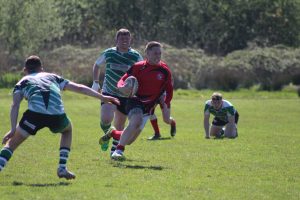
Fishguard looked to respond and came close on a number of occasions. On one occasion, they were held up illegally and Mike Jenkins sent a penalty through the posts to put the Seagulls on the board.
Whitland then went up the other end but after another foul, Setaro had a chance to extend their lead but his penalty went wide.
Setaro then made amends a minute later as he sent a penalty through the posts for a 15-3 lead.

From the kick off Whitland knocked the ball on giving Fishguard possession and after kicking to touch, Mike Jenkins offloaded for Jamie Lewis who scored in the corner. Jenkins then added the extras to bring the Seagulls to within five points of their opponents.
Fishguard came forward again with Chris Shousha making a darting run and after losing one of his boots he was brought down. Another Whitland foul saw Jenkins send a penalty through the posts to make the score 13-15 to the visitors.
Whitland again responded but Fishguard’s Luke Freebury intercepted the ball illegally, according to the referee and Whitland had another penalty which Setaro scored.

On the stroke of half time, Whitland kicked the ball forward and Seagulls’ Robbie Jones struggled to take the ball cleanly in the bright sun. That put Fishguard back and Whitland were able to win the ball back. Setaro again broke the tackles and passed to David Ebsworth who was brought down before the line but was still able to reach over for the try.
The conversion caused a moment of controversy as it was given by the Whitland touch judge and not given by the Fishguard touch judge. After the confusion was cleared up the conversion was not given and Whitland held a 23-13 lead at the break.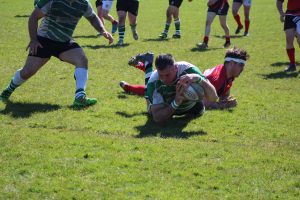
In the second half, Mike Jenkins went on a mazy run but he was penalised for holding onto the ball. Whitland chose to kick to touch but the kick didn’t go out and Fishguard attacked again.
They were then given a penalty and Jenkins again sent the penalty through the posts to bring them to within seven points of their opponents.
Whitland responded in kind and a penalty from Setaro restored his side’s ten point lead.
A knock on from Whitland saw Fishguard pick the ball up and play the advantage but they were unable to break through.
Whitland had a scrum five metres out but Setaro’s clearance kick barely cleared the 22 and Fishguard attacked again. They came close but a knock on ended their attack.
Moments later Setaro broke out and a series of passes found Jonny Thomas who touched down in the right corner. Setaro added the extras for a 33-16 lead.
Another penalty from Jenkins closed the gap once more and with ten minutes to go, Fishguard attacked and the ball was played to Osian Lewis who went over in the corner for a try. Jenkins added the extras to bring the Seagulls back to within ten points of Whitland.
Five minutes from time Setaro added another penalty and with the clock ticking over the 80-minute mark Sean Coles intercepted the ball in his own half and ran on to score the try. Setaro added the extras giving Whitland a 46-26 victory.













A CALL to extend a long-established Pembrokeshire golf club, bringing it up to a full 18 holes, has been submitted to county planners.
In the application, Mr and Mrs Young, through agent Preseli Planning Ltd, seek a change of use of land adjoining the Dawn Till Dusk Golf Club, Furze Hill Farm, Bastleford Road, Rosemarket, to form an extension to the existing golf course, along with landscaping and associated works.
A supporting statement through the agent says: “The application seeks full planning permission for the enlargement of the existing golf course to provide an additional six holes, to provide a total of 18 holes.
“The proposal would involve minor landscaping works to the fields and boundaries and the creation of a small number of ponds and bunkers. The extension would be located on land to the west of Furze Hill Farm and on the opposite side of the road to the existing golf course and clubhouse.
“An altered access to the land parcel is proposed as part of this application, which would provide an improved route for users crossing the public highway to avoid conflict with movements at the main entrance.

“The application site exceeds 1ha and therefore the proposal is considered major development necessitating a Pre-Application Consultation prior to formally submitting the planning application to the Local Planning Authority.”
It adds: “The existing golf course has operated in excess of 30 years and is popular with both visitors and locals. Club membership currently stands at approximately 350 and there is demand for enhancing the provisions of the course.
“The applicants’ sons have recently increased their involvement in the enterprise and in recent years wet winter months have necessitated the closure of the course, or parts of it, due to the ground becoming waterlogged, primarily due to the flat nature of the existing course.
“The extension would provide variation to the terrain, providing, dryer conditions, as well as the ability to alternate between the existing and proposed to maintain use, enhancing the viability of the enterprise.”

The application will be considered by Pembrokeshire County Council planners at a later date.

Lou Boorman celebrates home port win in round-the-world yacht race
A HAVERFORDWEST-born sailor has led her team to a landmark victory on the global stage, winning a major leg of the Clipper Round the World Yacht Race as it arrived in South Korea.
Lou Boorman, aged 23, skippered Team Tongyeong to first place as the fleet sailed into the Korean port city this week (Mar 16), marking a historic moment for the race.
The win is particularly significant as it is the first time the round-the-world event has ever stopped in Korea – and the home team claimed the top spot.
Speaking from the yacht after crossing the finish line, Lou said: “We did it, we performed under the pressure! To get a win into our home port, I can die happy!”

From Pembrokeshire to the world stage
Lou, who grew up in Haverfordwest, has quickly risen through the ranks of competitive sailing. Before taking on the challenge of leading a Clipper Race team, she had already secured titles as British, Irish and Welsh Female Champion.
Now skippering one of the race’s international teams, she is responsible not only for navigation and strategy, but also for leading a diverse crew – many of whom had never sailed before joining the race.
The Clipper Race is one of the toughest endurance challenges in sport, covering 40,000 nautical miles over eleven months, with crews facing extreme weather conditions ranging from freezing Pacific crossings to equatorial heat.

High-stakes gamble pays off
Team Tongyeong took a major risk during this stage, playing its ‘Joker’ card – a race tactic that doubles points if successful.
The gamble paid off, earning the team maximum points and securing their place at the top of the leaderboard.
Lou said: “We’ve worked really hard and put a lot of pressure on ourselves. Going into our home port there is a lot of pressure to perform, and we added to that pressure by playing our Joker – and we got twenty points, so I’m very proud of the team.”
This marks the team’s second win in recent stages, building momentum as they pass the halfway point of the global race.

Life at sea and leadership challenges
Reflecting on her journey so far, Lou highlighted the challenges of leadership as much as the physical demands of sailing.

She said: “Sometimes the sailing comes second to the people because they are the important ones. To lead them through that is one of the toughest things I’ve ever done, but it’s also one of the most rewarding.”
She added: “My favourite thing about sailing is the magic of the sea, the stars, the storms and the remoteness. I feel free and at my happiest at sea.”

Global race continues
The Clipper Race fleet will remain in Tongyeong for a week of cultural events before setting off across the North Pacific towards Seattle.
The race will later visit Panama, Washington DC, and Oban before returning to Portsmouth this summer, completing a full circumnavigation of the globe.
For Pembrokeshire, Lou’s achievement puts a local name firmly on the world sailing map – and highlights the global reach of talent from West Wales.

Six-week beginner programme offers affordable route into the sport
SOUTH PEMBROKESHIRE GOLF CLUB is preparing to launch its popular New2Golf scheme for 2026, with the latest intake starting on Monday (Apr 13).
Now in its eighth year at the Pembroke Dock course, the initiative offers a low-cost and welcoming introduction to golf. All equipment and professional tuition are included for a small fee, making it accessible to people of all ages and abilities – including complete beginners who have never picked up a club before.
The scheme is also ideal for those who have previously played golf and are looking to return to the game after a break.

Participants will receive coaching from qualified golf professionals at the club’s practice ground during early evening sessions over a six-week period. There will also be an option to continue with further sessions after the initial programme.
Golf provides a great opportunity to stay active, enjoy the outdoors and meet new people. As a low-impact sport, it allows players to gradually build fitness while learning new skills. Whether approached competitively or socially, it offers a relaxed and enjoyable way to spend time outdoors.

Last year’s New2Golf intake ranged in age from eight to 70, highlighting the sport’s broad appeal and accessibility.
Located in Pennar, Pembroke Dock, South Pembrokeshire Golf Club enjoys scenic views over the Haven waterway. The club has a thriving membership across junior, ladies’, men’s and seniors’ sections, and prides itself on being friendly and supportive to new players.
Members regularly help newcomers develop their skills on the course, offering guidance on rules, techniques and course play.
The clubhouse also serves as a social hub, offering home-cooked food, a bar and meeting facilities, with a busy calendar of events throughout the year.

Anyone who has ever considered taking up golf – or returning to the sport – is encouraged to get involved.
For more information or to enrol in the 2026 New2Golf scheme, contact [email protected] or visit the Wales Golf website.
New2Golf is organised and supported by Wales Golf.




Education14 hours ago
Milford Haven school plans unveiled but funding not yet secured
PLANS for a new £100 million school in Milford Haven have been unveiled, but the project has not yet secured...


News15 hours ago
Council unveils plans for new state-of-the-art secondary school in Milford Haven
PEMBROKESHIRE COUNTY COUNCIL has revealed plans for a new state-of-the-art school in Milford Haven, promising modern, inspiring learning spaces for...


Health18 hours ago
NHS waiting list falls — but cancer delays and diagnostic backlog worsen
Record progress claimed by Welsh Government as critics warn key targets are still being missed THE NHS in Wales has...


Crime2 days ago
Rapist jailed after ‘abhorrent’ attacks on woman and children
Haverfordwest man told police “women won’t have sex without force” A HAVERFORDWEST man who raped a woman and a young...


News2 days ago
Reform secures first Pembrokeshire councillor in Hakin by-election win
Late Reform candidate takes seat as independent surge and Labour withdrawal shape contest REFORM UK candidate Scott Thorley has won...


News2 days ago
Scott Thorley elected as Pembrokeshire’s first Reform councillor
REFORM UK candidate Scott Thorley has won the Hakin by-election after securing 179 votes. The full result is as follows:...


News3 days ago
Police confirm man has died after being recovered from River Cleddau
Major emergency response in town centre after concerns raised for man in water A MAN has died after being recovered...


Community3 days ago
Davies and Kurtz urge groups to seek employability funding
Community organisations in Pembrokeshire encouraged to apply for new grants supporting skills and job access LOCAL Senedd Members Samuel Kurtz...


News3 days ago
Emergency services flood Haverfordwest after reports of person in river
Town centre sealed off as multi-agency response continues A MAJOR emergency response is underway in the centre of Haverfordwest after...


News3 days ago
Detectives receive surge of new information in bid to identify man found at Powys reservoir
Public response follows release of facial image as officers pursue fresh lines of enquiry DETECTIVES investigating the identity of a...
-

 Health7 days ago
Welsh Ambulance Service to host bi-monthly Board meeting
-

 News6 days ago
Rayner and Lammy visit Wales to discuss justice and community safety
-

 News5 days ago
Fishguard linked to allegations in Many Tears Animal Rescue investigation
-
News3 days ago
Emergency services flood Haverfordwest after reports of person in river
-

 Local Government6 days ago
Investigation confirmed after inspectors visit Many Tears Animal Rescue
-

 Community7 days ago
Local charity hosts cancer awareness event in Cardigan
-

 Business7 days ago
Work set to begin on £50m hydrogen plant in Milford Haven
-

 Community7 days ago
Extra £1m announced to help feed families across Wales