


Business
1 Stop directors made millions

 THE PEMBROKESHIRE HERALD can reveal that 1 Stop Financial Services directors Timothy Hughes and Andrew Rees obtained massive incomes while mis-selling pensions products to nearly 2,000 customers across the UK.
Mr Hughes’ total declared income received during the period October 2010 to November 2012 was £1,511,846, while Mr Rees benefited to the tune of £1,181,437 at the same time.
After obtaining further information from the Financial Conduct Authority (FCA), the Pembrokeshire Herald is able to expand and clarify its article concerning the activities of Haverfordwest financial advisors Tim Hughes and Andrew Rees, who formerly traded as 1 Stop Financial Services.
The Herald can reveal that, while the pair were cleared of dishonesty by the FCA, elements of the conduct that led to the pair being ordered to pay penalties to the Financial Services Compensation Scheme in the region of £500,000, are capable of being construed as sharp practice.
In particular, the FCA highlights how the pair managed to rake off referral fees for themselves from a separate and unregulated company, EGI, of which they were both directors and shareholders.

Mr Rees and Mr Hughes not only obtained commission as introducers of business but fees from their customers in the region of £3,000 a time.
This receipt of financial benefit created a conflict of interest, as 1 Stop advised customers to transfer their pensions into a SIPP in order to purchase an underlying investment when Mr Rees and Mr Hughes had also a financial interest in facilitating the sale of that investment to the customer (through EGI). However, the pair failed to disclose, manage and mitigate adequately this conflict of interest.
Even when a declaration was placed into customer documentation recording the link between 1 Stop and EGI, it failed to mention the financial interest of Mr Rees or Mr Hughes in EGI.
As a result of their actions, 1,959 of 1 Stop’s customers were at risk of having invested a total of £112,331,229, mostly from pension funds including some final salary schemes, into SIPPs which may not have been suitable for them.

The FCA also found that customers’ wishes to securely invest their pension savings in secure products were ignored and risky investments entered into instead. In the case of one customer who wished to adopt a low-risk strategy, their final salary pension fund was channeled into an unsuitable and very risky investment.
In addition, customers including a joiner, builder and a publican were all certified by Messrs Rees and Hughes as having a high level of understanding of risky “wrapper-type” investments involving complex property transactions. The FCA did not believe the records created by 1 Stop in this regard.
49% of those customers affected were encourage to invest in overseas property developments operated by Harlequin Properties. None of those customers received any advice from 1 Stop on the suitability of that overseas property investment.
The Harlequin group of companies are engaged in the development and distribution of overseas property investments and resorts.

On January 18, 2013, the FCA issued an alert to financial advisers about investments in overseas properties bought through Harlequin Property. In March, the Serious Fraud Office (SFO) announced that it, together with Essex Police, was looking into complaints in relation to the Harlequin group. Investors who have invested in specific resorts were asked to contact the SFO.
On May 3, 2013 administrators were appointed for Harlequin Properties.
1 Stop customers who invested in risky investments on the advice of Mr Rees and Mr Hughes have been placed at significant risk of potentially losing all of their money.
In light of their personal liability for the negligent and incorrect advice tendered to their customers, Mr Rees and Mr Hughes were both banned from performing any significant influence function in relation to any regulated activity, carried on by any authorised person, exempt person or exempt professional firm.
In both cases, the FCA decided to impose that penalty neither Mr Rees nor Mr Hughes were judged a fit and proper person in terms of competence and capability.
Harlequin Property are the primary agent for Harlequin Hotels and Resorts, who they say create luxury five star resorts in various locations across the Caribbean. Their mission statement is to,
‘deliver excellent long term returns on clients’ investment by selecting property developments in the most desirable locations’.
The Serious Fraud Office told The Herald that: “The SFO, together with Essex Police, continues to investigate the Harlequin group of companies. We are not able to comment on the on-going investigation nor are we able to comment on an individual’s particular investment.”
In 2013 Harlequin were caught up in a mortgage scandal that saw investors in their properties put at risk of losing around £400 million of deposits.
Investors in Harlequin’s various property ventures and hotel resorts were required to pay a deposit of 30% of their property’s price to secure their investment. Where investors needed to take out a mortgage to pay for the remaining 70% of the property purchase, Harlequin offered to provide a loan which the investors could pay back upon completion.
However, investors were then asked to find around £157,150 each to pay for the properties without the aid of Harlequin’s ‘value guaranteed mortgage’.
Gareth Fatchett, partner at Regulatory Legal speaking in New Model Advisor, said, “Only 2% or respondents could complete without a mortgage, which means 98% of people will go into breach of contract, and Harlequin is saying if they don’t complete their payment they’ll lose their deposit. Advisers should have known from the outset there was not a mortgage available. I’d go so far as to say we’ve seen no evidence of a mortgage relating to a Harlequin property. I suspect the 10% or 15% commissions may have made advisers not check. It’s a huge mis-selling [scandal]. Advisers knew the people they were taking into these contracts couldn’t afford to complete, so therefore the mortgage was by far the most vital thing.”


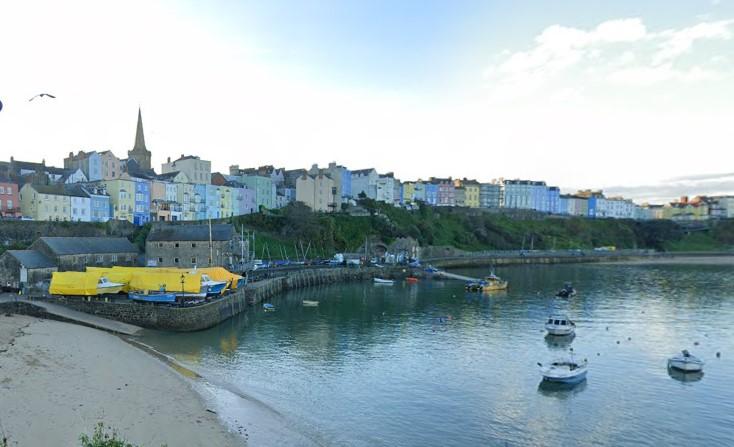
A CALL for works to Tenby’s listed building sailing club to improve energy efficiency for the community organisation has been given the go-ahead.
In an application to Pembrokeshire Coast National Park, Harrison Richards of Tenby Sailing Club sought permission for replacing 24 timber windows at the Grade-II-listed Tenby Sailing Club, Penniless Cove Hill, with new Accoya timber double-glazed units.
The application added: “An energy survey conducted by Dragon Energy Consultants highlighted the existing single glazing and rotten window frames as a significant contributor to the club’s energy consumption.
“Tenby Sailing Club is a community organisation which seeks to organise activities year-round but faces significant energy costs being housed in a historic building. The current windows are beyond repair, with cracked glazing, decay, water ingress, and poor energy efficiency.
“The two windows at balcony level are not included, as they were previously replaced and remain in good condition. All new units will replicate the existing profiles, dimensions, glazing patterns, and overall appearance, ensuring no visual change to the building’s character.
“The neighbouring three-storey harbour stores occupied by Tenby Sea Cadets have previously replaced the building’s windows with double glazing. This like-for-like replacement in appearance will improve durability, weather resistance, and thermal performance while preserving the special architectural and historic interest of the listed building.”
An officer report recommending approval said: “The Sailing Club was built as a warehouse c. 1825, abutting the C17 sluice. Originally wine stores, it was later used by the local fishermen for stores and is now the home to Tenby Sailing Club, established in 1936.”
It said no adverse comments to the proposals had been received.
It added: “The proposal is to replace the majority (24 total) of windows in painted timber, double-glazed with face-mounted glazing bars of traditional scale and profile. Whilst a modern practice of glazing, the proposal involves no loss of historic fabric, provides an obvious visual improvement and addresses concerns as to heating costs.”

It finished: “The scheme is considered to be in keeping with the character of the listed building, and its setting in terms of design and form. As such, the application can be supported subject to conditions.”
The application was conditionally approved by planners.

TAXI passengers in Milford Haven are facing a sudden jump in fares, as drivers increasingly switch on their meters and charge full council-approved rates.
One Herald reader said a short return trip from Milford Haven to Neyland cost £30 — around double what he expected to pay.
But drivers insist the prices are not new — they are simply the official tariff now being applied.
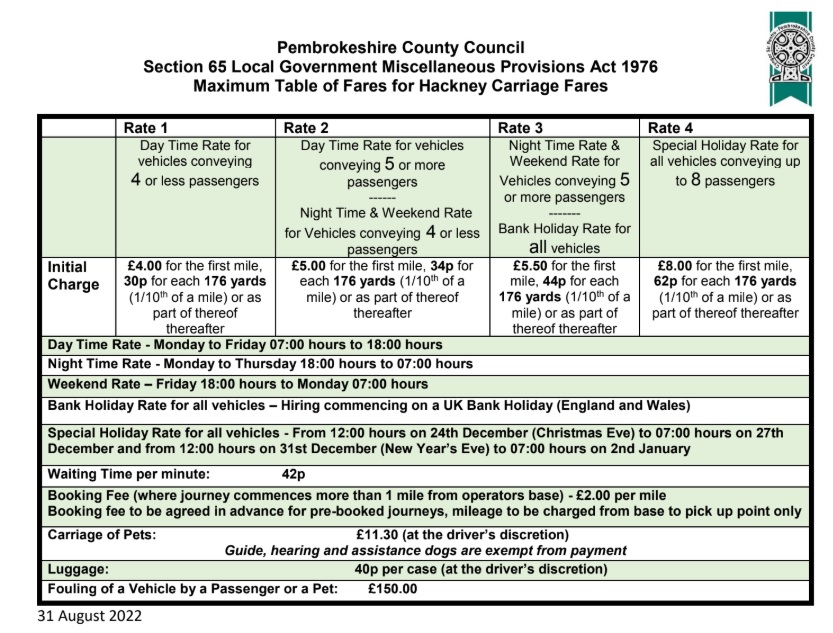
Under Pembrokeshire County Council rules, the standard daytime fare starts at £4 for the first mile (£5 after 6pm), rising by around £3 per mile thereafter. Waiting time is also charged, meaning even short return journeys can quickly add up.
Higher rates apply in the evenings, at weekends and on bank holidays.
End of the £3 taxi
Milford Haven has long been known for cheap taxis, with short in-town journeys often costing as little as £3 — far below official rates.
That was down to competition, older vehicles, and the need to keep prices low in a town where many rely on affordable transport.
Drivers say those days are now over.
One local driver told The Herald: “People got used to cheap fares, but that was never the real price. Now we have to use the meter or we’re losing money.”

Fuel costs biting
Most taxis run on diesel, now around 170p per litre locally. For drivers covering long distances each day, the increase has hit hard.
Global tensions in the Middle East have pushed up oil prices, feeding directly into higher fuel costs in the UK.
With fare increases requiring a lengthy council process, many drivers say they have no option but to charge the full tariff.

Vulnerable hit hardest
The change is being felt most by those who rely on taxis the most.
Elderly residents, people on low incomes and those without access to a car are now facing higher everyday travel costs.
There has been no recent increase in Pembrokeshire’s official taxi fares, which have remained broadly unchanged since 2022.
The difference is simple: drivers are now charging them.
As one put it: “We’re not putting prices up — we’re just finally charging what we’re supposed to be charging.”

CARDIFF AIRPORT is preparing for a busy Easter getaway, with more than 46,000 passengers expected to travel through the airport over the holiday period.
The figure represents an 18% increase compared to the same period last year, reflecting growing demand for both sunshine destinations and European city breaks.
The busiest routes this Easter are set to be Alicante, Dublin and Málaga, with flights operated by airlines including Ryanair, Vueling and TUI Airways.
Travellers heading for warmer weather can also take advantage of direct flights to the Canary Islands, including Tenerife, Lanzarote, Gran Canaria and Fuerteventura, alongside popular destinations such as Faro and Palma.
The airport says the increase builds on a strong start to 2026, with passenger numbers continuing to rise.
Chief executive Jon Bridge said the airport is approaching the one million passenger mark and expects the summer season to be its busiest since the pandemic.
He said: “It’s been an incredibly positive start to the year, and we’re looking forward to welcoming more passengers over the Easter period.
“Our teams are working hard to ensure travellers can start their holidays smoothly.”
Passengers travelling over Easter are being advised to allow extra time for their journey and check with airlines for the latest updates.
A total of 46,158 passengers are expected to pass through the airport between March 27 and April 12, with arrivals and departures almost evenly split.
Cardiff Airport said it continues to expand its range of destinations, including the addition of a direct service to Toronto, as it looks to strengthen its role in connecting Wales to international travel.



Crime15 hours ago
Police stop car in Pennar as three arrested in drugs investigation
Suspected drug driver report leads to major police response and multiple arrests DRAMATIC scenes were reported in Pennar on Monday...


Business20 hours ago
New pilot vessel Llanion arrives at Milford Haven
State-of-the-art 22-metre craft marks reset after £3.6m pilot boat controversy THE PORT OF MILFORD HAVEN has taken delivery of a...

Business2 days ago
Could Primark be coming to Haverfordwest? Major retailer in talks for former Wilko site
Council confirms advanced discussions as speculation grows over high street boost HAVERFORDWEST could soon see a major high street revival,...


Business2 days ago
Rail investment ‘could unlock 40,000 jobs and £11bn for Wales’ says new report
RAILWAY stations across Wales could help unlock around 40,000 jobs and more than £11 billion for the economy by 2036,...


Local Government2 days ago
Milford Haven set for £200m investment with schools, leisure centre and rail upgrade
Council outlines major plans for town with backing from Welsh Government MILFORD HAVEN is set for a major transformation with...


Community3 days ago
Broad Haven volunteers secure ‘national asset’ status for nature reserve
A SMALL stretch of woodland and former opencast coal mine has been transformed into a nationally recognised biodiversity site, in...


Entertainment4 days ago
Tenby steams up in spectacular style as crowds flock to festival
Colourful parade, towering creations and Victorian flair bring town centre to life TENBY was transformed into a vibrant Victorian fantasy...


Crime5 days ago
Publican jailed for six years for supplying cocaine and cannabis
Milford Haven man sentenced at Swansea Crown Court following drug dealing operation A MILFORD HAVEN publican has been jailed for...


Local Government5 days ago
Poverty summit highlights support efforts across Pembrokeshire
A SUMMIT bringing together key organisations from across Pembrokeshire has highlighted both the scale of local poverty and the work...


Education6 days ago
Milford Haven school plans unveiled but funding not yet secured
PLANS for a new £100 million school in Milford Haven have been unveiled, but the project has not yet secured...
-

 Crime7 days ago
Mother given community order after admitting child cruelty offence
-

 Health6 days ago
NHS waiting list falls — but cancer delays and diagnostic backlog worsen
-

 News7 days ago
Reform secures first Pembrokeshire councillor in Hakin by-election win
-

 Crime7 days ago
Woman stole from pharmacy despite ban, court hears
-
 Crime6 days ago
Illegal workers found at Cardigan takeaway after immigration raid
-

 Crime5 days ago
Pembroke man remanded in custody over knife threat, assault and damage allegations
-

 Crime7 days ago
Man pleads guilty in illegal ‘smokies’ food safety case
-

 Crime5 days ago
Broad Haven man remanded in custody over sexual harm prevention order breach
Gareth Evans
April 25, 2014 at 6:07 pm
Disgraceful, both should hang your heads in shame and leave Pembrokeshire for good.
malclom cummings
April 26, 2014 at 10:07 am
Crooks the pair of them. Shamefull what they have done .Makes you think have they been at it elsewhere in their work as IFAS.
ronnie briggs
May 27, 2014 at 7:28 pm
if they had a brain between them may be they would have known they could not get away with what they were up too. door to door salesmen or tesco shelf stacker who would trust someone like that again hopefully they will look into there all so called business dealings