


News
Hancock: Board must regain public trust


 THURSDAY’S meeting of the Health Board’s executive committee took place against a background of simmering resentment in Pembrokeshire at the fate of health services. New chairman Bernadine Rees told the meeting: “I am happy to be back and I understand the challenges. I want a meaningful engagement with the public.” Chief Executive Karen Howell added: “We want to determine what more can be done. We want to secure the long term sustainability of health services in Wales.” Members of the Board expressed concern that the Board had failed to communicate adequately with the public. Don Thomas said: “We need to listen, listen and act on the important issues. We’re keen to listen and understand what our residents are going through.” Local authority placeman Simon Hancock said: “It’s so important for us to understand how services on the ground are doing.” Independent member Eifion Griffiths said: “We have to make sure we are providing services for the population. We have to work with the whole of Wales. The local population will want to hear about what we are providing for them. Paul Hinge from the CHC added: “These changes have to be deliverable and you have to show them you have the ability to deliver them in a seamless manner.” Don Thomas said: “I hope there is an emerging recognition of the position we are in. The structural deficit in this board does need to be recognised and rectified.” IPPG nominee Simon Hancock drew attention to the serious service deficit in Tenby, the cause of major concern ahead of the main summer tourist season. He added that he was desperately concerned for Tenby describing the situation as critical. Simon Hancock’s concern on the issue highlights the fact that assurances given by the Board before the closure of Tenby’s purpose-built Minor Injuries Unit have been shown to be worthless, as local GP’s failed to sign up to the Board’s service model. Phil Kloer, interim director for primary care, community and mental health replied: “The important question is, why we have only got three GPs in the area.” Orthodontic and community dental care was another cause of concern. Orthodontic services were withdrawn from Withybush by the Board in 2010. It seems that centralising services has failed to deliver improvements. Paul Hinge told the meeting: “There is still an 18-month waiting list for orthodontics, this is unbelievable. They have to wait a long, long time and they are then offered a paying service to jump the queue: that part of it has got to stop. The amount of people who are moving out to other areas just to get a service is unbelievable.” Simon Hancock said: “It is important for this board to regain public trust.”


THE WELSH AMBULANCE SERVICE will hold an extraordinary Trust Board meeting later this month.
Members of the public will be able to watch the meeting online via Microsoft Teams on Thursday (Jun 25), from 9:30am to 10:00am.
Board members are expected to receive and approve the Trust’s Annual Report and Accounts for 2025–26.
Colin Dennis, Chair of the Welsh Ambulance Service, said: “Our Board meetings play a vital role in ensuring transparency and openness in everything we do, and we would invite anyone with an interest in the Trust’s work to join us virtually to find out more.”
A link to watch the meeting will be available through the Trust, but viewers are advised it will only work from 10 minutes before the meeting begins.

An agenda will be published on the Trust’s website in the days before the meeting.

AT LEAST 1.5 million people were taken to court over unpaid council tax last year, according to a new investigation by the GMB union.
The union said the figures showed a council tax system “completely broken”, with cash-strapped local authorities forced to pursue residents through the courts to recover unpaid bills.
The findings, released ahead of GMB’s annual congress in Blackpool on Tuesday (Jun 9), were based on Freedom of Information requests sent to all council tax-collecting local authorities in Britain.
Almost 200 councils replied within the statutory deadline.
The responses showed that 1,430,726 people were summoned to court in the financial year 2024/25. However, because many councils did not respond, GMB said the true figure was likely to be far higher.
The investigation also found that at least 4,593,838 council tax accounts were in arrears, while debt management proceedings had been launched against 3,231,480 accounts.
In total, at least £4.6bn is owed to councils in unpaid council tax.
In Wales, the figures showed £110,884,885 was owed, with 31,452 accounts in arrears, 14,792 facing debt management proceedings, and 34,437 people taken to court during 2024/25.
Broken system
Rachel Harrison, GMB National Secretary, said: “These horrifying figures show our council tax system is completely broken.

“Not only is the banding system woefully out of date, but forcing cash-strapped councils to pursue one and a half million people through the courts just to make ends meet can’t be the right way to do business.
“Austerity left deep scars on all our public services, which will last a generation or more.
“Meanwhile the lack of authority funding often means low pay for the people we rely on to look after our loved ones, to take our rubbish, to keep our towns and cities running.

“To fix all this, we need more guaranteed central government funding, progress on council tax reform so the richest pay their share, and changes to business rates so that authorities get more to regenerate our high streets.”
The highest regional total was recorded in Scotland, where £989m was owed and 245,294 people were taken to court.
London councils reported £625m owed, with 258,732 court summonses issued, while the West Midlands recorded 239,116 court cases and £490m in unpaid council tax.
News
Electricity network upgrades across Pembrokeshire to support homes, businesses and future demand

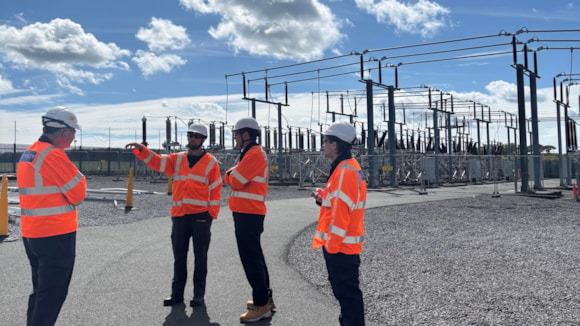
NATIONAL Grid Electricity Distribution runs the local electricity network in Pembrokeshire and is strengthening it to support how people live and work now and in the future.
Demand for electricity in Pembrokeshire is increasing rapidly, particularly as more people switch to electric cars and heat pumps, and more clean, home-grown generation comes online.
Henry Tufnell MP met with engineers in Milford Haven to see how these upgrades are increasing capacity for local communities.
Henry Tufnell MP said: “It was great to visit the site in Milford Haven and see first-hand the work being carried out to strengthen the local electricity network.
“Investment like this is important for supporting communities and businesses across Pembrokeshire and making sure the area is ready for future growth and cleaner energy.”
Steffan Jones, Operations Manager of West Wales Major Projects at National Grid Electricity Distribution, said: “Demand is growing as people use more power in their everyday lives at home and at work.
“We are upgrading our network across Pembrokeshire to support local communities, enable new connections and power future growth.”
The upgrades will help provide more capacity for local communities, making it easier to connect new homes, support businesses and enable technologies such as electric vehicles, heat pumps and solar energy.



Crime4 hours ago
Sex offender in senior role at Tenby family hotel
CREST HOTEL GROUP says it is investigating safeguarding concerns after staff at the Imperial Hotel in Tenby raised alarm over...


Sport16 hours ago
Runners tackle new route in Ras Y Castell 10k
MORE than 90 runners took to the streets and paths around Cardigan on Friday evening (June 5) for the annual...


Business23 hours ago
Turkish Kitchen reaches Welsh restaurant award semi-finals
Haverfordwest café praised as small independent business flies flag for Pembrokeshire A HAVERFORDWEST café has been named as a semi-finalist...


News23 hours ago
Person taken to hospital after major emergency response on Tenby Esplanade
A PERSON has been taken to hospital following a major multi-agency emergency response on The Esplanade in Tenby. Dyfed-Powys Police...


News24 hours ago
St Davids lifeboat crews rescue damaged yacht and stranded kayaker
TWO St Davids RNLI lifeboats were launched within hours of each other after a yacht was left disabled in a...


Community2 days ago
D-Day 82: Milford Haven remembers sacrifice of Normandy landings
COMMUNITIES gathered in Milford Haven on Saturday (Jun 6) to mark the 82nd anniversary of D-Day. The service, held at...


News2 days ago
D-Day at 82: The secret Pembrokeshire invasion that helped prepare for Normandy
Forgotten wartime operation saw thousands of troops storm Pembrokeshire beaches in rehearsal for D-Day LONG before Allied troops landed on...


News2 days ago
Welsh Water hit with £44.7m enforcement package over sewage failures
Pembrokeshire campaigners say regulator’s action vindicates years of concern over pollution in rivers and coastal waters DŴR Cymru Welsh Water...


News3 days ago
Council tax shake-up in doubt as Welsh Government reviews reform plans
Questions over 2028 revaluation as ministers reconsider next steps THE FUTURE of council tax reform in Wales has been thrown...


Crime3 days ago
Paddleboard company owner loses bid to cut sentence over Haverfordwest tragedy
A FORMER paddleboard company owner jailed over the deaths of four people on the Western Cleddau has failed in a...
-
Crime3 days ago
Paddleboard company owner loses bid to cut sentence over Haverfordwest tragedy
-

 Crime2 days ago
Milford Haven man admits harassment and assault
-

 Crime5 days ago
Milford Haven man bit neighbour’s neck near cashpoint
-

 Crime6 days ago
Milford Haven man jailed for illegal Premier League streaming service
-

 News2 days ago
Community appeal for privacy after serious emergency in Pendine
-

 Crime6 days ago
Haverfordwest man admits cocaine offence as Crown disputes basis of plea
-

 Crime5 days ago
Pembroke Dock driver avoided jail after drug-drive crash
-

 Local Government6 days ago
National Express use of new Haverfordwest interchange still subject to risk checks
Alun Jones
August 7, 2014 at 7:24 pm
What a shame that these Board Members did not make their views known under the previous Chief Exec and Chairman. If they had, then perhaps we would not be in the situation we now find ourselves with the disastrous centralisation of paediatrics, obstetrics and the proposed reduction in such services as A & E. Why is it only now we hear these comments. Were these members too afraid to speak under the previous regime, then it was only the CHC voice we heard speaking against the changes.