


Education
Anti-strike proposals an attack on devolution says NAHT Cymru


THE GOVERNMENT’S proposed minimum service levels for schools are ‘draconian, unnecessary, and an attack on devolution’, school leaders’ union NAHT Cymru says.
In its response to the government consultation, which closes today, NAHT Cymru says the legislation cuts across devolved powers by the Welsh Government and would effectively remove the right to strike from most school staff – and especially head teachers given that most schools only have one such role.
The new laws would make it legal to sack striking education workers who have been issued with ‘work notices’ and will allow hefty fines to be imposed on unions.
NAHT Cymru says the proposals fail to recognise legislation in Wales, such as the Well-being of Future Generations (Wales) Act 2015; the Trade Union (Wales) Act 2017 and Social Partnership and Public Procurement (Wales) Act 2023 – all of which look to strengthen workers and employers’ rights and promote working together to resolve disputes where possible.
Far from ensuring a ‘minimum’ service, the union says requiring all vulnerable, critical worker and exam groups to be in school would mean a majority of pupils attending and all schools being required to open on strike days.

NAHT Cymru National Secretary Laura Doel has condemned the legislation, saying: “The proposals by the UK government aim to undermine the principles of social partnership and are a direct attack on the devolution settlement.
“The Department for Education (DfE) has no idea of the systems in place that manage and maintain Welsh schools and the UK Government has no right to involve itself in matters that do not concern it.
“School leaders across Wales face significant challenges, particularly when it comes to pay, workload and funding and we are currently working with the Welsh Government to address those issues.
“Having said that, we will not hesitate to take further industrial action if it is the will of our members and we will do everything in our power to protect those rights.”

NAHT Cymru says there was no clear evidence of detriment to pupils during last year’s industrial action by education unions, which included a strike by teachers – but that cuts to education and chronic underfunding have far-reaching implications for the delivery of education.
Referring to last year’s action in Wales, during which NAHT Cymru took action short of strike, the response continues: ‘Teachers, school leaders and support staff have taken part in industrial action to defend their pay and working conditions, to prevent a worsening of the staffing shortage and to restore the quality of our education services. The introduction of minimum levels of service will not resolve these issues, but they will impact workers ability to do something about them.’
In its response, NAHT Cymru also highlights the principle that union members need the freedom to withdraw their labour if their workplace is for any reason considered unsafe.

It points out that the proposals do not allow workplace notices requiring staff to work to be appealed or for any independent oversight of disputes that arise. There is no provision for meaningful consultation with unions and no obligation to consult individuals identified in a work notice as being required to work during a strike and is completely lacking in reference to the devolved governments at all.
NAHT Cymru has welcomed education minister Jeremey Miles’ response to the legislation, after he wrote to the DfE stating the Welsh Government will continue to work with employers and unions under social partnership to resolve disputes.
Paul Whiteman, NAHT’s general secretary, said: “The government’s proposals are a hostile attack on the basic democratic right of workers to withdraw their labour.
“Strike action will always be a last resort for dedicated education professionals. Sadly, however, it is sometimes the only way to engage tin-eared governments and employers in serious talks about issues which may not only affect their working conditions, safety and livelihoods – but also their ability to offer the education all children deserve.
“These proposals will not help to prevent industrial disputes but will make it even harder to resolve them and for dedicated school staff to act when they fear education is being devalued. If that happens, ultimately it is children who will suffer.”
NAHT Cymru is calling for the UK government to retract the proposals and enter meaningful negotiations with education unions after it abandoned talks last year.
It urges ministers to ‘learn from other nations and create a culture of social dialogue and balanced cooperation through the introduction of sector-wide collective bargaining, together with the clear legal recognition of a positive right to strike.’
The union says the proposals are ‘highly likely to fall foul of equality law’, arguing that school leaders who are more likely to be required to work are often older. It points out that a majority of the workforce are female, and that the approach taken was ‘effectively discriminating against’ staff at schools with a higher proportion of pupils with additional learning needs (ALN), vulnerable and critical worker children.
NAHT Cymru adds the legislation would ‘make the UK an outlier among comparable nations’, undermining a host of international human rights and labour law commitments. These include the United Nations’ 1948 Universal Declaration of Human Rights, the European Convention on Human Rights, European Social Charter and commitments through the International Labour Organisation.

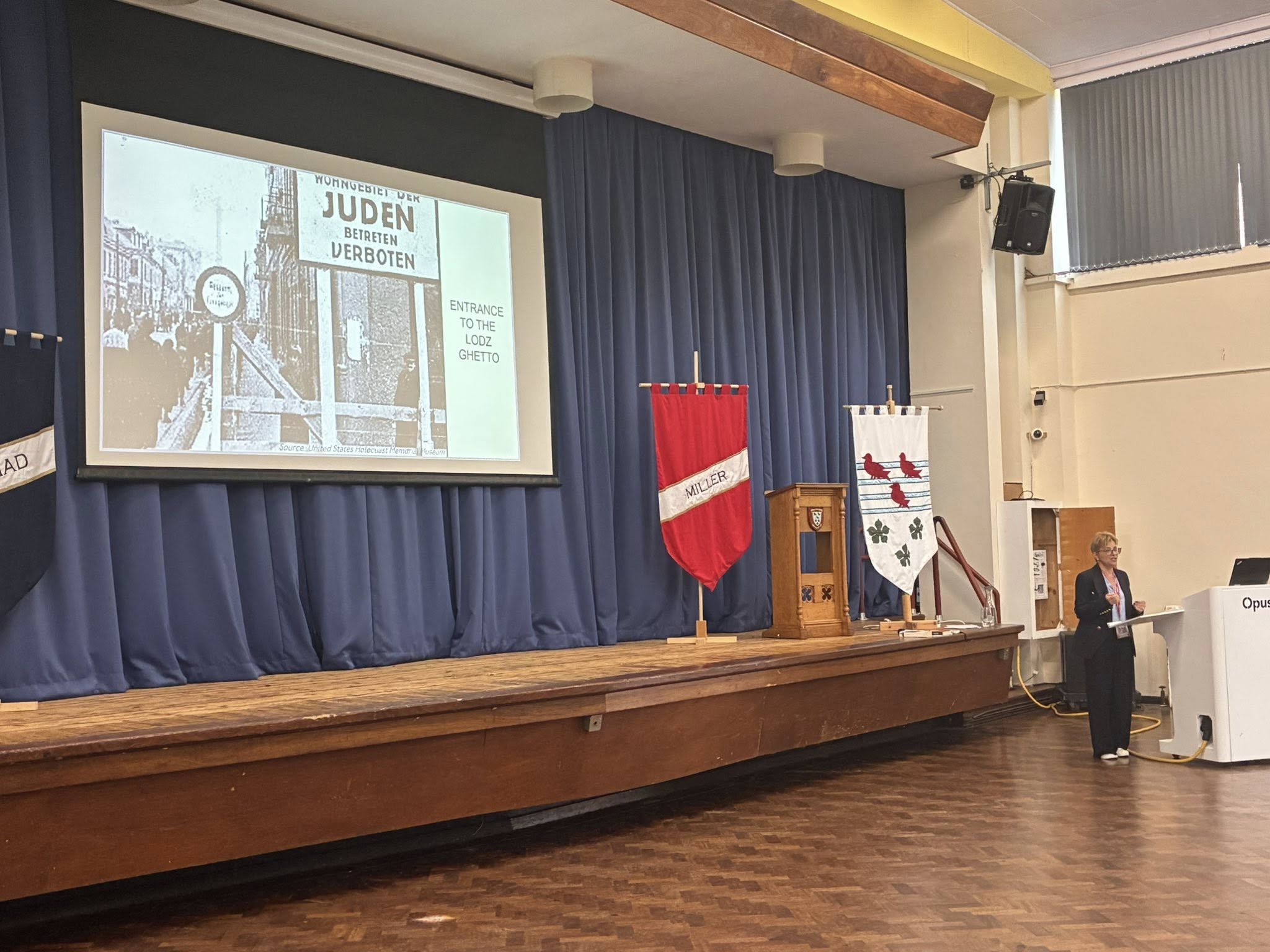
MORE than 150 pupils at Ysgol Greenhill have heard the moving Holocaust testimony of the late Zigi Shipper BEM, who survived some of the most terrible events of the Second World War.
The special visit took place on Tuesday (May 5), when Mrs Lu Lawrence came to the school to speak about the life of her father.
Zigi Shipper survived the Lodz ghetto, Auschwitz-Birkenau, Stutthof concentration camp and a death march, among other traumatic events. When he was liberated by British forces, he was just 15 years old.

Mrs Lawrence spoke to Key Stage 3 and GCSE pupils, sharing not only her father’s testimony but also her own family’s story.
Ysgol Greenhill said more than 150 students attended the session and were “exceptionally well behaved”, asking thoughtful questions during the visit.
The school said: “In the current climate of increasing anti-Semitism, understanding the dangers of prejudice is more important than ever.”
The visit was arranged by the Holocaust Educational Trust, which works with schools to ensure young people continue to learn about the Holocaust and the dangers of hatred and discrimination.
The session gave pupils an opportunity to hear a deeply personal account of survival, loss and resilience, and to reflect on why Holocaust education remains so important today.
Photo caption:
Important lesson: Mrs Lu Lawrence visited Ysgol Greenhill to share the Holocaust testimony of her late father Zigi Shipper BEM (Pic: Ysgol Greenhill).


WHEN the alerter sounds, 18-year-old Bobi Jones swaps his school for his local fire station, serving as one of Mid and West Wales Fire and Rescue Service’s (MAWWFRS) youngest On-Call Firefighters.
He responds to incidents in his own time and has been granted special permission by his school, Ysgol Bro Teifi to leave free periods whenever an emergency call comes in.
Bobi applied to become an on-call firefighter shortly before his 18th birthday and follows in the footsteps of his brother, father, uncle and grandfather, marking three generations of firefighters and over 75 years of combined service. His family’s legacy reflects the strong community roots and sense of duty that have underpinned MAWWFRS for three decades.
Having spent time around his local fire station and the fire and rescue service from a young age, Bobi was keen to join the service. With an upcoming point of entry test, he applied as soon as he was eligible.
After completing his initial training, Bobi joined the crew at Newcastle Emlyn Fire Station in November 2025 and has enjoyed responding to incidents while further building his skills and knowledge. One standout incident was a fire at a local gym where he was involved in rolling out hoses and establishing safety lines.
As well as following in his family’s footsteps, Bobi says he joined MAWWFRS as he wanted to support his local community, which he has found really rewarding. Alongside his operational role and playing for Newcastle Emlyn Rugby Club, Bobi is studying A-Level Business and Sport and plans to start an electrician apprenticeship after finishing school, with a long-term goal of becoming a Wholetime Firefighter.
Talking about balancing his role as an on-call firefighter with life as a sixth-form pupil at Ysgol Bro Teifi in Llandysul, Bobi said: “There’s a good crew here at Newcastle Emlyn Station, which includes members of my family. We all support each other and there’s great camaraderie here.”
Asked what advice he would give to anyone considering becoming an on-call firefighter, Bobi added: “I would say absolutely go for it, the availability options are flexible enough to suit everyone and the Service is always recruiting for more on-call firefighters.”
Mid and West Wales Fire and Rescue Service is currently recruiting for on-call firefighters who, like Bobi, remain an essential part in protecting communities.
The role of an on-call Firefighter provides many opportunities for personal and professional development, through training, teamwork, leadership and problem solving. On-call firefighters receive payment for their services, including retainer fees and call-out payments, supplementing their income from other employment.

Nurseries in Wales are warning that rising costs and underfunded childcare places are putting providers under severe pressure
NDNA CYMRU has launched its manifesto, The Best Start for Children in Wales, calling on the next Welsh Government to make early childhood play, learning and care a priority for every family and community.
The organisation says early findings from its nursery survey show 89% of day nurseries in Wales make a loss on sessional places, while 79% say the full day rate does not cover their costs.
Staffing bills have risen by an average of 10.5%, while nurseries have increased fees to parents by an average of 7.5%, meaning many providers are absorbing part of the extra cost themselves.
One nursery told NDNA: “We can’t increase prices as parents are struggling to pay their bill already.”
NDNA Cymru says the pressure is forcing some nurseries to spend less on resources, reduce staff hours and cut training, with one respondent saying they had been forced to lay off three members of staff.
The manifesto sets out four priorities for the next Welsh Government. These include a national review of funded childcare, funding rates that reflect the real cost of delivery, proper support for Additional Learning Needs, protection for existing providers before new capital projects are approved, and a fully funded workforce strategy.
Tim McLachlan, Chief Executive of NDNA Cymru said: “The next Welsh Government has the opportunity to do things better. We are calling on all parties to put children at the heart of any future policy, making sure it is properly funded and delivered consistently in communities across Wales.
“Our survey of day nurseries shows that they face unique funding pressures. It cannot be good for children, families or the economy to have nurseries fighting just to survive when we want to see them thrive.
“Parents rightly want more support to make childcare more affordable. But to be fair to everyone and make sure that policies can be delivered, political parties must make sure any promise they make is fully funded.”
NDNA Cymru said 92% of nurseries responding to its survey were either operating at a loss or only breaking even.
The survey also found that the new £6.67 hourly funding rate for three and four-year-olds does not cover costs for many providers. For full day care, the average shortfall was £1.56 per hour per child, rising to £2.05 for sessional care.
One nursery said: “In the 39 years I have been operating successfully and at a very high level of quality, this is the most challenging and disheartening time for my business in relation to financial sustainability.”

Another said: “Funding and fees are a constant worry alongside staff recruitment and retention; childcare is a lot more challenging and increases each year make it harder and harder.”
NDNA Cymru said it wants a fair and consistent childcare system across Wales, backed by national guidance, proper investment in staff, and adequate ALN funding so children’s needs can be met.



News16 hours ago
Plaid Cymru celebrates historic victory as Rhun ap Iorwerth arrives at Cardiff Bay
CROWDS gathered outside the Senedd as Plaid Cymru leader Rhun ap Iorwerth arrived in Cardiff Bay following his party’s historic...


Crime17 hours ago
Police standoff ends after four-hour incident in Pembroke Dock
ELIZABETH COURT SCENE STOOD DOWN AFTER DOMESTIC INCIDENT A FOUR-HOUR police standoff in Pembroke Dock has ended with a 21-year-old...


Crime21 hours ago
Teen denies attempted murder of Milford Haven teacher
TEENAGER REMANDED AHEAD OF JULY TRIAL A 15-YEAR-old boy has denied attempting to murder a teacher during a stabbing incident...


News2 days ago
Catastrophe for Labour as Plaid and Reform reshape Welsh politics
ELUNED MORGAN LOSES SEAT AS OLD CERTAINTIES ARE SWEPT AWAY THE VOTERS of Wales have delivered one of the most...


News2 days ago
Labour wiped out in Ceredigion Penfro as Plaid tops poll and First Minister loses seat
Shock result sends political shockwaves across Wales as Reform also surges in historic Senedd count LABOUR suffered one of the...


News2 days ago
Labour deputy says party ‘will not form next Welsh Government’
LABOUR FACES HISTORIC DEFEAT AS COUNTING CONTINUES ACROSS WALES LABOUR’S Deputy Leader in Wales has effectively conceded the Senedd election,...

News2 days ago
Counts underway in historic Senedd election
Wales waits for results as first election under new voting system reaches count stage COUNTING is underway across Wales today...


Charity3 days ago
Chief’s Tour honours fallen officers with 75-mile Pembrokeshire ride
Dyfed-Powys Police team raises thousands for bereaved police families charity A TEAM of officers and staff from Dyfed-Powys Police cycled...


Crime3 days ago
Racial abuse suspect barricaded himself inside Johnston lodge
ARMED police were called to a supported accommodation building in Johnston after a man allegedly barricaded himself inside a room...

Crime3 days ago
Milford Haven woman denies causing suffering to cat
Jury hears evidence over alleged failure to seek treatment for tumour A MILFORD HAVEN woman has denied causing unnecessary suffering...
-

 News5 days ago
Baby in critical condition after Fishguard emergency
-

 News4 days ago
Former housing officer admits drink-driving in Pembrokeshire retail park
-

 Crime4 days ago
Job loss threat for convicted Pembrokeshire drug-driver
-
 Crime4 days ago
Milford motorist disqualified for drug-driving
-

 Crime4 days ago
Police tip-off leads to driving ban for Milford motorist
-
Crime3 days ago
Racial abuse suspect barricaded himself inside Johnston lodge
-

 Crime4 days ago
Delivery driver caught twice over legal drink-drive limit
-

 Community4 days ago
Sixth-former firefighter balances schoolwork with saving lives