

Politics
No ‘divestment’ of council pension scheme Israel investments

A CALL for Pembrokeshire County Council to end its involvement in a pension fund that has invested millions with companies connected with Israel, will see engagement rather than “divestment,” councillors heard.
At the July meeting of Pembrokeshire County Council, two related, submitted, questions were asked by members of the public.
Both asked for the council to divest its involvement in the local government pension scheme the Dyfed pension fund, which they say has more than £60m invested in companies connected with Israel.
Suzanne Radford-Smith said: “I am writing to draw attention to the fact that Dyfed pension fund has £64m invested in companies that are connected with Israel and to ask that Dyfed pension fund divests from these companies.
“Many of these companies are making arms and weapons being used by the Israeli army in the war on Palestine which makes them complicit in the genocide in Gaza.

“I believe this makes PCC also complicit in that genocide.
“Will Pembrokeshire County Council divest the pension fund from these companies?”
A similar question by Marjorie Hawkins said: “I receive a pension from Dyfed Pension Fund and have recently found out that Dyfed pension fund has £64m invested in companies that are connected with Israel.
“Many of these companies are making arms and weapons being used by the Israeli army in the war on Palestine which makes them complicit in the genocide in Gaza.
“I am very dismayed to find out this information and feel that this makes PCC (as one of the county councils in Dyfed Pension Fund) also complicit in that genocide.
“I spent over 10 years working as a social worker in Pembrokeshire. 10 years before this I was a social worker in Swansea and also worked for the NHS previously. I chose to work in jobs that were not involved in making profits or exploiting other people. I am very upset and outraged to find that the pension I receive is complicit in a genocide that is ongoing and we witness daily.
“Will Pembrokeshire County Council divest the pension fund from such companies that are complicit in this genocide?”

Responding, Cabinet member for Corporate Finance, Cllr Joshua Beynon said the scheme, not administered by Pembrokeshire, had “a responsible investment policy which sets out its approach to responsible investing, including human rights”.
He added: “The fund believes that engaging with investee companies is likely to be more effective than divestment in improving desired outcomes and the committee encourages fund asset managers to engage with the companies they invest in. In addition, the fund believes in collective engagement and exercises a voice across a range of environmental, social and governance topics.”
He went on to say the engagement was and dialogue was “a more holistic approach than blanket divestment, particularly where a direct causal relationship may not exist between supply and impact”.
He explained: “For example, a company that supplies components to support renewable-infrastructure projects may also supply components to companies with contracts with law-enforcement agencies.
“It is thus our investment managers who are best placed to understand this nuance, considering all relevant Environmental, Social and Governance factors in their investment-management decisions, as well as their investment stewardship.
“The fund endeavours to identify and engage organisations on human rights issues through various channels including its membership of the local authority pension fund forum, the engagement programme of its investment manager, and via the voting and engagement activity undertaken by the funds voting and engagement provider.”
He concluded: “Engagement will continue on these issues with all its service providers, partners and other stakeholders, evolving its approach as necessary to meet its regulatory and fiduciary requirements.”



Ken Skates says Plaid has failed to back previous calls for more support for children with additional learning needs now it is in government
WELSH LABOUR interim leader Ken Skates has accused Plaid Cymru of “not following through” on its previous promises to support children and young people with additional learning needs.
Mr Skates challenged Plaid during this week’s First Minister’s Questions, claiming the party had “made a virtue” of its support for pupils with additional learning needs while in opposition, but had failed to deliver now it has responsibility in government.
The row follows the publication of Plaid Cymru’s first supplementary budget. Welsh Labour says no specific additional funding has been allocated to support children with additional learning needs in Welsh schools.
Welsh Labour claims that extra funding for Special Educational Needs and Disability in England, announced by the UK Labour Government, has resulted in £340m in consequentials for Wales. The party says that money should be used to strengthen ALN provision.
All 22 Welsh local authorities, along with teaching unions, have also raised concerns about the growing pressure on schools and councils as they try to meet rising demand for additional learning needs support.
During the Senedd exchange, Mr Skates referred to previous Plaid Cymru statements, including a 2024 social media post which said: “Wales can do better than this — under Plaid Cymru, the pupils who need support, will receive it.”
He also pointed to earlier interventions by Plaid figures, including Cefin Campbell, who had argued that more financial support was needed for pupils with additional learning needs.
Mr Skates said: “Over 40,000 pupils in Wales have additional learning needs. These are the pupils Plaid Cymru have previously said need support.
“While in opposition, Plaid Cymru insisted that they would provide for pupils with additional learning needs. Now they have the power and the resource to make those decisions, they are making a choice not to.”
Welsh Labour also highlighted work carried out in 2023 by Heledd Fychan MS, now Plaid Cymru’s Chief Whip and Minister for Culture and Sport, who published a report calling for greater support for neurodivergent children, young people and their families.
Mr Skates added: “Plaid Cymru have made promises to families in need and are now shying away from their responsibility to them.
“We want to support a government that is doing the best it can for families in Wales, but this funding is our red line. Welsh Labour will continue to hold this government to account until they do the right thing for children in Wales.”

Plaid Cymru has previously argued that local authorities need additional support to deal with rising ALN pressures, including the cost of specialist staff, transport and provision for pupils with complex needs.
The Welsh Government has said it continues to support local authorities with the implementation of ALN reform and has pointed to more than £170m invested since 2020, along with capital funding for specialist provision.
The Herald has approached Plaid Cymru and the Welsh Government for comment.
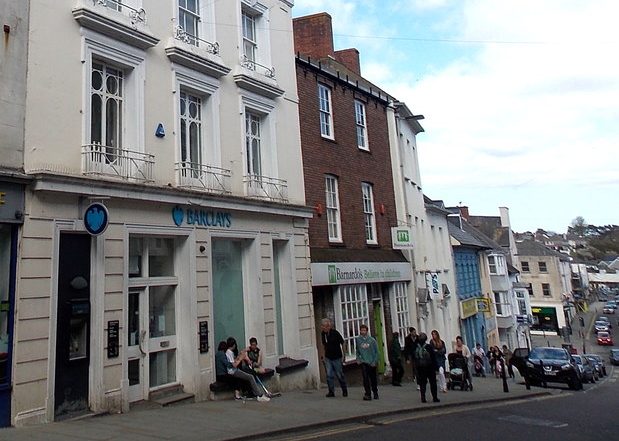
BARCLAYS has given no commitment to reopening bank branches in west Wales, despite calls for the banking giant to restore full services in Pembrokeshire and Ceredigion.
Paul Davies MS, Senedd Member for Ceredigion Penfro, wrote to Barclays UK Chief Executive Vim Maru urging the bank to consider reopening branches in Haverfordwest and Aberystwyth, with Tenby and Cardigan also suggested for review.
The call followed reports that Barclays is looking again at its high street presence and considering investment in its branch network.
But in a response to The Herald, Barclays stopped short of saying whether any west Wales towns were being considered for a reopened branch.
A Barclays spokesperson said: “Over the past year, we’ve added 47,000 hours of in-branch availability across the UK. We are now looking to enhance and invest in our branch footprint alongside our contact centres and app as we continue to meet the changing preferences of our customers. We’ll make more details known on proposed new branch locations at the appropriate time.
“Across Pembrokeshire and Ceredigion, we provide in person banking services from our local banking hubs in Pembroke Dock, Haverfordwest, Cardigan and Aberystwyth, and offer full branch services in neighbouring Carmarthen. Details of opening hours can be found on our website. We also operate a dedicated Welsh language telephone service available on 0333 202 7450, from 9am to 5pm, Monday to Friday.”
Barclays closed its Haverfordwest branch in May 2024. Its Aberystwyth and Cardigan branches also closed that year, leaving customers in large parts of west Wales without access to a full Barclays branch.
Mr Davies said the lack of branches in Pembrokeshire and Ceredigion represented a significant reduction in service provision for both personal and business customers.
He said: “It’s extremely disappointing that Barclays Bank currently has no branches in either Pembrokeshire or Ceredigion. This represents a significant reduction in service provision for both personal and business customers across the two counties.
“However, I welcome the bank’s recent announcement and have written to the Chief Executive to encourage Barclays to take this opportunity to restore banking services in our area by reopening branches in Pembrokeshire and Ceredigion.
“Access to face-to-face banking services remains vital for many residents, businesses and community organisations, and I hope the bank will give serious consideration to reopening the high street branches in west Wales.”
The issue is likely to be particularly significant in rural areas, where older residents, digitally excluded customers, small businesses, charities and community groups may still rely on in-person banking.

While Barclays says alternative services are available, critics argue that local banking points and hubs do not offer the same service as a fully staffed branch.
Barclays Local sites are generally cashless, while full branches offer a wider range of services. Banking hubs, operated separately through the national cash access scheme, provide counter services for basic cash transactions and access to community bankers on set days.
Mr Davies has called on Barclays to place Haverfordwest and Aberystwyth at the front of the queue if the bank proceeds with any programme to expand or reopen branches.
For now, however, Barclays has not confirmed whether any branch in Pembrokeshire or Ceredigion will return.

A NEW development agency will “improve productivity”, according to a Welsh Government minister – but opponents have dubbed it “yet another quango”.
Enterprise, connectivity, and energy minister Adam Price outlined his plans in the Senedd on Tuesday July 7.
He said: “Less than three weeks into this administration, we announced the most ambitious economic goal in Wales in two decades; namely, halving Wales’s productivity gap with the UK within ten years.
“If we are going to meet that challenge, we need a fundamental change in how we approach economic development in Wales. The proposed new agency will be a key driver in achieving that change.”
Mr Price previously faced criticism on his plans when he raised the proposal in the Senedd last month.
Reform’s shadow minister for economy and transport, Jason O’Connell, then described the idea of a new agency as “another unnecessary bureaucratic quango”.
Speaking in the Siambr, Mr Price said: “Creating a new development agency is a crucial part of driving the positive changes in productivity that we need. But it needs to be a much wider, collective effort across Wales.
“We need – collectively and collaboratively – to look at the current landscape and work with local and regional partners to create an economic development system where roles are clear and we’re all working together as one team for the people of Wales.”
As set out in Plaid’s 100 day plan, the party will be establishing an “expert panel” to advise the development of the new agency, which he confirmed will be chaired by Jonathan Lewis.
He said: “The appointment of the chair of the panel to advise on the remit and operating model of the new agency is a key stepping stone in the journey towards making Wales the best place in the United Kingdom to start a business, to grow a business, and to invest in a business.”
The minister told colleagues he would confirm the full membership of the panel in the coming weeks.

Reform’s Jason O’Connell told the Siambr that it was a “shame” MSs were once again debating “the creation of yet another quango”.
Noting the importance of scrutiny for “better government”, Mr O’Connell accused Plaid Cymru of denying the chamber that scrutiny.
He said: “If taxpayers are funding this new development agency, then they deserve transparency. Minister, you say you want the new agency to provide support, advice and guidance, but you’ve said nothing about how.
“So, let me give you a suggestion. Decades ago, Welsh Labour scrapped the Welsh Development Agency, WDA1. They promised a simpler, better support mechanism for Welsh businesses. But instead, we’ve got a patchwork of organisations: Business Wales for advice, the Development Bank of Wales for finance, and now what we’re proposing is WDA2 to sit on top. The current system is too confusing.”
Reform’s shadow economy minister then claimed Business Wales returns £18 of economic value for every £1 that’s invested. He also questioned Mr Price on why he has no plans to bring Business Wales into the new WDA to make things “less confusing and more accessible”.
Responding, Mr Price said his government “absolutely” wants to make sure businesses can access a “streamlined level of support”.
Mr O’Connell also asked about attracting inward investment to Wales, noting the “real test” is whether that investment becomes “rooted across Welsh communities up and down the country”.
He said: “In the last WDA, Wales welcomed major international employers, created thousands of jobs, and celebrated new investment, as short-lived as it was.
“But those companies moved production elsewhere when the government reduced the support. They took high-paying jobs with them, because their supply chains were never truly anchored in Wales, and it was easy to do so.”
The Pontypridd Cynon Merthyr MS drew attention to the Irish economy where “inward investors are expected to work with local suppliers, strengthen domestic supply chains, and create opportunities for already-established local businesses in that country to grow alongside them”.
Mr Price noted his agreement with the shadow minister on the need to be strategic about inward investment.
He said: “Foreign direct investment has a role in any economy, but we need to actually focus it on those areas that will be more embedded – through supply chains, as he suggests – in the Welsh economy that actually build on our existing and possible future strengths.”

Labour’s Shav Taj said her party shares Plaid Cymru’s ambition for a “new type of Wales, a reinvigorated Wales, a Wales that attracts more investment and ultimately creates good jobs”.
The Labour spokesperson for economic transformation told the Siambr that what the people of Wales want to know is what “meaningful difference” these internal arrangements will make.
She also drew attention to the work of the previous Labour government in ensuring a strong economy for Wales, including setting up the Development Bank of Wales and hosting the Wales investment summit.
Ms Taj said it’s the “practical” questions that are important and pressed Mr Price on when the new agency will get staff, whether they will be new staff or shuffled from other departments, and how much the new agency will cost the Welsh public.
She also pushed for confirmation on the “constitutional status” of the agency, notably whether the Senedd will need to legislate “at some point” for it to get going.
Ms Taj added: “Ultimately, this is about jobs, jobs for the future, high-skilled jobs, and young people in Wales are really watching to see whether or not your government is going to do any better than we did.”
Mr Price responded: “They [development agencies] have played a central role in virtually anywhere that you can think about in the nations and regions that have closed an economic gap, and few of those nations or regions that have had one have got rid of them.
“We’re one of the few exceptions. There may be a reason for that, and I suggest it’s because they are an incredibly valuable tool.
“Do you need to get the design right? Absolutely. The right relationship in terms of how arm’s length it is from government but how close it is from a government – getting that right is absolutely important and it’s one of the key questions that we’ve already done a lot of thinking on, and we will continue as we go through the design process.”
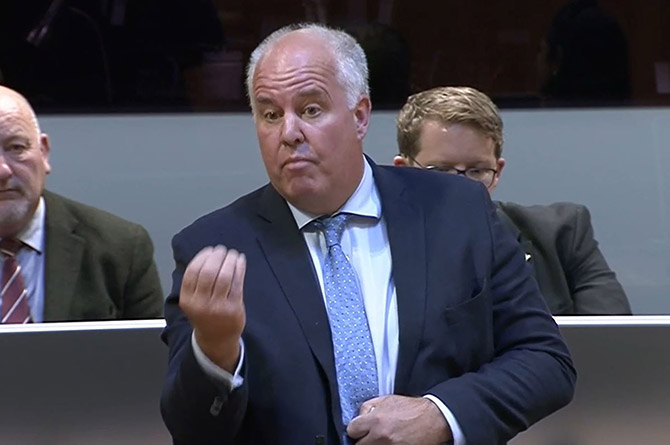
Pen-y-Bont Bro Morgannwg MS, Andrew RT Davies, expressed the Conservatives support for “the principle” but said there was “too much blank space” around the new agency.
He asked Mr Price for a timeframe in which he expects to bring the organisation into existence, whether it be 12 months, two years, or by the end of this Senedd term
Mr Davies also questioned the cost and said: “I’m not going to ask you for every pound, shilling and pence, but can you give an indication on what your thinking is of the type of budget that you will make available to the organisation?”
He continued: “When we look at the old WDA, it had a complete offer, from building industrial sites, gaining the planning permission and promoting foreign direct investment.
“Does this organisation, in your mind, need to do all that, or will it be more specific in what it does about promoting Wales as a destination for inward investment? And when we look at the organisation, are we thinking of an organisation that will look like Natural Resources Wales with a remit letter, or will this be a unique organisation that hasn’t been seen in the Welsh public landscape before?”
Mr Price confirmed the new agency will be a statutory body, and said he plans to bring forward legislation “fairly soon”.
He also noted the Welsh Government’s ambition for the new agency to be operational “as soon as possible”, but said he could not provide a specific date.



Crime8 hours ago
Teacher stabbing trial: The first week of evidence
Jury hears accounts of alleged planned classroom attack, teacher’s fear she was dying, and boy’s words after leaving school A...


Community10 hours ago
Haverfordwest Castle refurbishment reaches new heights as roof goes on
Major milestone reached in project to transform historic gaol building into flagship visitor attraction A MAJOR milestone has been reached...


Business1 day ago
Pembrokeshire lands £98m share of Wales marine energy boom
New industry report says county has received the second highest level of marine energy investment in Wales, supporting more than...
Crime1 day ago
First aider tells jury teacher was “crying, shaking” after classroom stabbing
A SCHOOL first aider has told a jury that teacher Vicki Williams was “crying, shaking” and in “complete shock” after...


Crime2 days ago
Teacher feared she was dying after Milford Haven classroom stabbing
A TEACHER allegedly stabbed in the head at Milford Haven Comprehensive School told a jury she feared she was dying...


News2 days ago
Farage to resign as MP and fight Clacton by-election amid finance row
NIGEL FARAGE has announced he will resign as MP for Clacton and stand again in the by-election he intends to...
Crime2 days ago
Teacher tells jury there were ‘no issues’ with accused pupil hours before ‘stabbing’
Milford Haven teacher gives evidence as trial of 15-year-old continues at Swansea Crown Court A TEACHER allegedly stabbed at Milford...


News3 days ago
Major incident stood down after fire at Impala Terminal in Milford Haven
Fire involved decommissioned oil tank containing residual crude oil and around 60 cylinders A MAJOR incident declared during a fire...


News3 days ago
Large fire breaks out at Impala Terminal in Milford Haven
Black smoke seen for miles as emergency services respond to incident at former Puma Energy site A LARGE fire has...
Crime3 days ago
Prosecution outlines ‘planned attack’ as Milford Haven teacher stabbing trial opens
Jury hears teenager allegedly brought kitchen knife into school before teacher was stabbed in the head THE JURY in the...
-
 Education7 days ago
Education secretary vows to tackle ‘root causes’ of antisocial behaviour in schools
-

 Education6 days ago
Ysgol Glannau Gwaun celebrates prestigious Gold Active Travel award
-

 Community7 days ago
Closure-threatened Stepaside school expected to remain open
-
 Education7 days ago
First Minister pressed on biological sex, additional learning needs, and NHS jobs
-

 Community7 days ago
Saundersfoot Harbour regeneration project wins national planning award
-

 Farming3 days ago
Pembrokeshire slaughterhouse given urgent improvement rating after audit failure
-
News3 days ago
Large fire breaks out at Impala Terminal in Milford Haven
-

 Entertainment1 day ago
Swing and big band classics heading to Torch Theatre