


News
New school approved, despite concerns

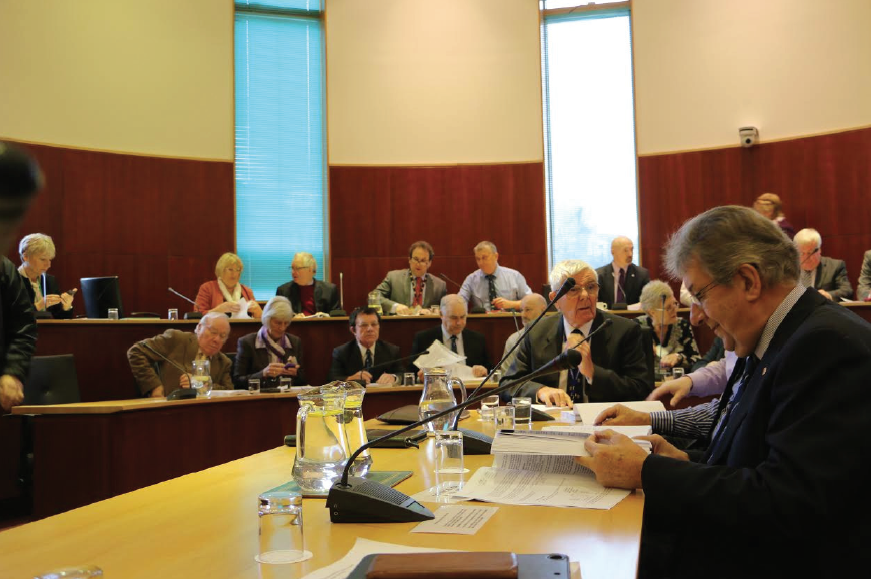

County Hall: Members attend the Extraordinary meeting yesterday (Jan 13)
A NEW school will be built in the Angle peninsula despite concerns over the proposed location.
The proposal will see the closure of Angle VC, Orielton CP and Stackpole VC Schools and a new 3-11 VC school established. At Thursday’s (Jan 14) Extraordinary Meeting of Pembrokeshire County Council, it was revealed that a proposed new school on a site in Hundleton was the preferred option. However, concerns were raised over Hundleton’s proximity to Monkton School which some councillors felt might lead to a drop in pupil numbers. There were also suggestions to keep the Stackpole School open because of its size and to put the new school there.
After a lengthy debate a majority voted in favour of the plans for the new school on a site in Hundleton. Cabinet Member for Education, Cllr Sue Perkins said: “There is a strong level of support for these proposals. A federation was considered but the legislations does not allow for this to happen. “It should be acknowledged that meeting all the needs of the Angle peninsula is a difficult challenge. “The new school will have 120 pupils which is hardly a large school and the proposal is the most sensible and equitable solution.”
Hundleton Cllr John Allen- Mirehouse said: “These have been three difficult years for the schools. All of the schools achieve well, there reports are excellent. One thing that has come out of the reports from the inspector is the ethos of the schools. “These are small rural friendly schools but finance has made it very difficult for Stackpole and Hundleton and the reason for that is the falling numbers of pupils. “People on the peninsula would very much like to keep the status quo but there is a universal agreement that the first choice is not an option. “The new school would be on one of two sites and the preferred site is at Hundleton. “There have been many consultations and there is a minority group that would like to retain Stackpole but that is really not an option. “The future, if an option is not taken up, looks grim for all three schools. It is a difficult choice but a majority want the new school and that will offer what the other three cannot offer of a first class facility. “We are looking at the education of a minority and this will bring educational benefits that will occur for generations to come”
Cllr Tony Wilcox said: “This is a sign of the times and everybody would welcome the new school but it is the location I have a problem with. Most of the children go to the Stackpole School. We own the site and we would only have to use the one bus to get children to and from the school. “We would have to buy land in Orielton and the location may cause problems for Monkton.” Council Leader Jamie Adams said that the council had to be mindful of the roads around Stackpole and that although Stackpole is the largest school, it was about where people travel from to attend the school.

Cllr Viv Stoddart was also concerned about the new location and added that there was no mention of the preferred site in the recommendation. Cllr Adams said that the preferred option was the Orielton site. Cllr Jacob Williams said: “I agree with the concerns. The site at Hundleton would be within two miles of Monkton and I don’t think that is ideal. The Monkton School is too close to this site. “The site at Stackpole is bigger, it has playing fields and is in Pembrokeshire County Council Ownership. The case has not been made that the site needs to be at Hundleton. Why spend extra money on new land at Hundleton?”
Cllr Daphne Bush said: “Travelling from Angle to Hundleton is far better and you cant expect Angle children to travel to Stackpole and Hundleton is a super alternative. Cllr Mike John said it would not be fair to expect children from Angle to travel to the Stackpole School and added that the new school needed to be in a central location. Cllr Tessa Hodgson said she was unhappy with the recommendation as she felt it should include the possibility of looking at the Stackpole site as an alternative. The plans were approved by a majority vote.



RSPCA says police are also investigating after further reports in same town
FRESH concerns have been raised in Milford Haven following reports of new animal shootings in the town.
The RSPCA has confirmed it is aware of further incidents and said Dyfed-Powys Police are also believed to be involved.
An RSPCA spokesperson said: “This is concerning and our hearts go out to anyone who has been affected by these incidents.
“Anyone with any information is asked to contact the RSPCA appeals line number on 0300 123 8018 and refer to incident number 01751732 or please contact the police who are also investigating.”
The latest reports follow earlier incidents in the Hakin area, where cats and wildlife were targeted with an air gun.
Earlier this month, the RSPCA issued an appeal after a cat died after being shot for a second time. A pigeon was also put to sleep after being found with an airgun pellet injury, while several cats had previously been shot in the area.
The charity said anyone caught deliberately using an air gun to injure an animal can face up to five years in prison and an unlimited fine under the Animal Welfare Act.
Deliberately injuring or killing wild birds is also a criminal offence under the Wildlife and Countryside Act 1981.
The RSPCA added that cats and wildlife are particularly vulnerable because they are often outside with nobody to protect them.
Anyone with information should contact the RSPCA appeals line on 0300 123 8018, quoting incident number 01751732, or contact Dyfed-Powys Police.

CEREDIGION Penfro MS Anna Nicholl has welcomed the Welsh Government’s broad ambition to strengthen rural resilience and sustainability, but has warned that farmers and local communities must be involved in shaping the detail if policies are to work in practice.
Speaking during a Senedd debate on June 23, Ms Nicholl referred to a recent visit to a farm in Pembrokeshire with the Farmers’ Union of Wales, where she heard first-hand about the significant challenges facing the sector.

She highlighted examples of farms working with Farming Connect to reduce emissions, boost biodiversity and increase profits at the same time.
Ms Nicholl welcomed some of the Government’s stated priorities, including tackling bovine TB, reforming nitrate vulnerable zone regulations and cutting red tape, saying they had given the industry “fresh hope”.
But she pressed ministers on how they would work with farmers when drawing up the detail of future policy.
In response, the Cabinet Minister for Rural Resilience and Sustainability said the Sustainable Farming Scheme was being refined following feedback, with an emphasis on working with the sector, making the system easier to navigate and offering greater long-term certainty.
Ms Nicholl said: “It’s clear that change is needed to respond to the climate and nature crises, but that change must happen with our rural communities, not against them.
“It’s not just farming that matters here – it’s about keeping our food system strong, supporting local businesses, and securing jobs in our rural areas.
“Farmers in Ceredigion and Pembrokeshire want to see a system that is fair, simple to navigate, and provides real financial security, while also tackling the nature and climate crisis.
“It’s positive to hear that the Government is talking about less bureaucracy and more partnership. I look forward to seeing that happen in practice now.”
Photo caption: Anna Nicholl MS, Member of the Senedd for Ceredigion Penfro, on a farm visit in north Pembrokeshire arranged by the Farmers’ Union of Wales.

Round Table says legal clarity over pedestrian access is still holding up event plan
TENBY ROUND TABLE has welcomed Pembrokeshire County Council’s statement that it wants the Tenby Summer Spectacular to go ahead, but says one key legal question remains unanswered.
The council said on Wednesday (Jun 24) that it had not requested or directed that the event should be cancelled, and that it wanted to see the Spectacular proceed if safety requirements could be met.
But organisers say they are still waiting for a detailed response from council officers on how pedestrian access to the licensed event area at Tenby Harbour can be lawfully managed.
Tenby Round Table said volunteer members were “working tirelessly” to prepare the information needed to finalise the Event Management Plan.
However, it said the final version could not be completed until the question of lawful pedestrian access had been answered by Pembrokeshire County Council.
In a statement, Tenby Round Table said: “We welcome Cllr Miller’s statement. We obviously share his desire to see these events go ahead, they are important for the community and for the charities that benefit from them.
“We would like to clarify the position of where we are in the process however. Volunteer members of Tenby Round Table are working tirelessly to prepare all the information required to finalise our Event Management Plan.
“The reason we cannot produce the final version of this is the one outstanding question, how pedestrian access to the licensed event area will be lawfully managed, which only PCC can answer.
“A detailed response to this, backed up with a legal framework, is what we have been waiting for nine months for from PCC.”
Round Table said its most recent email on the issue was sent on Monday and had not yet been acknowledged or answered.
It said that email was itself chasing a response which had already passed an extended deadline.
The statement added: “This response is the single most important element currently holding up our EMP submission and our ability to confirm the events can proceed.

“We would very much welcome Cllr Miller’s and Cllr Skyrme-Blackhall’s encouragement of the relevant PCC officers to respond by the deadline set, as to date this press release has been our only communication from PCC since our announcement.”
Earlier, Pembrokeshire County Council Deputy Leader Cllr Paul Miller said the authority had supported the Spectacular for nearly 15 years and had not sought its cancellation.
He said: “The Spectacular is a much-loved event with significant number of attendees. As a result, we have an important duty to make sure the event can take place safely to address the concerns formally raised by the Responsible Authorities under the Licensing Act, which include the blue light services.
“Tenby Harbour is a working harbour and a key community asset – and just as every year this event needs to be licensed, and the organisers need to provide important information on how they plan to safely manage the event.”
Cllr Miller added: “As a council, we very much want this event to go ahead but we have to make sure the event is safe for the public, with the right safety measures in place.
“Once the organisers provide the required information, the Licensing Sub-Committee, currently scheduled for July, will consider the event application, in exactly the same way they consider the large number of other events which occur across Pembrokeshire each year.”
Local member Cllr Sam Skyrme-Blackhall also said she wanted to see the Spectaculars go ahead.
She said: “It is important for locals and visitors alike to celebrate Tenby, have fun and raise money for worthy causes.
“I am really encouraged from meetings that I have had with senior officers that everyone is ready to do all that they can to enable these events to go ahead.”
The future of this year’s Tenby Spectaculars now appears to rest on whether the outstanding legal question over pedestrian access can be resolved in time for organisers to submit their final Event Management Plan ahead of the Licensing Sub-Committee hearing expected in July.



Local Government2 hours ago
Tenby Spectacular row continues as organisers say key question remains unanswered
Round Table says legal clarity over pedestrian access is still holding up event plan TENBY ROUND TABLE has welcomed Pembrokeshire...


Community20 hours ago
Manorbier fire scandal: Council’s payout just £63,777 after school destroyed
PEMBROKESHIRE COUNTY COUNCIL has accepted an insurance settlement which leaves it with just £63,777.07 after the catastrophic fire which destroyed...


News1 day ago
Bus overturns in major incident near Kidwelly
All passengers rescued as emergency services remain at scene A BUS overturned on the A484 between Kidwelly and Ferryside on...


Community2 days ago
Tenby Summer Spectacular cancelled amid council row over harbour access
Organisers say popular charity events cannot safely go ahead without clear powers to control crowds TENBY ROUND TABLE has announced...


News2 days ago
Motorcyclist dies after four-vehicle crash on A40 in Carmarthenshire
A MOTORCYCLIST has died following a four-vehicle collision on the A40 between St Clears and Whitland. Dyfed-Powys Police said the...


News2 days ago
Rhun ap Iorwerth urges new deal for Wales after Starmer quits
First Minister says next Prime Minister must focus on greater powers, fair funding and respect for Wales’ democratic mandate FIRST...


News2 days ago
How Labour’s landslide victory unravelled in just two years
Prime Minister announces resignation after losing support within his own party as Andy Burnham emerges as overwhelming favourite to take...


News3 days ago
Long Course Weekend set to bring thousands to Pembrokeshire
Three days of swimming, cycling and running will once again transform Tenby into one of the UK’s biggest endurance sporting...


Community3 days ago
The gentle giant behind the tattoos
Pembrokeshire security worker Josh Davies praised for professionalism, kindness and proving first impressions can be wrong JOSH Davies is hard...


Charity4 days ago
Toy Story fans fill charity toy box at Haverfordwest cinema
Donations pour in for SNAP Specialist Play as families embrace Toy Story 5 launch A TOY STORY-themed charity appeal at...
-

 Crime6 days ago
Milford Haven man jailed for breaching domestic violence protection order
-

 News6 days ago
Crash on Freeman’s Way causes school-run chaos across Haverfordwest
-

 Health4 days ago
Woman jailed assaults on police, harassment and XL Bully possession
-

 Crime4 days ago
Milford Haven woman spared jail despite string of shop thefts
-

 Crime6 days ago
Portfield Gate man faces careless driving allegation after Tufton crash
-
Community3 days ago
The gentle giant behind the tattoos
-

 Local Government6 days ago
Pembrokeshire faces accessible housing shortage as 403 people wait for homes
-

 News7 days ago
Brexit at 10: How Britain was sold a dream that cost us dearly