

News
The long-term challenge facing Newgale


PM visit: David Cameron visited Newgale last year
DURING the severe storms early last year, the A487 at Newgale was closed for several days when shingle was washed onto the road.
A recent report commissioned by Pembrokeshire County Council concluded that the shingle bank will become increasing unstable and vulnerable to failure, with a timescale of 10-20 years over which the current situation may become unsustainable.
The Council therefore instigated a public meeting to discuss the future of the shingle bank at Newgale, which was held at Solva Memorial Hall on February 18. This discussed the stability of the shingle bank and the consequences of any future failure and feedback was welcomed from the public.
A substantial amount of feedback has already been received, and the Council intends to summarise this and provide a public report on this reaction to date.
Head of Highways & Construction at the Council commented: “We have received a huge amount of constructive feedback in response to this initial invite for opinions as to the way forward at Newgale, and thank the public for their widespread and informative comments”.

“The feedback includes comment on the importance of tourism as a key industry in Pembrokeshire and that the road through Newgale is an important link to the St David’s Peninsular, providing one of the iconic viewpoints of the Pembrokeshire coastline”.
“As a response to a number of concerns, it is stressed the Council is not abandoning Newgale. The current shoreline policy identified for Newgale is one of Managed Realignment. This means that Pembrokeshire County Council and Natural Resources Wales, as the risk management authorities for coastal flood and erosion, will implement a managed way forward to minimise, as far as is possible, the impacts of change on the locality.”.
In order to manage any change, the Council will need to appraise all the possible options from retention of the status quo, to the provision of a new road. Funding will also need to be secured, all the requisite statutory consents obtained, and eventually any scheme procured and constructed.
The Cabinet Spokesperson for Environmental and Regulatory Services and the Welsh Language, Cllr Huw George, noted: “Ongoing consultation will be a vital and important strand running through all this work”.
The Council have also had preliminary discussion with National Resources Wales and Pembrokeshire Coast National Park Authority.
Coastal flooding or fluvial flooding from a main river such as the Brandy Brook is the responsibility of Natural Resources Wales and so any scheme that affects the Brook will need to be undertaken in partnership with them. Mr. Phillip Pickersgill, the Acting Head of Operations South west Wales, commented:-
 “The storms last year highlighted the risks to our coastline and the communities that live there. Indications are that climate change will increase these risks and we need to understand and manage them appropriately. We welcome the opportunity to work with Pembrokeshire County Council in helping communities and the environment adapt to this risk.”

Mr. Tegryn Jones, Chief Executive, Pembrokeshire Coast National Park Authority, commented on the actions being taken: “The Pembrokeshire Coast National Park Authority welcomes the proactive lead being taken by Pembrokeshire County Council and Natural Resources Wales to properly consider and address the changing coastline at Newgale”.
“All relevant organisations need to work with local communities to ensure a long-term sustainable solution that takes account of the economic, social and environmental wellbeing of Newgale and the St David’s Peninsula.”
Stephen Crabb MP said: “There is clearly a long-term challenge facing Newgale and the St Davids Peninsula, and there will be some major engineering challenges whatever option is chosen. However, with all the relevant agencies working together there should be no need for knee-jerk responses. We have time to come up with a solution which protects businesses and communities in Newgale and the Peninsula.”
“It was a postive step forward to bring together the Council, Natural Resources Wales and the National Park on Friday to discuss what will happen next. I emphasised the need to involve the local community at every step of the process, to ensure that a solution is reached that protects the village and allows business and tourism to thrive in North Pembrokeshire. It’s also vital that the spectacular view of Newgale beach is protected.”

Lee Bridges says senior vacancy should prompt a review of management costs as frontline services face financial pressure
A MILFORD HAVEN town councillor has questioned whether Pembrokeshire County Council needs to appoint a new deputy chief executive at a time when local services are under growing financial pressure.
Councillor Lee Bridges spoke out after the authority advertised for a Deputy Chief Executive and Director of Place, with a salary of between £132,063 and £145,050.
The successful candidate would also receive a £9,576 annual lease car allowance and a relocation package, taking the potential overall package above £154,000.
Cllr Bridges stressed that his concerns related to the position itself and were not intended as criticism of the person currently holding, or previously holding, the role.
He said: “At a time when local authorities across Wales are facing significant financial pressures and frontline services are under increasing strain, I do question whether this role is really necessary.
“The council already has a chief executive, directors responsible for each service area, together with multiple layers of senior managers, middle managers and team leaders.
“When opportunities arise through senior vacancies, they should also be seen as opportunities to review and streamline management structures rather than simply replacing like-for-like.”
The senior post carries responsibility for areas including regeneration, economic development, planning, transport, environmental services, climate change and major capital projects.
The successful applicant would also support major investment opportunities linked to the Celtic Freeport.
Cllr Bridges said strong leadership remained important, but argued that the cost of senior management needed to be balanced against the pressure on council services.
He said: “Every pound spent on senior management is a pound that cannot be invested in frontline services that residents rely upon every day.
“Over recent years, we have repeatedly heard that difficult financial decisions have had to be made, with services being reduced or placed under increasing pressure because budgets are stretched.

“If that is genuinely the case, then it seems entirely reasonable that senior management structures should be reviewed with the same level of scrutiny as every other area of council spending.”
He said the vacancy should have prompted the authority to consider whether the responsibilities could be divided among existing senior officers.
Cllr Bridges added: “I would have welcomed a strategic review of whether this post is genuinely essential, or whether its responsibilities could be absorbed within the existing leadership team.
“Any savings could then be redirected towards protecting services for Pembrokeshire residents, whether that is highways, social care, education, environmental services or other frontline functions.”
He said his comments were intended to encourage debate about council priorities rather than criticise individuals.
“This is not about personalities,” he said. “It is about ensuring that, when opportunities arise through natural vacancies, the council asks whether there is a better way of structuring itself for the future.
“At a time when every public pound counts, I think residents would expect those questions to be asked before another senior appointment is made.”
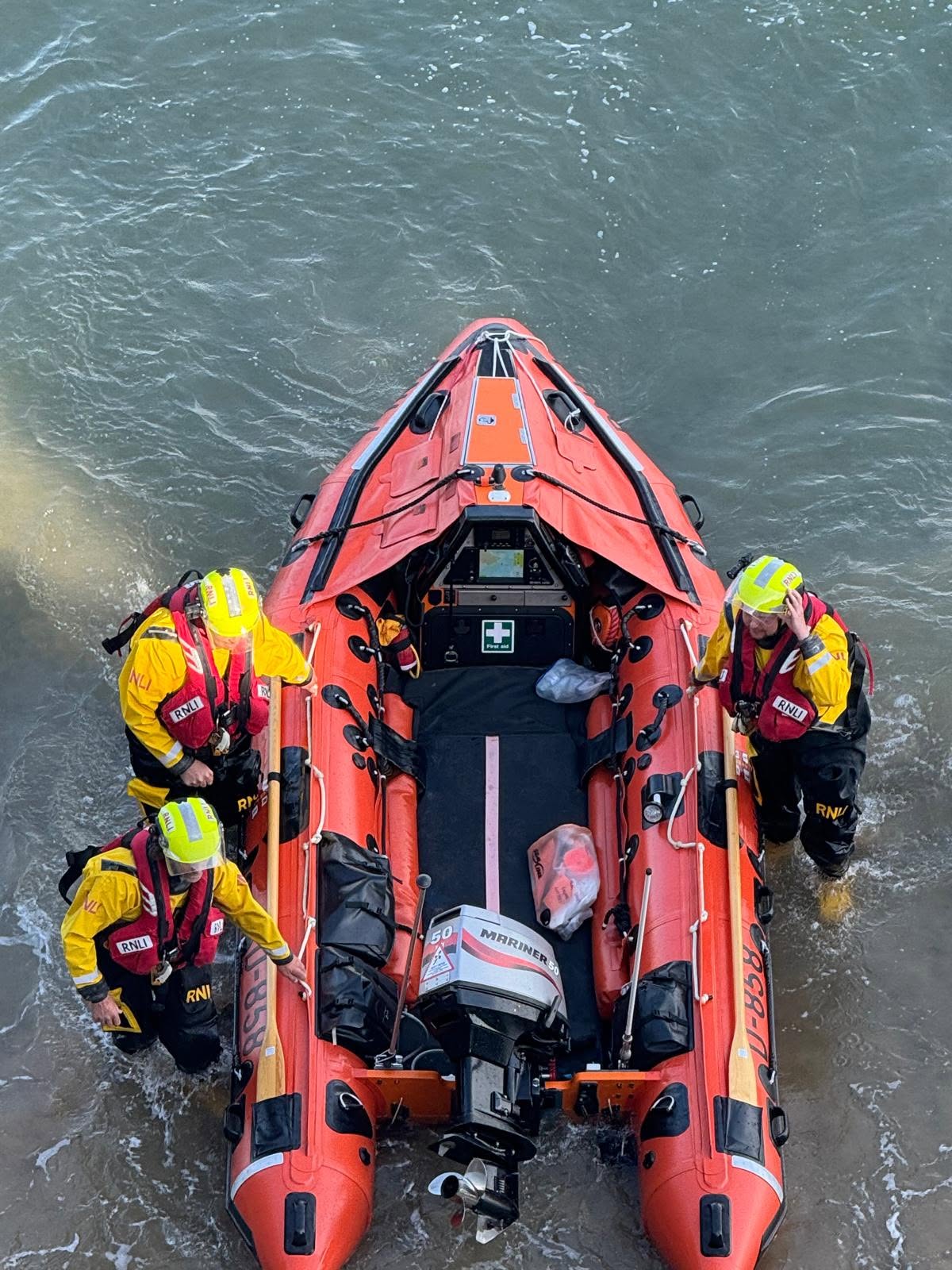
Four adults and two children were taken to safety after the sea rapidly surrounded them below the Imperial Hotel
TENBY’S inshore lifeboat was launched on Tuesday evening after four adults and two children became cut off by the incoming tide.
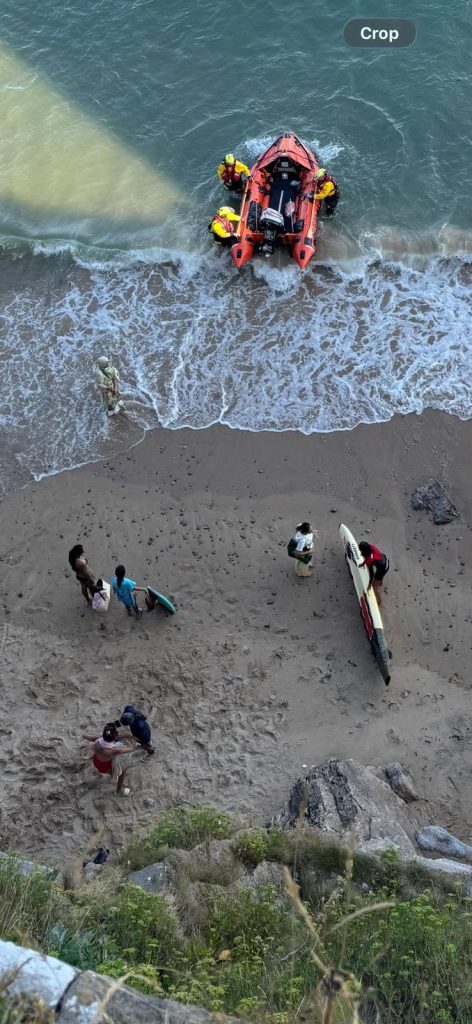
The alarm was raised at around 5.50pm when the coastguard received several 999 calls reporting that the group was trapped on the beach below the Imperial Hotel, with the water rising quickly around them.
Tenby RNLI’s volunteer crew reached the scene within a minute and found the six casualties with an RNLI beach lifeguard, who had heard they were in difficulty and paddled around to assist them.
All six were taken aboard the lifeboat and brought safely to Castle Beach.
They were reported to be unharmed following the incident and were able to make their own way home.

Broadcaster warns its current funding model is becoming unsustainable as viewers move away from live television and BBC iPlayer
THE NUMBER of television licences in force across the UK has fallen by almost 540,000 in just one year, according to the BBC’s latest annual report.
A total of 23.3 million licences were active at the end of the 2025/26 financial year, compared with 23.8 million 12 months earlier.
The reduction of 539,000 was considerably larger than the fall recorded during the previous year and reflects the growing number of households which say they no longer watch programmes requiring a television licence.
Households need a licence to watch or record television programmes as they are being broadcast on any channel, or to use BBC iPlayer. Those who only use other streaming services to watch programmes on demand do not generally require one.
The number of households declaring that they did not need a licence rose by 62,000 during the year, reaching approximately 3.7 million.
Licence numbers have now fallen by more than 2.5 million since the beginning of the decade, when around 25.9 million were in force.
BBC chief financial officer Berangere Michel said the majority of the decline appeared to be caused by people no longer consuming content covered by the licence.
She warned that the trend was unlikely to reverse and was instead expected to accelerate, strengthening the BBC’s argument that the way it is funded must be reformed.
The corporation’s annual report said its financial outlook had worsened during the second half of 2025, with licence sales falling more quickly than previously forecast.
Inflation, rising production costs and difficult trading conditions across the wider media industry have also increased the gap between the BBC’s income and its expenditure.
Although licence fee income stood at around £3.87 billion in 2025/26, the value of that income has fallen sharply when inflation is taken into account.
In today’s prices, the corporation received approximately £1.34 billion less than the equivalent amount raised in 2016/17, representing a real-terms reduction of around 26 per cent.

The BBC reported an operating loss of £121 million for 2025/26 despite an increase in the price of the television licence during the year.
Director-general Matt Brittin described the situation as a “moment of real jeopardy” for both the BBC and public service broadcasting in the UK.
He said the corporation continued to play an important role in public life, the economy and Britain’s cultural influence, but acknowledged that it would have to change substantially to remain relevant in a rapidly evolving media market.
The report shows that 94 per cent of adults use at least one BBC service each month, but fewer than 80 per cent of households now contribute through the licence fee.
BBC chairman Samir Shah said the difference between the number of people using BBC services and those paying for them demonstrated that the existing system could no longer support the corporation’s public service responsibilities.
The BBC is preparing for negotiations over its next Royal Charter, with the current arrangements due to expire at the end of 2027.
Options being discussed include retaining a reformed licence fee, extending payments to some households using commercial streaming services, or developing a different funding system. The Government has not yet made a final decision.
The future of the licence fee also has implications for broadcasting in Wales. S4C receives its public funding through the television licence, with £97.6 million allocated to the Welsh-language broadcaster during 2025/26.
The BBC has already announced plans to reduce spending across its news, nations and content divisions.
The first phase is expected to save around £160 million, contributing towards a wider target of £500 million by 2028/29. The programme is expected to result in between 1,800 and 2,000 job losses over three years.
BBC executives maintain that substantial reform will be needed alongside those savings if the organisation is to continue providing television, radio, news, online and regional services on their current scale.

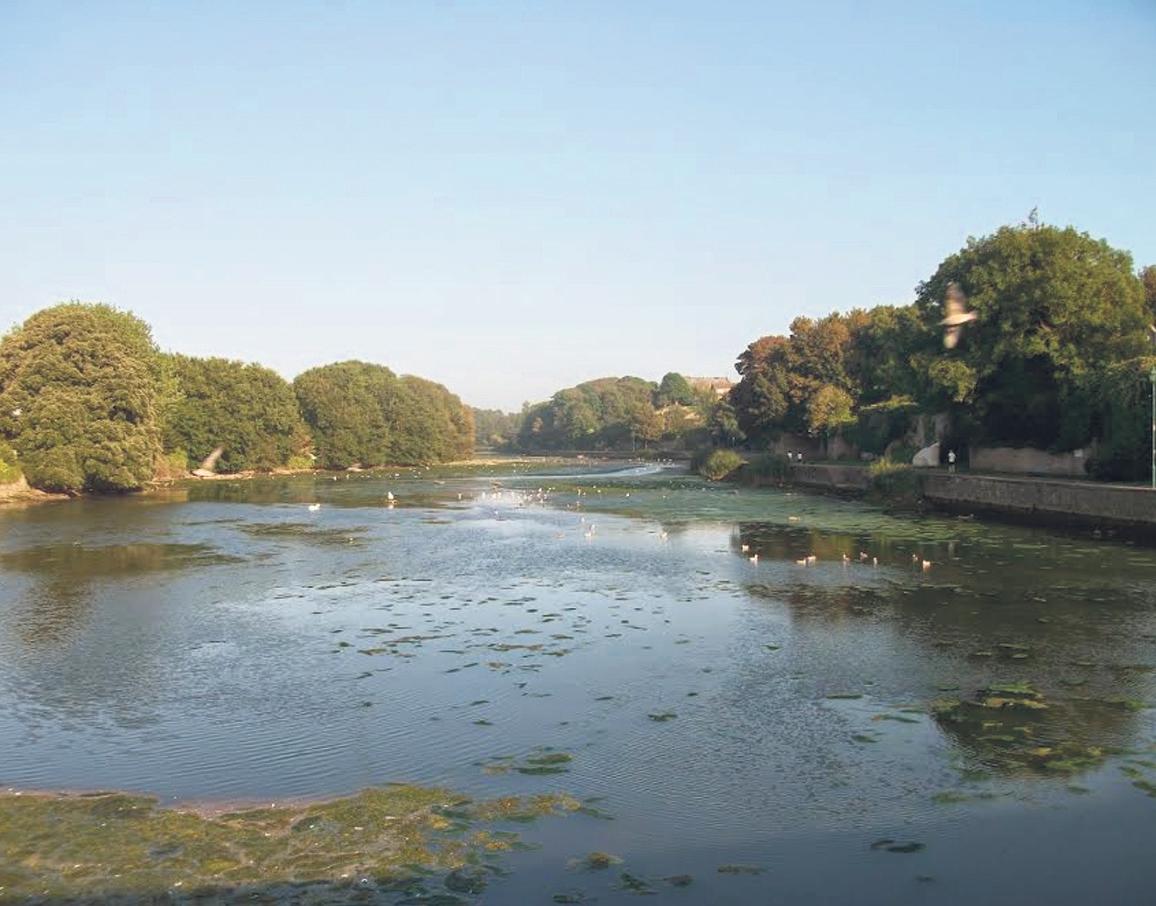
Local Government21 hours ago
Catapult attacks suspected after wildlife deaths at Pembroke Mill Pond
Wildlife Crime Officers are investigating after the town council said around five animals showed signs of deliberate injury WILDLIFE found...

Crime23 hours ago
Narberth retailer speaks of shoplifting toll after ‘collectable bear’ stolen
Independent shop owner said rising costs meant businesses could not afford to absorb losses caused by theft A NARBERTH retailer...


Crime24 hours ago
Teen accused of attempting to murder teacher says she lied about stabbing
Defendant accepts teacher was terrified and that a knife wound to the head could kill, but denies deliberately attacking her...


Local Government3 days ago
Calls grow for independent investigation into Manorbier school closure
Councillor alleges misleading figures, inadequate insurance and poor treatment of staff CALLS for an independent investigation into the controversial closure...


Community3 days ago
Neyland Carnival hailed a huge success after streets fill with colour and crowds
NEYLAND CARNIVAL organisers have thanked the community, volunteers and local businesses who helped make this year’s event a memorable success....

Community3 days ago
Tenby Summer Spectacular: Anger grows over ‘disaster waiting to happen’ warning
A growing backlash has followed police calls for the event’s licence to be revoked, with supporters questioning why authorities failed...

Charity4 days ago
RSPB secures ‘missing link’ to reconnect wildlife habitats in Carmarthenshire
RSPB CYMRU has purchased a 96-hectare upland site in Carmarthenshire, describing it as a vital step towards reconnecting one of...


Crime5 days ago
Ann Widdecombe: Welsh politicians pay tribute as murder probe launched
Prime Minister Sir Keir Starmer has praised the former minister’s “conviction and dedication”, while political figures in Wales remembered her...


News5 days ago
Solardo pulls out of Haverfordwest show as organisers offer full refunds
Headline act confirms non-appearance as Park House Series announces major event changes DANCE music duo Solardo will no longer perform...


Local Government5 days ago
Conservatives win Pembroke Dock seat as Reform stalls and Dowson polls just 11
Jamie Street takes Market ward with a 43-vote majority as Reform finishes fourth despite its major Senedd breakthrough two months...
-

 Farming6 days ago
Working Carmarthenshire farm opens gates to visitors with new holiday cottages
-

 Sport6 days ago
Rising rally star claims maiden Mini Rally Challenge victory
-
 Farming6 days ago
Outer Hebrides stickmaker to make final Royal Welsh Show appearance
-

 Crime6 days ago
Greenacres confirms seized dogs are safe as investigation continues
-

 Sport6 days ago
Bluebirds give new home strip first run-out
-

 Crime7 days ago
Welsh-born woman Ruth Ellis granted pardon 71 years after execution
-
 Health5 days ago
Hospital ward closed after highly contagious scabies outbreak
-
Crime6 days ago
Teacher stabbing trial: The first week of evidence
Tomos
April 6, 2015 at 10:14 am
Possibly many will not like my solution – sacrifice the land and buildings to the sea, recompense the owners generously and build another road – it will be cheaper in the long run – unfortunately politicians are only concerned with the short term