


News
Further interest rates cuts to hit savers


 SAVERS face further misery as the Bank of England slashed interest rates to 0.25% yesterday (Aug 4) in an attempt to stimulate the struggling economy in the wake of the Brexit vote.
Retirees and the semi-retired reliant on savings in ‘safe’ bank and building society accounts face a double whammy as record low interest rates combine with rising inflation caused by a weakened pound.
The Bank of Scotland pre-empted this move last week when it wrote to 1.3 million business customers warning that they could start imposing charges on credit balances; effectively imposing negative interest rates.
This would follow moves by banks in Switzerland and Sweden. Even if negative interest rates are not introduced for individual savers, interest rates of practically zero will see hard-earned nest eggs shrink in real terms as the the cost of living rises.
This will be a huge blow to thrifty pensioners who did though they had done ‘the right thing’ throughout their working lives by putting money aside for retirement. The over 65s form a disproportionately high percentage of the west Wales population, and as they are forced to further tighten their belts, this will pile more pressure onto struggling local businesses in one of the most deprived areas of the UK.

Mrs Alice Hughes from Pembroke Dock, who relies on a small nest egg to top up her state pension, told the Herald: “I’ve always been careful and put money away in the building society. With interest rates the way they are now, I’m wondering whether I’d be better off keeping it under the mattress.”
Mr Ronald Edwards from Cardigan, who is due to retire in six months time said: “I’ve been looking at annuities online, and the amounts being offered are so low, I might as well cash in my pension pot and buy a classic car. At least there’s a chance of it increasing in value.”
In further moves, the Bank of England announced further printing of money to prop up the economy, and revised the growth forecast for 2017 from 2.3% to 0.8%.
With pressure on company pension pots creating difficult decisions for managers about whether to invest in wage increases or filling the pension deficit, workers in west Wales could see their already low wages stagnate for the foreseeable future.

Mark Carney, the Canadian Govener of the Bank of England said that this was a necessary step to adjust to the new reality post-Brexit, in which the economic outlook has changed.
There may be some positive news for those with savings in stocks and shares, which receive a boost when interest rates are cut.
There is more positive news for mortgage holders and home-buyers on variable interest rate mortgages, who will see a drop in their monthly payments.

As the pound continues to slide against the dollar, holidaying in the UK may become a more attractive option to families feeling the squeeze, providing a boost to the west Wales tourist industry.
How are you being affected by the record low interest rates? Email [email protected].



Home Office says national target was met early as ministers link extra patrols to arrests and anti-social behaviour crackdown
THE UK GOVERNMENT says there are now 200 more neighbourhood police officers on the beat in Wales than there were a year ago, as ministers push a wider drive to increase visible policing in communities.
The claim was made as the Home Office announced it had met its target of putting more than 3,000 additional police officers and Police Community Support Officers into neighbourhood roles across England and Wales, two months ahead of schedule.
According to figures released on Tuesday (Apr 7), a total of 3,123 extra neighbourhood policing staff have either been recruited or redeployed since April last year, with the government saying they are now focused on tackling local crime and anti-social behaviour.
The Wales Secretary, Jo Stevens said: “There are now 200 more neighbourhood police officers on the beat in Wales than a year ago, fighting the crime and anti-social behaviour that can have a huge impact on communities.
“It is a central mission of the UK Government that people feel safe in their neighbourhoods and the increased police presence is already delivering results and leading to more arrests across the country.”

Ministers say the extra officers form part of a longer-term plan to roll out 13,000 additional neighbourhood policing personnel by the end of this parliament.
The Home Office said a recent Winter of Action campaign, carried out during December and January in more than 600 towns and cities, led to almost 18,000 arrests as police patrols were stepped up.
Of those arrests, the government said more than 5,000 were linked to retail crime, more than 1,000 to sexual offences, almost 1,000 to street crime, and over 10,000 to violent assault.
Crime and Policing Minister Sarah Jones said neighbourhood policing had been “hollowed out” in recent years and that too many officers had been kept in desk-based support roles rather than deployed on the streets.
She said: “We’re delivering the biggest reforms to policing in over 200 years and, crucially, putting 13,000 more neighbourhood officers where they belong – on the beat and fighting crime in our communities.”
The Home Office also pointed to what it described as early successes in several police force areas, including South Wales Police, which it said had reported a 37 per cent drop in home burglaries and a 14 per cent fall in anti-social behaviour.
The announcement also comes as the government launches a new strategy aimed at halving knife crime within a decade.

Under the Neighbourhood Policing Guarantee, ministers say every neighbourhood in England and Wales will have named, contactable officers, with residents promised a meaningful response to local concerns within 72 hours.
All police forces have also now published anti-social behaviour action plans setting out how they intend to tackle persistent local problems.
John Hayward-Cripps, chief executive of the Neighbourhood Watch Network, welcomed the increase and said stronger local relationships would help build confidence and improve the flow of intelligence from communities.
Harvinder Saimbhi, chief executive of ASB Help, said the extra officers should help reassure victims that their concerns are being taken seriously.
The government says the expansion of neighbourhood policing marks a major step towards reversing years of decline in visible local policing, though the longer-term impact on crime levels will be closely watched.

TRIBUTES have been paid to Johnny Morris, a much-loved Fishguard photographer who has died at the age of 91.
For decades, Johnny was a familiar figure across north Pembrokeshire, capturing community life through his camera lens for the local press, as well as for countless local groups, charities and organisations.
He was widely regarded as the go-to photographer for Fishguard and the surrounding area, with an extensive archive of images documenting local people, events and history over many years.
As well as his photography, Johnny was known for his love of gardening, his knowledge of local history and his gift for telling stories. Friends said he was often happiest in his garden, where he won several local trophies for his growing skills.
Johnny died peacefully on Sunday, March 22, at Park House Court in Tenby. He was predeceased by his wife Irene. He is survived by his daughter Joy, son-in-law Dilwyn, and his brother Derek.

Former Western Telegraph reporter Anwen Baldwin paid tribute, describing him as a lovely man and a great photographer.
She said: “He knew so much about the local area, its people, events and history.
“He had a great sense of humour and I loved hearing his stories about Fishguard past and present, although not all of them were for publication.
“He had a huge archive of pictures documenting the area over the years, and if I ever needed an image for a story, he would have it, no matter how obscure the request.
“He took me under his wing when I first started as the Western Telegraph’s north Pembrokeshire reporter and became a good friend who I always looked forward to catching up with.
“He will be greatly missed by the local community and the many reporters and editors who were always pleased to see a picture from Johnny Morris on their pages.”

Fishguard RNLI said Johnny had played an important role in recording the life of the station over many years. In a mark of respect, the flag at the lifeboat station has been lowered to half-mast.
A spokesperson said: “It is with great sadness that we learn of the passing of local photographer and supporter of Fishguard RNLI, Johnny Morris.
“As the station’s photographer Johnny documented a vast array of station life, from crew photos and station fundraising events, to the arrival of our current D-Class inshore lifeboat, as well as countless other community events.
“As a mark of respect, the flag over the station will continue to be flown at half-mast.”
Fishguard and District Round Table also paid tribute, describing Johnny as a local photography legend and a strong supporter of community events and charities.
The group said he had always been on hand to record important milestones in the town.
Long-standing member Gwil Evans added: “He had a brilliant knack of being able to make even the worst of us look like a million bucks.”
Johnny’s funeral will take place on Friday, April 10, at 11:30am at the Chapel of Rest, Feidr Castell, Fishguard, followed by interment at Hermon Cemetery.
Family flowers only are requested. Donations in lieu of flowers may be made payable to Fishguard Lifeboat, care of Paul Jenkins & Sons Funeral Directors, Feidr Castell, Fishguard.

Chairman says issue has been dealt with, but winding-up notice is still listed ahead of High Court hearing
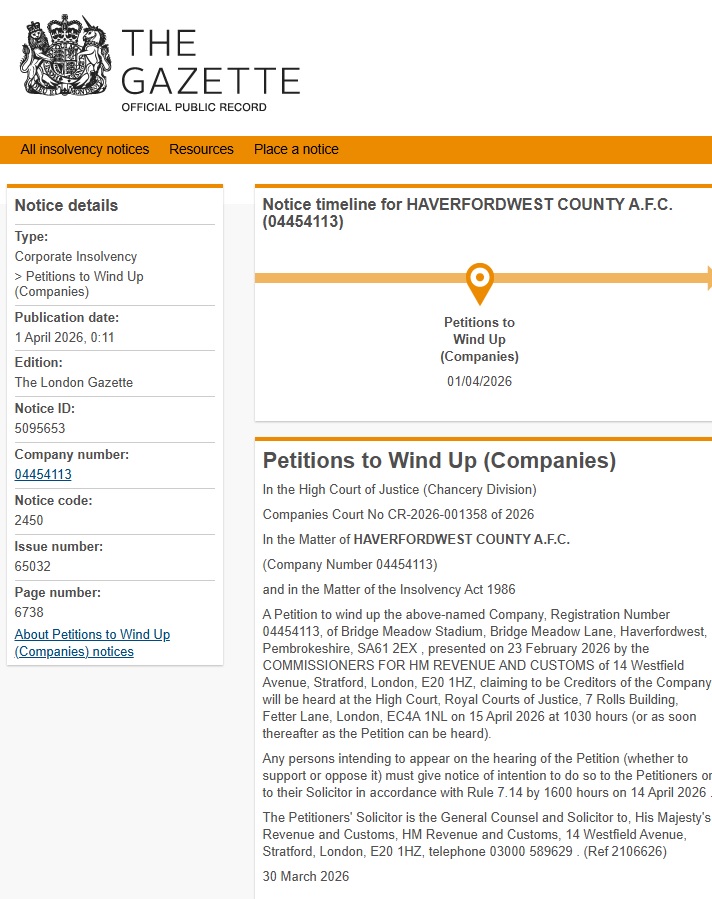
HAVERFORDWEST County AFC is facing serious questions after an HM Revenue and Customs winding-up petition against the company behind the club remained live on The London Gazette website despite the chairman insisting the matter has already been dealt with.
The petition against Haverfordwest County A.F.C. Ltd was presented on February 23 and is listed to be heard at the High Court in London on Wednesday, April 15 at 10:30am. The public notice states that HMRC is seeking to wind up the company, registered at Bridge Meadow Stadium, Bridge Meadow Lane, Haverfordwest, claiming to be a creditor.

Any person intending to support or oppose the petition must give notice by 4:00pm on April 14. At the time of publication, the notice remained publicly visible and there was nothing on the Gazette entry to show that it had been withdrawn, dismissed or otherwise disposed of.
After being contacted by The Herald, chairman Rob Edwards said the case was “a non-story” and claimed it related to “a VAT offset against PAYE that wasn’t recorded”. He said the issue had been rectified “some time ago”, that the club had no debt to HMRC, and that HMRC had already provided a petition to withdraw to the court.
However, HMRC did not confirm that when approached by The Herald. Instead, a spokesperson gave only a general statement, saying: “We take a supportive approach to dealing with customers who have tax debts and only file winding-up petitions once we’ve exhausted all other options, in order to protect taxpayers’ money.”
That leaves an obvious gap between the chairman’s account and the public record. If Edwards is right, the matter may already be in the process of being withdrawn. But until the court or Gazette record is updated, the petition remains live in public and continues to list a High Court hearing next week.
Even if the matter is ultimately withdrawn, the fact it progressed to the stage of a published HMRC winding-up petition is likely to raise concern among supporters, sponsors and creditors. A petition of this kind is a serious insolvency step, not a routine administrative query. If it were to proceed and succeed, the company could face compulsory liquidation.
The issue is especially striking because the club has recently spoken publicly about growth, investment and longer-term ambition. In January, Haverfordwest said it was in the latter stages of an exclusivity agreement relating to significant investment from a US-based fund. Earlier statements had also referred to outside backing, ambitions to move towards full-time football, and a wider business vision around the club.
Those statements painted a picture of momentum and expansion. The emergence of a live HMRC petition, whatever the eventual explanation, is therefore bound to prompt scrutiny of the club’s financial management and internal controls.

Questions are also likely to be asked about Rob Edwards’ wider business interests beyond west Wales. Recent coverage has linked him and Morley Sports Management to ventures in the United States, underlining the scale of the broader commercial ambition surrounding Haverfordwest’s rise.
For supporters, sponsors, staff and creditors, the immediate question is whether the matter will be formally withdrawn or whether the public court record will remain unchanged until the hearing date. Until that becomes clear, one of Welsh football’s most talked-about recent success stories is facing a deeply serious test off the pitch.
UPDATE: 14:16 HRS, April 7, 2026:

The club has now published an official statement saying the petition “has been withdrawn by HMRC,” but the petition still appears live on The London Gazette and still lists the April 15 hearing. The club statement says there is “no debt owed to HMRC” and attributes the matter to “an allocation issue around a PAYE/VAT offset at the end of last year.”



News2 hours ago
Haverfordwest County AFC faces High Court winding-up threat from HMRC
Chairman says issue has been dealt with, but winding-up notice is still listed ahead of High Court hearing HAVERFORDWEST County...


Local Government2 hours ago
Food hygiene checks have not been carried out in parts of a Welsh county since 2019
FOOD hygiene checks have not been carried out in parts of a Welsh county since 2019 due an inspection backlog,...


Local Government3 hours ago
Bridge works on Neyland-Burton road to continue into late April
Council says safety repairs remain on programme but traffic lights will stay in place as major bridge scheme moves into...

Charity21 hours ago
Angle RNLI answers string of call-outs across the Milford Haven Waterway
Volunteer crew launched for searches, police incidents, a medical evacuation and a grounded yacht during a busy spell from mid-February...


Charity24 hours ago
St Davids RNLI launches on Easter Monday after drifting kayak spotted off Solva
Missing vessel recovered near shore after coastguard confirms it had been reported lost days earlier ST DAVIDS RNLI launched on...


News1 day ago
Diesel nears £2 a litre in Pembrokeshire as drivers scramble for cheaper fuel
Johnston forecourt hits 194.9p while wide price gaps and rush to fill up pile pressure on motorists across the county...


News2 days ago
St Davids Cathedral marked Easter Sunday with full day of worship
FROM dawn vigil to choral evensong, the cathedral welcomed worshippers for one of the most important days in the Christian...


Crime2 days ago
Neyland man spared immediate jail over aggravated vehicle taking
Defendant given a suspended prison sentence after magistrates heard the offence was serious enough to cross the custody threshold KRISTIAN...


Health3 days ago
Crumbling NHS faces £1bn repairs bill in Wales
Senedd election promises collide with the harsh reality of ageing hospitals, fire safety concerns and a maintenance crisis stretching across...


News3 days ago
Emergency services respond to incident in Haverfordwest town centre
EMERGENCY SERVICES were called to an incident in Haverfordwest town centre on Saturday morning (Apr 4), with police and ambulance...
-

 News4 days ago
Accommodation providers in Wales will be required to register under new law
-

 Business7 days ago
Fishguard to Wexford rail tunnel plan backed by Elon Musk firm
-

 Entertainment5 days ago
From Milford Haven to the world: The story of The Evolution Experience
-

 Entertainment5 days ago
BBC unveils major new Welsh dramas with Tenby set for prime-time spotlight
-

 Crime7 days ago
Driver trapped after crash while nearly four times over drink-drive limit
-
 Business7 days ago
Refusal over Pembrokeshire shepherd hut let goes to appeal
-

 Business5 days ago
Fire damaged Newgale Duke of Edinburgh Inn plans refused
-

 Community5 days ago
Sycamore Gap legacy takes root at Carew Castle
learn more
December 29, 2025 at 10:52 pm
I never thought about it this way before. Thanks for opening my eyes.
Lamborghini Huracán EVO
December 31, 2025 at 2:22 pm
Great advice! I’ll definitely be implementing some of these tips.