


News
Nurse struck off after death of disabled man



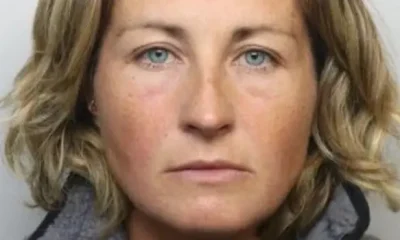
Lorraine Stevens, 61: Struck off (pic. WNS)
A NURSE has been struck off after a patient died from downing a bottle of washing up liquid at a care home.
Lorraine Stevens, 61, didn’t raise the alarm when the man drank from the bottle – but instead made him drink several glasses of water to dilute it.
The patient was vomiting and frothing at the mouth, but Stevens waited nearly three hours to tell anyone else that he was unwell.
And when she did finally speak to her manager Stevens failed to mention how long he had been ill for, the misconduct hearing was told.
The disabled man – referred to only as Patient A – died the next morning.

Case presenter Gregory Wedge said: “Patient A reached through an open kitchen window and grabbed a bottle of washing up liquid, from which he drank an unknown quantity.
“The washing up liquid was promptly taken away from him and it is alleged that he was given glasses of water to drink.
“About 15 minutes after the incident, Patient A allegedly began coughing, vomiting and there was some foam at his mouth. He was given more water and continued to cough and vomit for 30 to 40 minutes.”
Mr Wedge said Stevens was the only qualified nurse at Begelly Bungalow in Begelly, Pembrokeshire, which housed four people with learning disabilities.

Patient A, who had been at the managed bungalow for just four months before his death, suffered brain damage at birth and had a history of trying to drink dangerous liquids.
But Stevens didn’t raise the alarm for two-and-a-half hours after he drank from the washing up bottle, and when she eventually did still failed to tell her manager the incident had happened hours beforehand.
The man collapsed at the bungalow around 8pm, some ten hours after consuming the liquid, and died in hospital early the following morning on July 13, 2013.

The Nurses and Midwifery Council also was told Stevens later mocked up risk assessment form for Patient A on the day his family came to collect his belongings.
The form said kitchen cupboards should be locked at the bungalow – but she didn’t point out it was written after his death.
Mr Wedge said Stevens had acted “dishonestly”.
He said: “She should have admitted that there was no risk assessment in place, rather than falsifying clinical documents in an attempt to create the impression that there had been one.”
Dyfed Powys Police investigated Stevens in connection with the man’s death, but no charges were ever brought to her or employers Hywel Dda University Health Board.
Panel chair Monica French told the hearing in Cardiff that Stevens’ actions “increased the risk of harm” to her patient.
She also said Stevens’ decision to leave her shift early on the day, leaving the “deteriorating” man to be cared for by staff without medical training, placed him at “an unwarranted risk of harm.”
Miss French said: “Stevens failed to ensure that Patient A was safe and to provide him with the high standard of care expected of her as a registered nurse.
“In addition, her dishonest actions in respect of the risk assessment were inconsistent with her obligations as a registered nurse.
“There was no evidence before the panel that Stevens had any insight or remorse into the potential gravity of her actions and omissions or their impact.”
Stevens, from Pembroke Dock, was given a struck off the nurses register, and will not be able to reapply for five years.
Speaking at her home, she said: “I don’t want to talk about it.”


WELSH CONSERVATIVE Shadow Farming Minister Andrew RT Davies has called on Plaid Cymru ministers to stop funding public information campaigns which he says undermine Welsh meat.
The criticism follows a Welsh Government response to a written question from Welsh Conservative Senedd Leader Darren Millar, which showed £662,000 was allocated to the Climate Action Wales campaign during 2025-26.
Examples of the campaign include online advice on ‘green food choices’, sustainable eating and meat-free options, alongside wider material on energy, travel and consumer behaviour.
The campaign gives advice on reducing carbon emissions through choices on food, travel, energy and purchasing. Its sustainable food guidance says meat is among the largest contributors to greenhouse gas emissions, particularly from ruminant livestock such as cows and sheep.

It also advises people to limit red and processed meat, while saying those who do eat meat should try to buy local, sustainably farmed produce where available.
Mr Davies said Welsh meat should be promoted rather than undermined.
He said: “Welsh meat is of the highest quality and the industry forms a key part of our economy.
“Plaid Cymru separatists must celebrate it, not fund campaigns that undermine Welsh meat.
“No project aimed at discouraging meat consumption should receive public funds.”
The Welsh Government response said the figures related to public information campaigns connected to the previous government’s policies.

SCHOOL leaders have warned that a Welsh Government plan to increase incentive payments for trainee teachers in priority subjects risks creating a “two-tier workforce”.
NAHT Cymru said the move may help attract some new teachers, but warned it does not address the wider recruitment and retention crisis facing schools across Wales.
The Welsh Government’s priority subject incentive scheme offers grants to eligible postgraduate teacher trainees in subjects including biology, chemistry, design and technology, digital technology and computer science, mathematics, international languages, physics and Welsh.
Laura Doel, national secretary of NAHT Cymru, said: “While we agree that an ambitious plan to help schools struggling with recruitment and retention of teachers is needed, we don’t think focusing on subject-specific incentives is the way to go.
“This risks creating a two-tier workforce and appears to be a short-term sticking plaster solution for a systemic problem.”
She said there appeared to be no requirement for teachers to remain in schools for a set number of years after induction in order to keep the payment.
Ms Doel added: “We know a significant proportion of teachers leave the profession within the first five years of teaching.”
NAHT Cymru said ministers should focus instead on the wider pressures affecting teachers, school leaders and primary schools, as well as secondary subjects where recruitment is difficult.
The union said improving pay, terms and conditions, and reducing workload would do more to make teaching an attractive long-term career.
Ms Doel said: “By going further in restoring the real-terms value of pay, which fell sharply over the previous decade, improving terms and conditions, and bearing down on unsustainable levels of workload, ministers could make the profession an attractive long-term career proposition once again.
“But schools also need fairer funding to recruit the staff and support staff they need and deliver for pupils.”
She said ensuring schools receive the full consequential funding owed through the Barnett Formula should be a priority for the new administration.

NAHT represents more than 38,000 school leaders across early years, primary, secondary and special schools in England, Wales and Northern Ireland.

Ministers say unsuitable homes are worsening health and contributing to delayed hospital discharges across Wales
POOR or unsuitable housing is directly affecting people’s health and placing additional strain on NHS services in Wales, the Welsh Government has admitted, following the publication of a major new report warning of the growing health impacts of inadequate homes.
The warning comes in a new report by the Royal College of Occupational Therapists (RCOT), which argues that poor housing is worsening physical and mental health, increasing hospital readmissions and adding avoidable pressure to health and social care services.
The report says millions of people across the UK are living in homes that fail to meet their needs, with problems ranging from damp and poor accessibility to unsuitable living environments for older people and those with disabilities or long-term health conditions.
The Welsh Government acknowledged the issue when asked for comment by The Pembrokeshire Herald.
A Welsh Government spokesperson said: “Poor or unsuitable housing directly impacts people’s health and places additional pressure on NHS services.
“Delayed discharges linked to unsuitable housing are a serious concern and we are taking steps to improve patient flow and reduce delays, strengthening joint working between health, social care and housing services so people can leave hospital safely.
“This Welsh Government has been clear that housing is a public health issue, which is why we are aligning action across government, including through dedicated ministerial oversight, to create a healthier population.
“We are also strengthening adaptation services to support independent living and prevent avoidable admissions and are establishing a new national development body to speed up delivery of accessible social homes.”
The RCOT report argues there is little point discharging patients from hospital if they are returning to homes that worsen their condition or fail to meet their needs. It also highlights growing concerns around delayed hospital discharges, accessibility and an ageing population.
In west Wales, Hywel Dda University Health Board said housing and wider living conditions have a significant effect on health outcomes.
James Severs, Executive Director of Allied Health Professions and Health Science at Hywel Dda University Health Board, said: “Most of what determines our health and well-being sits beyond the NHS. While healthcare is vital, it is the conditions in which people live, learn, work and age that have the greatest impact on health outcomes. As a Health Board, we recognise that the NHS contributes only a proportion of overall population health, with wider factors such as housing, education, employment and the environment playing a much larger role.
“This is why our strategy for ‘A Healthier Mid and West Wales’ is focused on moving beyond an illness-centred model of care to one that prioritises prevention, early intervention and support in communities. We are committed to working in partnership with local authorities, the third sector and our communities to address these wider determinants of health, reduce inequalities and enable people to live healthier lives, well lived.”

The report states that almost half of adults in Wales are already living with long-term health conditions and warns that failing to address poor housing could place increasing pressure on already stretched services.
The Pembrokeshire Herald has approached Pembrokeshire County Council for comment.



Crime2 hours ago
Farmers fined in bovine TB scandal face fresh court action
Hartt family members listed at Haverfordwest Magistrates’ Court over unpaid penalties linked to major cattle prosecution TWO PEMBROKESHIRE farmers convicted...


Crime6 hours ago
Pembrokeshire child killer stabbed to death in prison cell, murder trial hears
Kyle Bevan, jailed for the murder of Haverfordwest toddler Lola James, was allegedly stabbed 25 times and left ‘as if...


News13 hours ago
Pendine cliff fall victim recovering after major emergency response
A 22-YEAR-OLD man who suffered serious injuries after falling from cliffs overlooking Pendine Beach is recovering well following emergency surgery....


News1 day ago
First Minister challenged over jobs for student nurses
REFORM WALES has accused the First Minister of failing to guarantee jobs for student nurses in Wales, despite continuing pressure...


Crime1 day ago
Knife blankets call as school staff face rising violence fears
GMB says protective equipment should be considered where risk assessments show staff could face blades SCHOOL staff should be given...


News1 day ago
Claire Archibald secures review of Milford Haven train times
RURAL TRANSPORT CONCERNS RAISED WITH TFW CLAIRE ARCHIBALD MS has secured a review of train times between Milford Haven and...


Crime1 day ago
PCC review calls for stronger youth crime prevention work
REPORT MAKES 13 RECOMMENDATIONS A REVIEW into crime and anti-social behaviour services for young adults has called for stronger prevention...

Crime2 days ago
Families condemn failed appeal by paddleboard boss jailed over Haverfordwest tragedy
RELATIVES SAY LATEST COURT BID HAS REOPENED PAIN AFTER FOUR DEATHS ON WESTERN CLEDDAU THE FAMILIES of victims of the...


Community2 days ago
Forgotten wartime archive found in Pembroke Dock attic after 80 years
Remarkable family collection reveals story of father and son who served through two world wars A REMARKABLE untouched family archive...


Crime2 days ago
Sex offender in senior role at Tenby family hotel
CREST HOTEL GROUP says it is investigating safeguarding concerns after staff at the Imperial Hotel in Tenby raised alarm over...
-
Crime5 days ago
Paddleboard company owner loses bid to cut sentence over Haverfordwest tragedy
-

 Crime4 days ago
Milford Haven man admits harassment and assault
-

 News4 days ago
Community appeal for privacy after serious emergency in Pendine
-
Crime2 days ago
Sex offender in senior role at Tenby family hotel
-
Community2 days ago
Forgotten wartime archive found in Pembroke Dock attic after 80 years
-

 Business5 days ago
Call for gym and Padel courts at Kiln Park Farm unanimously backed
-
Crime2 days ago
Families condemn failed appeal by paddleboard boss jailed over Haverfordwest tragedy
-

 Community4 days ago
Founders Day hailed a success despite rising costs and extra security