


News
Supermarkets could have to provide services in Welsh


 AS PART of a Welsh Government pledge to increase Welsh language usage, private companies including supermarkets and banks could be made to provide services in Welsh, according to a report from the BBC.
The Welsh Government’s widely-publicised aim is to ensure that there will be one million Welsh speakers by 2050.
Local Authorities already have to provide services in Welsh, and standards are being set for water, energy, bus and rail companies.
Campaigners have said Welsh language minister Alun Davies told them they should cover the whole private sector.
Welsh language campaign group Cymdeithas yr Iaith Gymraeg (Welsh Language Society) has said Mr Davies told them of his support for widening such measures to other firms at a meeting in March.

In a letter to the minister the following day, the group said: “We are glad that you are privately and personally in favour of including the rest of the private sector in the measure.”
The Welsh Government is expected to publish its plans to reform Welsh language requirements before the assembly breaks for summer recess in late July.
Plaid Cymru, which is leading the debate on Wednesday, is urging ministers to plan for “substantial growth” in Welsh medium education and childcare, strengthen the role of the Welsh language commissioner, and to ensure economic planning takes the Welsh language into account.
Consultation in 2016 on the target of one million Welsh speakers suggested it would be based on the census returns where people in Wales are asked to identify whether they speak the language or not, although not how fluently or regularly.

The last census in 2011 showed the number of Welsh speakers in Wales fell from 582,000 in 2001 (20.8% of the population) to 562,000 (19%). In certain areas, the number of Welsh-speakers has halved over the past 30 years.
A century ago, almost a million people spoke the language.


A COMMUNITY football club has raised £1,000 for Ward 10 at Withybush Hospital following a successful charity guest speaker night.
New Hedges Saundersfoot United Football Club organised the annual event at the Regency Hall in Saundersfoot on Saturday (June 28), welcoming supporters for an evening of entertainment and football stories from former Liverpool goalkeeper Bruce Grobbelaar.
The club said the event was held in memory of Gareth Allen, a much-loved former player who died in 2023.
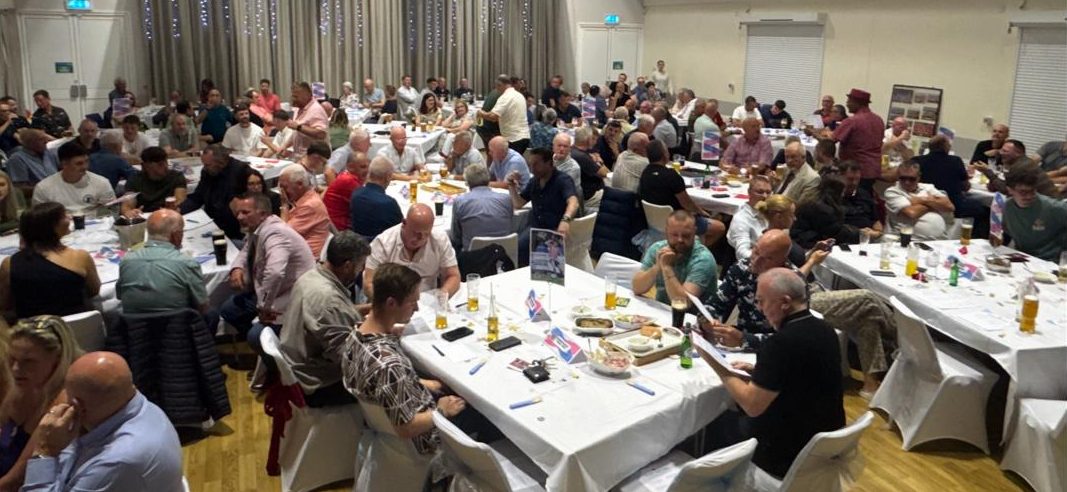
Simon Brace and Stuart McLaren from the club said: “New Hedges Saundersfoot United Football Club is a local amateur junior and senior football club serving the Saundersfoot community.
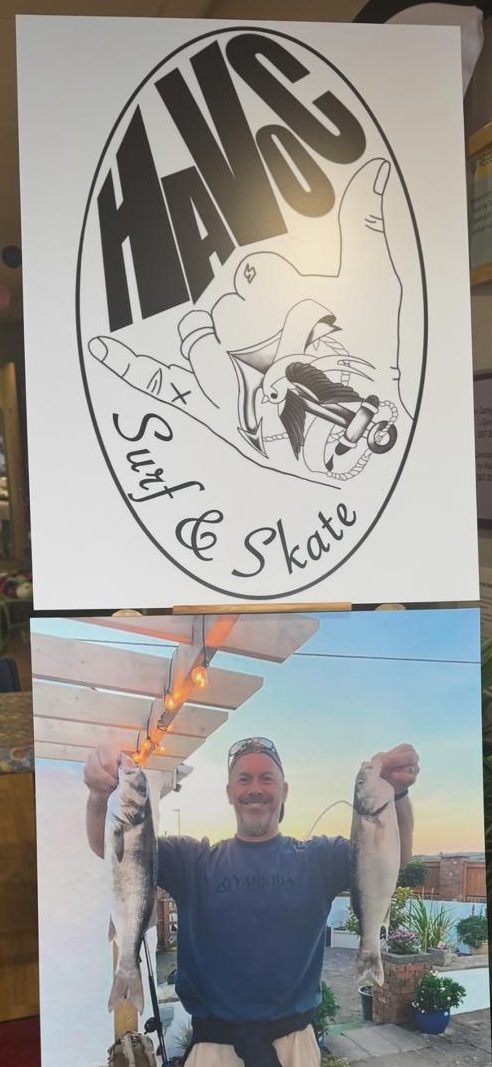
“This year’s event was organised in memory of Gareth Allen, a much-loved former player of the club who sadly passed away in 2023. We wanted to honour Gareth and show our appreciation for the care he received by donating the proceeds to Ward 10 at Withybush Hospital.”

Katie Hancock, Fundraising Officer for Hywel Dda Health Charities, thanked the club for its support.
She said: “Thank you so much to Simon, Stuart and everyone at New Hedges Saundersfoot Football Club for selecting Ward 10 as one of the beneficiaries of your charity night.
“Your generosity is a lovely tribute to Gareth, and the donation is truly appreciated by the team on Ward 10. We are so grateful for your amazing support.
“The support of our local communities enables us to provide services over and above what the NHS can provide across the three counties of Hywel Dda, and we are extremely grateful for every donation we receive.”

For more information about the charity or how to support local NHS patients and staff, visit www.hywelddahealthcharities.org.uk.


VISITORS and harbour users in Tenby are being asked to take care while dredging work is carried out at the harbour entrance next week.
Sand will be removed from the mouth of Tenby Harbour and deposited at the northern end of North Beach. The work is not expected to affect vessel movements in the harbour.
Operations will begin on Monday (Mar 16) and are scheduled to continue until Wednesday (Mar 18).
Tenby Harbourmaster Chris Salisbury confirmed that the necessary licence for the dredging work is in place.
He said: “We ask that members of the public keep clear of the operating area while the machinery is in use and that dogs are kept on a lead during this time.”
Cllr Rhys Sinnett, Cabinet Member for Residents’ Services at Pembrokeshire County Council, said the work was essential to keep the harbour functioning properly.
“I’m grateful to our officers for carrying out this work at Tenby Harbour,” he said. “The dredging is essential for the continued operation of the harbour.
“The timing has been dictated by the tides, and these dates represented the final opportunity to complete the work before boats are returned to the water.”

THE UK GOVERNMENT has urged its international partners to maintain pressure on Russia after the United States eased sanctions on some shipments of Russian oil already moving through global markets.
Downing Street said Britain would not follow the US move and insisted sanctions remain a key tool in limiting Moscow’s ability to fund its war in Ukraine.
The US Treasury confirmed that certain cargoes of Russian oil already in transit would be allowed to continue to their destinations. Officials described the step as a “targeted, short-term measure” designed to help stabilise global energy markets during rising geopolitical tensions.
The announcement comes as oil prices surge amid escalating conflict in the Middle East. Iran has threatened further disruption to shipping through the Strait of Hormuz — one of the world’s most important oil transport routes — following ongoing US-Israeli strikes in the region.
Attacks on energy infrastructure in Gulf states have also contributed to uncertainty in global supply.
A spokesman for Prime Minister Sir Keir Starmer said the UK’s position remains firm.
“All partners should maintain pressure on Russia and its war chest,” the spokesman said.
“Our support for Ukraine is degrading Russia’s ability to wage war, both militarily and financially.”
Energy Minister Michael Shanks also stressed that sanctions remain critical to weakening Russia’s ability to sustain the conflict.
“This is an absolutely critical moment in the Russian aggression against Ukraine and sanctions are important,” he said.
“What we cannot have is Putin sitting in the Kremlin thinking this is an opportunity to invest more in the war machine.”
European leaders have also expressed concern about any relaxation of sanctions. German Chancellor Friedrich Merz said easing restrictions now would be “wrong”, while French President Emmanuel Macron warned tensions in the Middle East should not become a reason to soften measures against Russia.

Ukraine’s president Volodymyr Zelensky previously warned that easing sanctions would be a “serious blow” to Ukraine and could allow Russia to strengthen its military capabilities.
Milford Haven connection
The issue carries particular significance in Pembrokeshire because of the role the Port of Milford Haven plays in the UK’s energy infrastructure.
In the early days following Russia’s invasion of Ukraine in 2022, vessels carrying Russian fuel became the focus of controversy across Europe.
One tanker transporting Russian diesel that had been expected to unload in Milford Haven was later diverted to Antwerp amid political pressure and uncertainty over sanctions.
Another vessel carrying Russian crude did berth in the Milford Haven Waterway and unload at the Valero refinery terminal before the UK introduced a full ban on Russian oil imports later that year.
Across the UK, some energy workers refused to handle Russian cargoes during the early stages of the conflict, forcing certain tankers to divert to other European ports.
Large oil tankers arriving in Milford Haven berth at deep-water terminals and refinery jetties along the waterway rather than traditional docks, allowing the port to handle some of the largest vessels operating in European waters.
The waterway remains one of the UK’s most important energy hubs, handling crude oil, refined fuel products and liquefied natural gas imports.
Impact on fuel prices
The rising price of oil is already feeding through to motorists and households, with petrol prices climbing and heating oil costs increasing in recent weeks.
Energy Secretary Ed Miliband warned that regulators would intervene if energy companies attempt to exploit the situation by raising prices excessively.
“We will not tolerate rip-offs,” he said, adding that the competition watchdog is ready to act if necessary.
Opposition parties have meanwhile called on the government to cancel a planned increase in fuel duty scheduled for September if the crisis continues.
With tensions rising both in Eastern Europe and the Middle East, ministers say global energy markets could remain volatile for some time — with potential consequences for fuel costs and supply security across the UK.



Business5 hours ago
Work set to begin on £50m hydrogen plant in Milford Haven
A MAJOR new hydrogen production facility worth around £50 million is expected to begin construction in Milford Haven later this...


Education1 day ago
Manorbier school closure approved while insurance claim still unresolved
Council confirms negotiations with insurer ongoing following 2022 fire PEMBROKESHIRE COUNTY COUNCIL has confirmed that negotiations with its insurer over...


Crime2 days ago
‘Knife attack’ at Spittal property leaves man in hospital
POLICE have arrested a woman following what is being described as a ‘knife attack’ at a property in Spittal on...


Community2 days ago
Pembrokeshire to receive its first banking hub in Pembroke Dock
LINK, the UK’s Cash Access and ATM network, has today announced local people and businesses in Pembroke Dock will benefit from a new banking...


Health3 days ago
Future of Withybush Hospital petition sparks urgent call for Senedd debate
CALLS have been made for an urgent debate in the Senedd over the future of services at Withybush Hospital as...


Sport4 days ago
Sean Bowen set for historic Welsh clash at Cheltenham Gold Cup
PEMBROKESHIRE jockey Sean Bowen could be part of a historic all-Welsh showdown when he lines up in the Cheltenham Gold...


Community4 days ago
Tenby still waiting as Wales hits 50 rural mobile mast upgrades
Seaside town plagued by signal congestion again absent from latest government-backed coverage improvements A NEW milestone in the UK Government’s...


Crime5 days ago
Man raped 15-year-old girl in caravan while she was on family holiday in west Wales
Jury convicts Pendine man after court hears he raped intoxicated teenager in caravan during family holiday A MAN who raped...


Community5 days ago
Crash sparks fresh questions over future of former Haverfordwest library
CONCERNS have been raised about the future of a distinctive Haverfordwest building after a car crashed into it last week,...


Community6 days ago
Councillors vote to close Ysgol Clydau despite community concerns
Petition and protests fail to prevent closure of small rural school near Tegryn PEMBROKESHIRE COUNTY COUNCIL has voted to close...
-

 Local Government2 days ago
Register now to vote in May’s Senedd election
-

 Health5 days ago
Women’s health services ‘expanding’ across mid and west Wales says Health Board
-

 Health4 hours ago
Welsh Ambulance Service to host bi-monthly Board meeting
-
Community6 days ago
Councillors vote to close Ysgol Clydau despite community concerns
-

 Comment6 days ago
Manorbier deserved honesty — not false hope
-

 Crime4 days ago
Former Pembrokeshire Army officer stripped of MBE after fraud conviction
-

 Cymraeg5 days ago
Commissioner’s five-year report highlights key opportunities to strengthen Welsh language
-

 Community6 days ago
Farm matriarch who built family poultry business dies aged 90