


Education
Plagiarism at Universities rises

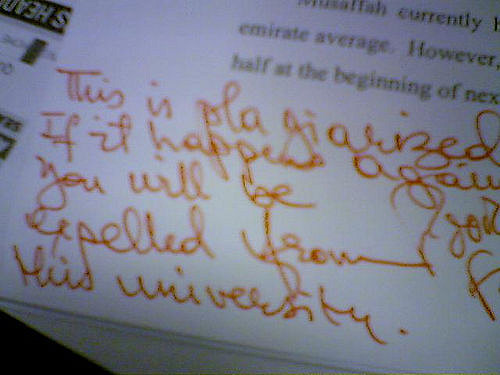
THE FIRST weeks at University can be hectic.
There is finding friends, finding a decent takeaway, exploring the world in a number of ways that parents don’t like to acknowledge exist.
IGNORANCE NO EXCUSE
There are also, at most universities, a short bedding-in period when students are given an idea of the academic standards they are supposed to attain.
And one message is hammered home early and hammered home often: plagiarism can seriously mess up your academic future. If you are caught, you face a range of punishments which can include having to re-sit a course module up to expulsion from the University.

Even if you help someone cheat – because that is what plagiarism is, cheating – you can be penalised. The student who helps a friend cheat by letting them copy their submitted work is as guilty as the friend they try to ‘help’.
It’s not as if it’s a great mystery to students that the penalties for cheating are serious. That is spelled out by lecturers, and contained in every single course manual and the student code of conduct.
THE PRESSURE TO PERFORM
The pressure on students to perform can be tough. The increase in the numbers of students attending university has debased the value of a degree to the extent that some overseas universities no longer recognise UK universities’ award of one year Master’s degree, let alone regard undergraduate degrees as the hallmark of academic achievement. That applies to universities across the UK.

Most professions will specify that a 2:1 or better is required at undergraduate level for admission to postgraduate study. Graduate traineeships often specify the same requirement as a minimum.
Teaching, for example, is so desperately keen to recruit the best undergraduates and postgraduates that it offers incentives for those with better honours degrees in select subjects. The determination to shed the ‘those who can’t, teach’ label has created a marketplace in which a first class honours degree in a priority subject – physics, maths, chemistry, Welsh – can access £20K of funding for postgraduate qualification as a teacher. A 2:2 degree in any other subject gets you nothing in additional support.
CHEATING NOT NEW

A minority of students have always cheated, but the use of the internet has created an environment in which cheating has become easier. As higher education has become more accessible so has easy access to any number of shortcuts and back-alley ways to bumping up marks.
Looking at some standalone work-related training modules delivered by private companies, there is solid evidence that not only are the lecturers under-qualified to deliver the course material but that they turn a blind-eye to a culture of cut and paste.
The Herald is aware of one course tutor who actively encouraged one person attending such a course to simply resubmit their undergraduate coursework to gain the qualification they were seeking via the provider employing the tutor.
Self-plagiarism is still plagiarism and it is still cheating. More importantly, the training provider – or rather, the course tutor – was, of course, swindling the employer funding the training.
Does it matter?
Of course it does. In a working world in which employers look at qualifications first, how is the employer meant to distinguish between a qualification gained through GENUINE effort, work, and ability and one gained by a cheating recourse to Control-C followed by Control-V?
Those who get away with it are often smug, but they also liars and – ultimately – frauds.
BUYING FAILURE
Essay mills, the last resort of the truly idle cheat, claim to be able to deliver a guaranteed grade in any subject on any topic – for a price.
Essay mills represent cheating on a commercial and contractual scale. An essay mill is a business that allows customers to commission an original piece of writing on a particular topic so that they may commit academic fraud. Students commission others to write their coursework for them through an essay mill in the hope they will attain the grade required.
The Quality Assurance Agency for Higher Education said in 2016: “Providers of these services claim that the essays they produce are ‘100 per cent plagiarism free’, but that is a misleading claim. While the essay may not contain any plagiarised text itself, it becomes an act of plagiarism and academic dishonesty once the student submits it for assessment and represents it as his or her own work.
“If students submit work that is not their own, this compromises the fairness of the assessment process and poses a threat to the reputation of UK higher education. There are potentially serious ramifications for the public if people who falsely claim to be competent as a result of an academic award enter a profession and practise.”
In February this year, the UK Government began a consultation with QAA, universities, and the NUS. At that point, the UK Government suggested it was reluctant to go down the legislative route to try and tackle the problem, but in other countries both the provider AND the student would be guilty of a criminal offence.
Such is the scale of the issue across the UK, and not solely in Wales, that QAA has recommended that the advertising of ‘contract cheating’ services be banned and that criminal penalties be put in place for cheating by the use of essay mills. In New Zealand, essay mills have been fined and had their assets frozen.
PLAGIARISM IN WELSH UNIS
The issue has been thrown into sharp relief by a Freedom of Information Act request made by BBC Radio Wales.
Figures obtained by the broadcaster showed an increase in cases of alleged plagiarism from 1,370 2013/14 to 2,044 in 2015/16.
The BBC Freedom of Information request disclosed the following over the three academic years 2013/14 to 2015/16
- University of South Wales (approximately 30,000 students): 1,144 students accused of cheating, two prohibited from sitting future exams
- Cardiff Metropolitan University: 565 students accused of cheating, 12 prohibited from sitting future exams
- University of Wales Trinity Saint David – UWTSD: 928 students accused of cheating, 47 prohibited from sitting future exams
- Bangor University: 36 students accused of cheating, four prohibited from sitting future exams
- Cardiff University: 713 students accused of cheating, three prohibited from sitting future exams
- Swansea University: 1,157 students accused of cheating, 25 prohibited from sitting future exams
- Wrexham Glyndwr University: 103 students accused of cheating, three prohibited from sitting future exams
- Aberystwyth University: 551 students accused of cheating, 0 prohibited from sitting future exams
- The increased detection of plagiarism suggests that universities are becoming more adept at identifying incidents of academic fraud.
Many Universities use software to detect plagiarism, for example Turn-it-in. The software uses a document comparison algorithm that checks papers against a massive database of stored academic papers to identify cheats.
We asked UWTSD to comment on the figures.


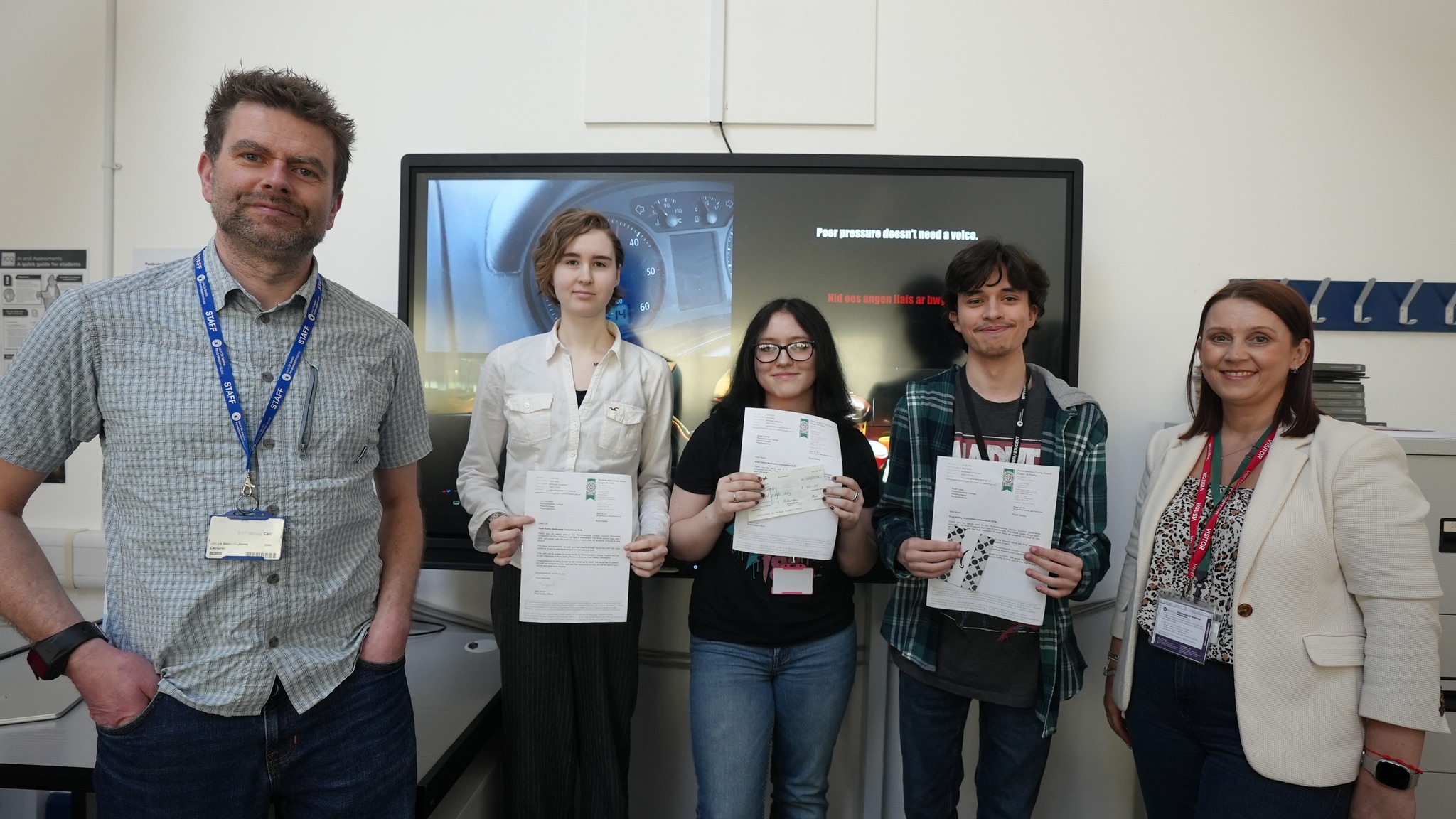
Creative Media learners recognised after producing hard-hitting videos to warn young drivers about the dangers of peer pressure
PEMBROKESHIRE COLLEGE has praised its Creative Media learners after students produced a series of powerful short films as part of an annual road safety competition run in partnership with Pembrokeshire County Council.
The project challenged learners to create short social media videos highlighting one of the main causes of serious road traffic collisions, with this year’s theme focusing on the dangers of peer pressure. The films were designed to help raise awareness of road safety issues among young people across the county.
Aliyah was named overall winner for her video, Peer Pressure Doesn’t Need a Voice, and received a £100 prize.
Noah was recognised as a runner-up for his film, Don’t Treat the Road Like a Toy, while Lily was also commended for her entry, Don’t Give in to Peer Pressure.
The college said the competition gave learners the chance to respond to a real-world brief while producing work with an important public safety message.
Lecturer Denys Bassett-Jones praised the standard of the entries and said the issue of peer pressure was a major factor in young people’s lives, making it an important theme to highlight to new drivers and their passengers.
Sally Jones, Road Safety Officer at Pembrokeshire County Council, also praised the students’ work and said the group had produced interesting and dynamic videos while rising well to the brief.
The college said projects like this continue to give learners valuable practical experience while supporting wider efforts to reduce serious collisions on local roads.

THE SYSTEM supporting children and young people with Additional Learning Needs in Wales is facing serious pressures that could threaten its long-term sustainability, according to a new report from Audit Wales.
Published on Tuesday (Apr 7), the report examines support for children and young people with Additional Learning Needs, or ALN, in the context of changes introduced under the Additional Learning Needs and Education Tribunal (Wales) Act 2018.
Audit Wales said public bodies do not have a full understanding of demand, workforce capacity, skills, costs or outcomes, leaving them without the information needed for effective planning, budgeting and value-for-money assessments.
The report raises concerns about whether the current system is performing well enough to help learners achieve their full potential.
In 2024-25, 48,257 learners aged from nought to 25 were recorded as having ALN or Special Educational Needs. However, Audit Wales said that figure is incomplete and does not capture the full picture across all settings.

Available data shows the number of school learners recorded as having ALN or SEN fell by 58 per cent between 2018-19 and 2024-25, although the reasons for that drop are disputed. Over the same period, the number of school learners receiving statutory support through a statement of SEN, or now an Individual Development Plan, increased by 164 per cent.
The report says spending on supporting learners with ALN has also risen significantly, adding pressure to already stretched public budgets. While Audit Wales said it could not put an exact figure on total spending, identifiable annual costs are approaching £1 billion, with the true figure likely to be higher.
Councils’ budgeted expenditure on ALN or SEN rose by 34 per cent in real terms between 2018-19 and 2025-26.
Audit Wales said its conclusions were based on evidence showing that the system lacks good enough data to understand growing demand and complexity, while patchy workforce information makes it harder to assess staffing capacity and skills gaps. It also found that public bodies do not have a strong enough understanding of costs, raising concerns about financial sustainability.

The report adds that although the goals of the ALN system are clear, there is only limited evidence on whether it is delivering strong outcomes for learners, and that the system remains adversarial despite some signs of improvement.
Its recommendations are aimed mainly at the Welsh Government, particularly in its national leadership role, although Audit Wales said successful implementation would require action from a wide range of public bodies.
Auditor General Adrian Crompton said: “Children and young people with Additional Learning Needs include some of the most vulnerable people in society.

“There has been a significant amount of work involved in efforts to reform the system for the better over recent years. However, the system remains under strain and there is still a lot more that can be done to ensure it does as well as it can for our children and young people, both now and for future generations.”
The 2018 Act introduced a new system designed to create a more integrated, collaborative and person-centred approach to supporting learners with ALN. It extended statutory provision to learners aged nought to 25 and replaced the previous separate systems for under-16s with SEN and post-16 learners with learning difficulties or disabilities.
A major part of the reform was the introduction of Individual Development Plans, which replaced both non-statutory SEN support and statutory statements of SEN. Under the new system, every learner with ALN is entitled to an IDP.
Audit Wales stressed that the figure of 48,257 learners does not include all settings for learners aged nought to 25, including further education, meaning the overall scale of need may be higher than official data suggests.
For more information, contact Rhian Jones at Audit Wales on 02920 320 575 or by email at [email protected]
.

A RECORD number of young musicians from across Pembrokeshire took part in this year’s Valero Primary Music Festival, with nearly 600 pupils showcasing their talents.
The event, organised by Pembrokeshire Music Service, was held at Ysgol Caer Elen on Saturday (March 14), drawing a large and enthusiastic audience.
The festival’s overall winner was Hafan y Môr pupil Carys Meiring, who impressed judges with a standout trombone performance of Let’s Call the Whole Thing Off. She had earlier secured victory in the open brass class.

Young talent shines
The afternoon Spotlight concert opened with an energetic performance from the county’s Second Steps ensembles, bringing together young players from across Pembrokeshire.
Winners from the day’s open classes also took to the stage, highlighting the depth of musical talent across local schools.
Osian Kite, of Roch CP School, won the open woodwind class with a performance of Sentimental Serenade on alto saxophone.
Cadi Marshall-Jones, from Ysgol Bro Preseli, claimed the open piano and harp title with Over the Sea to Skye, while Roch CP School cellist Mari Broomfield won the open strings category with Vamoose.
In percussion, Ysgol Caer Elen’s Aled Hooper secured first place in the open class with a drum kit performance of Are You Gonna Go My Way.
The open ensemble prize went to Tavernspite pupils Finn Hickman and Evelyn James, whose piano duet of Handel’s Passacaglia impressed both judges and audience.
Building confidence through music
Head of Pembrokeshire Music Service, Philippa Roberts said the festival continues to play a vital role in developing young performers.
She said: “Pembrokeshire Music Service is proud to deliver the Valero Music Festival, offering an exciting opportunity to nearly 600 young performers from across the county.
“Providing children with the chance to perform, shine, and receive supportive feedback from professional musicians is incredibly powerful and helps build lasting confidence.

“In line with the Music Plan for Wales, we remain committed to creating meaningful musical experiences for children throughout Pembrokeshire. Our sincere thanks go to Valero for their fantastic support.”
The festival forms part of a wider effort to promote music education across Wales, encouraging participation and nurturing the next generation of performers.
Photo caption:
Talented performers: Overall winner Carys Meiring is pictured with fellow category winners and organisers (Pic: Pembrokeshire Music Service).



News6 hours ago
Reform attacks Plaid on spending and immigration ahead of Senedd poll
Party claims Plaid’s plans would strain public finances and increase pressure on services, while rivals insist Wales needs a different...


News7 hours ago
Emergency response after person enters water at Milford Haven marina
Casualty recovered as police, coastguard and lifeboat crews attend A MAJOR emergency response was launched at Milford Marina in Milford...


News1 day ago
Senedd election candidates confirmed as vote.wales goes live
Voters can now check who is standing in their constituency ahead of polling day on May 7 A TOTAL of...


Crime2 days ago
Police and partners launch summer crackdown after Tenby station stabbings
Extra patrols, more rail security and tougher action promised after violent disorder left four youths injured POLICE and partner agencies...


Crime2 days ago
Drug and weapon charges after Pembroke Dock arrest
Man remanded in custody following Diamond Street vehicle search A MAN has been remanded in custody after appearing at Swansea...


Crime2 days ago
Woman fights order taking four dogs from her
Swansea Crown Court hears appeal after long-running barking dispute in Trefin A PEMBROKESHIRE woman has told Swansea Crown Court that...


News2 days ago
Former county councillor Paul Dowson to stand in Ceredigion Penfro
Ex-Pembrokeshire member says he will offer voters a straight-talking independent alternative at the Senedd election FORMER Pembrokeshire county councillor Paul...


News3 days ago
Plaid Cymru sets out childcare, NHS and child poverty pledges in 2026 manifesto
Rhun ap Iorwerth’s party says plan is radical and fully costed as it bids to lead next Welsh government PLAID...


Community3 days ago
Police intervene after post raises fears of planned Pembroke Dock fight
Extra patrols launched after social media alert in aftermath of Tenby stabbings POLICE intervened after an online warning raised fears...

Crime3 days ago
Man arrested after alleged child sexual assault in Haverfordwest
Police enquiries ongoing after incident in Castle Square A MAN has been arrested after an alleged sexual assault of a...
-

 Crime5 days ago
Four youths stabbed at Tenby railway station as two arrested
-

 Local Government5 days ago
Bridge works on Neyland-Burton road to continue into late April
-

 News5 days ago
Haverfordwest County AFC faces High Court winding-up threat from HMRC
-

 Entertainment4 days ago
Little Pigs at Home offers a peaceful sanctuary escape in Pembrokeshire
-

 Politics7 days ago
Pembrokeshire National Trust car park schemes approved
-

 Charity6 days ago
Angle RNLI answers string of call-outs across the Milford Haven Waterway
-
 Community6 days ago
Cosheston gypsy traveller 60 foot shed plans refused
-

 Crime4 days ago
Henry Tufnell responds after four youths stabbed in Tenby