


Community
Helicopter chief raises nearly £4,000 for charity

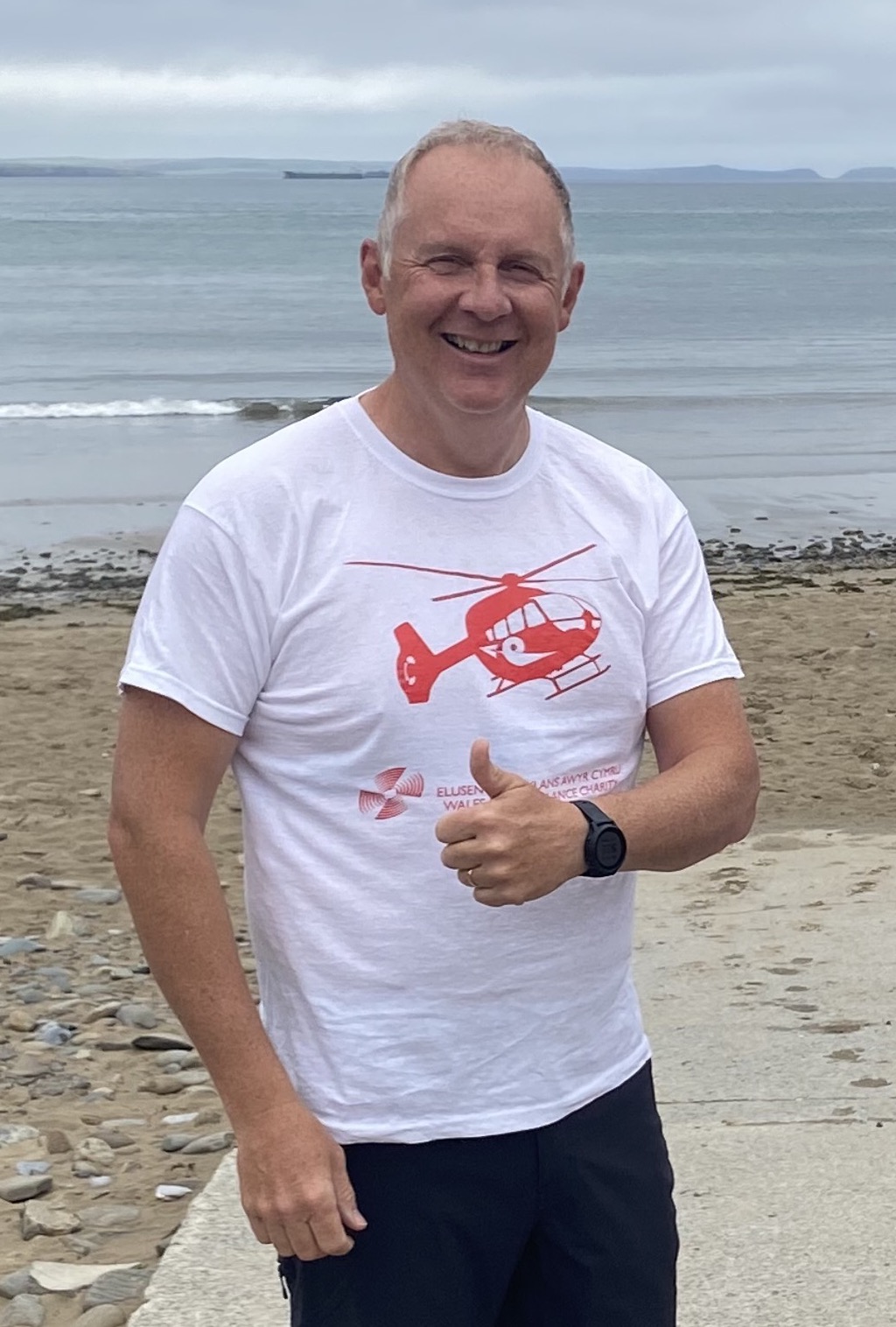
A PEMBROKESHIRE aviation boss has raised nearly £4,000 for two charities by walking an epic 186 miles along the coastal path.
Steven Landrey whose life was saved by the Wales Air Ambulance set off from Amroth in May and finished the Pembrokeshire Coastal Path Charity Walk at St Dogmaels in August.
Steven, 52, raised £3,900 for the Wales Air Ambulance and the British Heart Foundation.
Steve, who worked as European managing director for air ambulance operator, Babcock, collapsed while out cycling with friends. He suffered a cardiac arrest and stopped breathing.
Thankfully the Wales Air Ambulance was able to respond swiftly to the scene and gave Steve the lifesaving care he needed.

Ironically, Babcock holds the contract to run the Wales Air Ambulance’s aviation operation.
The challenge, which took place just nine months after his cardiac arrest, saw Steve covering 314km on foot in 76.5 hours, climbing over 8,400 metres in the process – just a few hundred metres shy of the summit of Mount Everest.
Steve started his epic challenge with his cardiac rehabilitation instructor David Braithwaite, who carried a defibrator ‘just in case’ throughout the 186 miles.
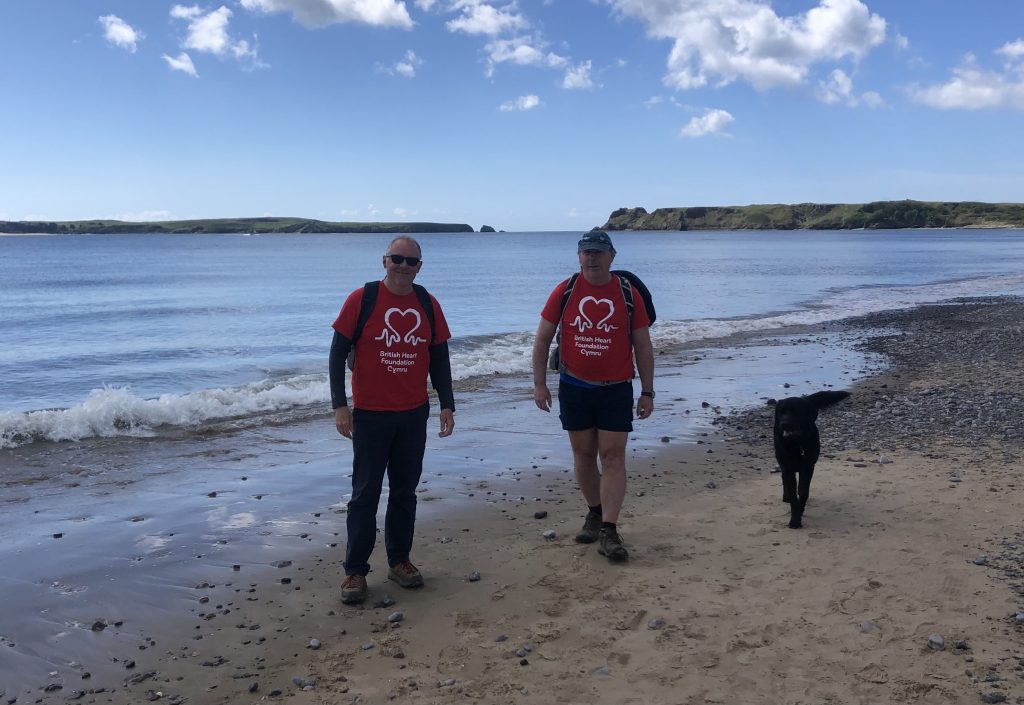
A delighted Steve said: “What an experience! There was some amazing scenery, wildlife that put a smile on your face, rain that only Wales can deliver, and sunrises that remind you how small you really are on this planet we call home.

“After ‘competing’ all my life – whether in a sporting sense, a career sense, or indeed with myself, this walk has started to educate me to focus on ‘enjoying’ rather than pushing to best I can be all the time. It’s only taken me 52 years to get to this epiphany!”
Dedicated Steve walked twice a week to get the miles in and was joined by his wife Katrina and their two dogs, Jumble and Nigel. Many family and friends showed their support to Steve by joining him on his walks throughout his fundraiser.
Steve is extremely grateful to everyone who has supported him since he became ill and during his challenge.

He added: “Most important of all, are the people that supported me on this adventure. My wife who, not just over the course this walk, but over the past 12 months, has constantly been there when I needed her most, when I’ve been at my most vulnerable and when at times I’ve lost perspective. I love you.
“David Braithwaite, who planned and guided the walk. Who helped me to be in good enough cardiac condition to do the walk and who carried a defibrillator the whole 314km’s “just in case”. Thank you.”
Steve would also like to thank everyone who has not only walked with him but has supported and encouraged him throughout. He was grateful for the company on his walks that ‘made the whole endeavour so much more enjoyable’.
Steve said: “I’m delighted by the amount of money we’ve raised, now nearing £4000. I’ve sure Wales Air Ambulance and British Heart Foundation will put the money to good use as they continue to support the health and wellbeing of our communities. Of course, none of this would have been possible without those that have supported and donated towards this charity walk, thank you so much.”
Babcock Director Hayley Belmore said: “We know what we do is important, and we are extremely proud to be part of the incredible service the Wales Air Ambulance Charity provides, but when you respond to someone you know, it really amplifies it. Everyone at Babcock is so pleased Steve has made such a good recovery and we congratulate him on his epic fundraiser!”
Wales Air Ambulance Chief Executive, Dr Sue Barnes, said: “Congratulations to Steve who raised an incredible £3,900 for two charities close to his heart. It is incredible that he set himself the challenge of walking 186 miles less than a year after his life was saved by our medics. His dedication following his experience is an absolute inspiration and it’s a great relief to hear that Steve is recovering well after his illness.
“Our Charity has worked in partnership with Babcock for many years and Steve was on the receiving end of a service that he has proactively been involved in. On behalf of our Charity, I’d like to offer my heartfelt thanks to Steve and his supporters, who have supported him throughout his recovery and fundraiser. Every contribution helps to keep our helicopters in the air so that we can continue to provide a lifesaving service for the people of Wales.”
In December 2020, the Charity achieved its aim of operating a 24/7 service. Wales now has access to the service’s Emergency Department-standard critical care around the clock and to keep the helicopters in the air, the Charity needs to raise £8 million every year.
There are several ways that the public can continue to support the Wales Air Ambulance.
These include online donations, signing up to the Charity’s Lifesaving Lottery or by coming up with their own innovative ways to fundraise at home. Further information can be found via www.walesairambulance.com.
Alternatively, a £5 text-message donation can be made by texting the word HELI to 70711.


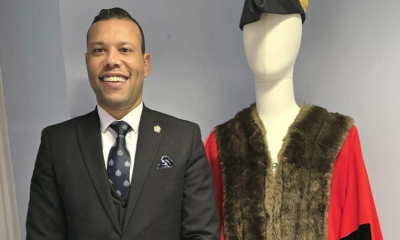








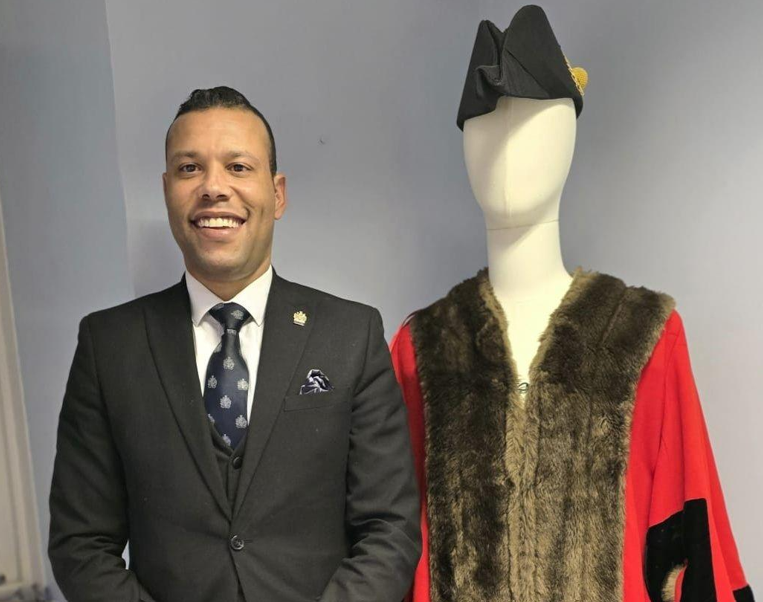
A PEMBROKESHIRE town council will soon have its first-ever person of colour as mayor, and its youngest mayor in a century.
Haverfordwest Town Councillor Randell Iziah Thomas-Turner, aged 37, is to become mayor this May.
Cllr Turner said: “Tonight [March 19], I had the honour of accepting the nomination as mayor-elect — a moment that will forever stay with me.
“In doing so, I am humbled to be making history as the first mayor of colour in Haverfordwest and the youngest mayor in a century. This is not just my achievement, it belongs to every person who believes in progress, representation, and the power of community. This is a new chapter for our town — one built on unity, opportunity, and hope.
“My mayor-making will take place this May, and I cannot wait to officially step into the role and begin serving the people of Haverfordwest with pride, passion, and purpose. Haverfordwest is the best in the West — and together, we are just getting started.

“Diversity is not a challenge to overcome, but a strength to embrace. When people from different backgrounds, experiences, and perspectives come together with respect and openness, we unlock new ideas, stronger solutions, and deeper understanding.”
It’s a double celebration for the Thomas-Turner family.
Wife, and fellow town councillor, Dani, has been voted as sheriff of the town for the second-year-running, the first woman to serve as sheriff for two consecutive years.
“The coming civic year will be one to watch as my husband Councillor Randell Izaiah Thomas-Turner is becoming the first mayor of colour in Haverfordwest’s history,” said Cllr Dani Thomas-Turner, adding: “It’s going to be a year of history and memory making for sure.”



SAMUEL Kurtz MS has welcomed more than £4.3 million in National Lottery funding awarded to community projects across Carmarthen West and South Pembrokeshire since 2021.
Figures released by The National Lottery Community Fund show that £4,318,484 has been distributed through 122 grants in the constituency since the 2021/22 financial year, the same year Mr Kurtz was elected.
The funding has supported a wide range of grassroots charities, voluntary organisations and community groups through programmes including National Lottery Awards for All, offering grants of up to £20,000, and People and Places, which provides larger awards of up to £500,000.
Projects backed locally include mental health support for young people, environmental and sustainability initiatives, community workshops, outdoor wellbeing activities, support for vulnerable adults, and programmes aimed at building skills and confidence.
Among the organisations to benefit is Pembrokeshire Coast National Park Authority, which received £343,584 for its Routes to Discovery project, helping improve mental and physical wellbeing through accessible outdoor activities.
St Davids Diocesan Council for Social Responsibility was awarded £398,078 to deliver its Plant Dewi: Strengthening our Communities initiative, supporting families and local groups.
Other recipients include The VC Gallery, Redberth Croft CIC, The Tenby Project CIC and Neptune’s Army of Rubbish Cleaners, with funding supporting projects ranging from food initiatives and nature-based wellbeing to volunteering and environmental action.
Mr Kurtz said: “Community groups and charities across Carmarthen West and South Pembrokeshire do incredible work supporting people and strengthening local communities.
“It is fantastic to see more than £4.3 million of National Lottery funding invested in projects that are improving wellbeing, tackling isolation and creating opportunities for people of all ages during my time in office.
“The voluntary sector plays a vital role in our area, and this funding is helping organisations deliver projects that bring people together and make a real difference to people’s lives.”
The National Lottery Community Fund is the largest funder of community activity in Wales, supporting initiatives that bring communities together, promote environmental sustainability, help children and young people thrive, and improve health and wellbeing.
Organisations across Wales can apply for funding through the Awards for All and People and Places programmes to support projects that matter most to their communities.

Further information is available on The National Lottery Community Fund website.
Tributes pour in for former Neyland officer remembered as a “true gentleman” and “local legend”
A FORMER Neyland police officer remembered as a “true gentleman” and “local legend” has died at the age of 83, prompting an outpouring of tributes from across Pembrokeshire.
Louis Knight, of Neyland Hill, Neyland, passed away peacefully at Withybush Hospital, Haverfordwest on Thursday (Mar 5).
Mr Knight, who served as a police officer in the area for many years, was a familiar and respected figure in Neyland and beyond. In the hours following the announcement of his death, hundreds of messages flooded social media, painting a picture of a man whose impact stretched far beyond his time in uniform.
Many described him simply as “one of the best,” while others called him “a proper local legend” and “a tremendous police officer.”
One resident wrote: “A face and name I will never forget from my youth.”
Another said: “He was a tremendous police officer… a kick up the backside and a word was enough. It stayed with you.”
Others remembered his warmth and humour away from policing.
“He always had a story to tell on the way home in the taxi,” one tribute read, while another added: “Every time you asked him how he was, the answer was always ‘bloody marvellous.’”
Many spoke of his kindness and the time he gave to people.

“Louis was one of the most kindest gentlemen around. Always made time to chat,” one message said.
Another added: “Neyland won’t be the same again.”
While some reflected fondly on a different era of policing, what came through most strongly was the respect Mr Knight earned within his community — something repeatedly highlighted in tributes from those who knew him as children, neighbours, and later as adults.
Mr Knight was the beloved husband of the late Angela, devoted father of Andrew and Alison, and adored father-in-law of Frank. He was also a loving grandfather to Michelle and Laura, and a cherished brother of Jennifer, Charles and Richard.
His family said he was loved dearly and will be greatly missed by all who knew him.
The funeral service will take place on Wednesday (Apr 1) at 11:30am at Parc Gwyn Crematorium, Narberth.
Family flowers only. Donations in memory of Louis, if desired, are for Ward 8 at Withybush Hospital and may be sent directly to the ward at SA61 2PZ.
All enquiries to Tom Newing & Sons Ltd, Funeral Directors, Dartmouth Street, Milford Haven (01646 693180).
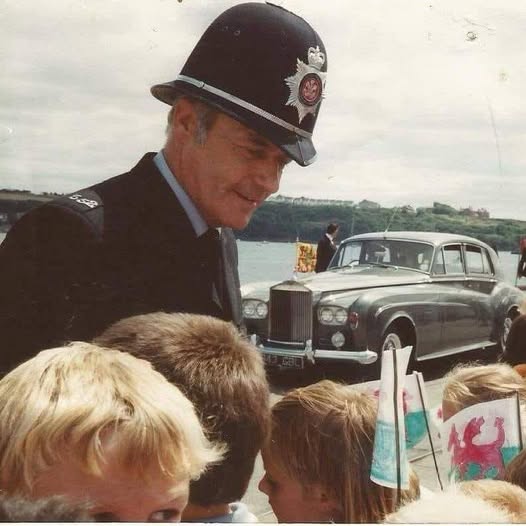
Photo caption:
PC Louis Knight pictured during a Royal Visit, engaging with local children — a familiar sight in Neyland for many years (Pic: Supplied).



Crime17 hours ago
Publican jailed for six years for supplying cocaine and cannabis
Milford Haven man sentenced at Swansea Crown Court following drug dealing operation A MILFORD HAVEN publican has been jailed for...


Local Government19 hours ago
Poverty summit highlights support efforts across Pembrokeshire
A SUMMIT bringing together key organisations from across Pembrokeshire has highlighted both the scale of local poverty and the work...


Education2 days ago
Milford Haven school plans unveiled but funding not yet secured
PLANS for a new £100 million school in Milford Haven have been unveiled, but the project has not yet secured...


News2 days ago
Council unveils plans for new state-of-the-art secondary school in Milford Haven
PEMBROKESHIRE COUNTY COUNCIL has revealed plans for a new state-of-the-art school in Milford Haven, promising modern, inspiring learning spaces for...


Health2 days ago
NHS waiting list falls — but cancer delays and diagnostic backlog worsen
Record progress claimed by Welsh Government as critics warn key targets are still being missed THE NHS in Wales has...


Crime3 days ago
Rapist jailed after ‘abhorrent’ attacks on woman and children
Haverfordwest man told police “women won’t have sex without force” A HAVERFORDWEST man who raped a woman and a young...


News3 days ago
Reform secures first Pembrokeshire councillor in Hakin by-election win
Late Reform candidate takes seat as independent surge and Labour withdrawal shape contest REFORM UK candidate Scott Thorley has won...

News3 days ago
Scott Thorley elected as Pembrokeshire’s first Reform councillor
REFORM UK candidate Scott Thorley has won the Hakin by-election after securing 179 votes. The full result is as follows:...


News4 days ago
Police confirm man has died after being recovered from River Cleddau
Major emergency response in town centre after concerns raised for man in water A MAN has died after being recovered...


Community4 days ago
Davies and Kurtz urge groups to seek employability funding
Community organisations in Pembrokeshire encouraged to apply for new grants supporting skills and job access LOCAL Senedd Members Samuel Kurtz...
-
 News7 days ago
Rayner and Lammy visit Wales to discuss justice and community safety
-
 News6 days ago
Fishguard linked to allegations in Many Tears Animal Rescue investigation
-

 News4 days ago
Emergency services flood Haverfordwest after reports of person in river
-
 Local Government7 days ago
Investigation confirmed after inspectors visit Many Tears Animal Rescue
-

 Crime3 days ago
Mother given community order after admitting child cruelty offence
-

 News3 days ago
Senedd vote to ban greyhound racing hailed as ‘landmark moment’ by charities
-
 Business7 days ago
Oil firm praised for putting customers first during price surge
-
 Community7 days ago
Town hall takeover plan questioned as cost figures conflict