


Crime
Newport duo in custody after back-to-back golf club burglaries


TWO men have pleaded guilty after targeting golf clubs in Haverfordwest and Carmarthen in an overnight burglary-spree.
Mikael Bourkhari, aged 45, and Simon Dickey, aged 38 – both from Newport, South Wales – were charged with two counts of burglary and one count of obstructing police.
At around 12.45am on Sunday 18 January, Dyfed-Powys Police received a call reporting that the intruder alarm had been activated at Haverfordwest Golf Club.
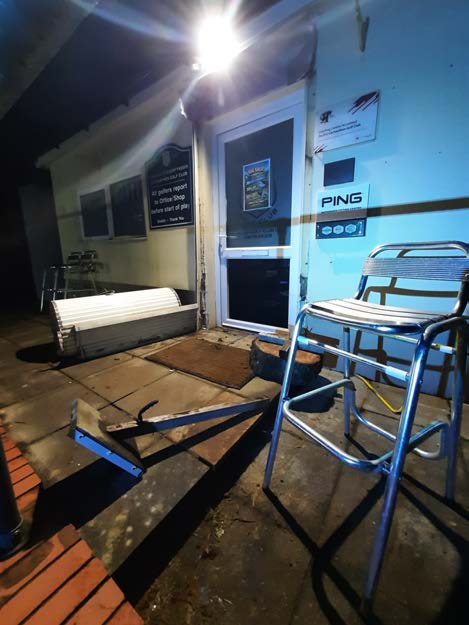
When officers arrived just six minutes later, it was clear that the building had been the target of a deliberate and forcible break-in.
With the alarm still blaring, and a light shining from inside, officers entered the golf club, prepared to catch the intruder red-handed.

Instead, they found that the scene had been abandoned and badly damaged.
Club owners arrived shortly after and noted that several golf clubs worth between £100 and £500 each had been taken from the club shop. It was estimated that the total value of items stolen was around £36,000.
While officers secured evidence at the scene, control room staff at police headquarters gathered intelligence on vehicles in the area that could potentially be linked with the crime.
A red Vauxhall van was identified as part of their enquiries, and a description of the vehicle was shared with officers in both Pembrokeshire and Carmarthenshire.

With officers over the county border alerted to the break-in, local units decided to patrol the golf club in Carmarthen as a precaution. On arrival, it was apparent that the Carmarthen golf club had also been hit.
The front door was extensively damaged, and a yellow crowbar abandoned at the scene. It was estimated that around £7,000 worth of golf clubs had also been stolen from the premises. It was also estimated that around £5,000 worth of damage was caused to the building.
Shortly after 2am, Roads Policing Officers located the suspect vehicle travelling along the A48 towards Pont Abraham, despite fake number plates having been used.


The van was stopped, and a suspiciously large number of golf clubs and bags were found inside. The driver and his passenger – who identified themselves as “Richard Smythe” and “Michael Hale” – were arrested on suspicion of burglary.
Back at custody, the pair confessed to giving fake names and were further arrested on suspicion of obstructing police.
All the stolen items were recovered and returned to the golf clubs.
Mikael Bourkhari and Simon Dickey appeared at Llanelli Magistrates Court the following morning (19 January) and pleaded guilty to both counts of burglary and one count of obstructing police.
The two were remanded into custody until their sentencing on Monday 2 February.
Detective Sergeant Sophie Lambert of Dyfed-Powys Police said: “Crimes like this have a profound impact on the community, particularly those whose livelihoods are built on the success of their business.
“This was a fantastic example of multiple teams across different locations working together to stop these criminals in their tracks.
“The work by the control room staff to quickly identify the suspect vehicle played a crucial role in the swift interception by our Roads Policing Officers. This co-ordinated response undoubtedly prevented further offences from taking place.
“We welcome these guilty pleas and hope that this case sends a clear message that we will take robust action against anyone seeking to break the law in our force area.”


Council confirms ongoing enquiries after Herald investigation into Steven Grant
CONSUMERS who say they lost money after dealings with Computer Solutions Wales may have been left falling between police, banks and Trading Standards, Pembrokeshire County Council has acknowledged.
The admission comes after The Pembrokeshire Herald raised further questions about complaints involving Steven Grant, who has operated under the Computer Solutions Wales name.
The Herald has now been contacted by numerous customers, former workers and relatives of customers who allege payments were made for repairs, equipment or services which were delayed, not completed, or not refunded.
Pembrokeshire County Council has confirmed that Trading Standards complaints relating to Mr Grant and Computer Solutions Wales remain under review, and declined to answer some questions because of what it described as “ongoing investigations”.
A council spokesperson said: “Given ongoing investigations, it would not be appropriate to answer questions 3, 4 and 5.”
Those questions related to the number of complaints recorded, whether the council’s assessment had changed, and whether ongoing enquiries included examination of any wider pattern of complaints.
Council confirms police referral gap
The Herald asked Pembrokeshire County Council whether it had formal information-sharing arrangements with Dyfed-Powys Police in cases involving potential consumer detriment or trading concerns.
The council said it maintained working relationships with police and that information was shared where appropriate, in accordance with legislation, data protection rules and established professional protocols.
However, it added that there was “no single overarching agreement that captures every type of referral”.
The council said: “Where the Police identify potential consumer detriment or trading concerns, these may be referred to the Trading Standards Team for further consideration.”
It also said a significant proportion of complaints were received through the Citizens Advice Consumer Service, which records reports on a national intelligence database and allows Trading Standards to monitor trends, identify repeat offenders and prioritise enforcement activity where necessary.
Consumers ‘falling between agencies’
The Herald also asked whether the council was concerned that some complainants might be falling between agencies — for example where police classify matters as civil, Trading Standards is not automatically notified, and financial institutions may seek police reference numbers or criminal findings before progressing reimbursement claims.

The council said: “The Council recognises the potential for some matters to fall between agency remits, particularly where issues are assessed as civil disputes rather than criminal offences.
“In such cases, the Police may not make a referral to Trading Standards, and consumers may instead be directed towards civil remedies.”
The authority said the Citizens Advice Consumer Service was intended to reduce that risk by providing a central reporting mechanism so concerns relating to consumer detriment could still be captured and assessed by Trading Standards, even where they had not been referred by police.
But the council also acknowledged problems where banks or credit card providers require police evidence before considering refunds.
The spokesperson said: “The Council is aware that challenges can arise where financial institutions require evidence such as a crime reference number before progressing reimbursement claims.
“While Trading Standards does not determine the criteria used by financial institutions, we continue to work with partners to promote clear reporting routes and ensure consumers are signposted appropriately to the most relevant agency.”
Police treated Starlink complaint as civil
The Herald had asked the council about a documented complaint from a customer who said she paid £1,427.95 for a Starlink installation which was not carried out.
Dyfed-Powys Police confirmed separately that it received a report of alleged fraud on October 3, 2025.
A police spokesperson said: “It was alleged that a payment had been made for services that were not subsequently delivered.
“The allegation was investigated by the force and confirmed to be a civil matter, which was communicated to the victim as well as further advice being given with regards to the returning of their funds. No further police action was taken.”
The complainant says she was left in difficulty because her bank would not refund the payment without police action.
Trading Standards said it had not been aware of that specific police complaint and said the complainant should report it through the Citizens Advice consumer helpline so it could be recorded and referred.
Earlier Trading Standards involvement
In an earlier statement to the Herald, Pembrokeshire County Council confirmed that complaints relating to Steven Grant and Computer Solutions Wales were first received by Trading Standards in October 2024.
At that stage, the council said the complaints were assessed as predominantly civil in nature and did not warrant a criminal investigation.
However, Trading Standards officers met Mr Grant to discuss concerns and offered “extensive business advice” verbally and in writing, outlining his statutory duties as a trader and steps he could take to resolve grievances.
The council said advice was also offered to complainants on how devices might be recovered and the avenues available for civil redress.
But the authority added: “Unfortunately, since this early engagement Trading Standards colleagues have been unable to obtain updates from Mr Grant, and attempts to engage in further dialogue have gone unmet.”
The council also confirmed officers were aware of changes to trading address, company status and officers.
The council said it was aware that certain matters remained unresolved and of wider complaints, and would continue to assess whether a criminal investigation might be warranted.
Customers and workers come forward
The Herald’s investigation began after customers contacted the newspaper alleging missing devices, unpaid refunds and payments for goods or services they said were not supplied.
Since publication, further people have come forward.
Among them is a Cardiff-based animator, Rebecca “Bex” Merrell, who says she paid £2,964.55 to Steven Grant trading as Computer Solutions Wales for a replacement computer in December 2024.
Bank records seen by the Herald confirm the payment. Ms Merrell says the computer was never delivered and that promised refunds did not arrive.
Her father, Jay Merrell, has also contacted the newspaper and confirmed the family’s account.
The Herald has also seen evidence from Emma Venables, an NHS worker, who says she paid £589 in October 2024 to repair her son’s water-damaged laptop.
Bank records confirm the payment. Ms Venables says she was later told the laptop was repaired but locked inside premises because of a landlord dispute. She says she later gained access to the premises through a letting agent, but the laptop was not there. She says no refund was received.
Another customer, who asked not to be named, told the Herald she paid £1,750 by credit card for a new Apple Mac and transfer of family photographs from her late husband’s old computer. She says she waited months, was given repeated explanations for delays, and eventually recovered the money through a Section 75 credit card claim.
Her original computer was later returned by a member of staff.
Pensioner’s hard drive
The Herald has also been contacted by Tanya Mardell, who says her 71-year-old father paid £600 in total in an attempt to recover data from a hard drive containing more than 10,000 family photographs.
Mrs Mardell said her father first paid £400 and later paid a further £200 after what she described as “a lot of backwards and forwards”.
She said Mr Grant still had the hard drive and that her father now wanted it returned, whether repaired or not, so he could try another company.
She said the situation had been “incredibly stressful, emotional and financially draining” for her father, who lives on his pension.
Two PCs and court order
Another complainant, Zac Townley, said he handed over two custom-built desktop PCs for repair in March 2025 and later paid £710 after being told the work was complete.
He says the computers were never returned.
Mr Townley took the matter to court. He says a hearing took place in October 2025, which Mr Grant did not attend. The court ruled in his favour and issued an order in November for the return of the two computers and repayment of £377 in court fees.
Mr Townley says the deadline passed and the computers remained unreturned.
Holiday home Wi-Fi dispute
Retired builder David Norman Barrett, who runs holiday accommodation, visited the Herald offices and said he paid Mr Grant £1,000 to install new Wi-Fi equipment at one of his rental properties.
Mr Barrett said the work was not completed and that repeated attempts to arrange follow-up visits were met with explanations that Mr Grant was unwell or dealing with other urgent matters.
“One time he said he had collapsed and was in hospital so couldn’t attend. I did not believe him,” Mr Barrett said.
He said Mr Grant later requested additional payments despite the original amount being paid upfront.
Mr Barrett said he eventually instructed another company to complete the work.
“They were excellent and finished everything properly for £600,” he said.
Mr Barrett’s grandson, Tom, confirmed his account to the newspaper.
A Herald reporter contacted Mr Grant by telephone regarding Mr Barrett’s complaint.
Mr Grant confirmed he had received money from Mr Barrett and said he was aware a second company later completed the work, but disputed the amount involved.
“Mr Barrett had given me money, but not £1,000,” he said.
Mr Grant also alleged that Mr Barrett had taken his tools, which he said was the reason he did not return to complete the job.
Mr Barrett denied that allegation.
Laptop left in pieces
The Herald has also been contacted by college tutor and self-employed seamstress Suzanne Morris, who says she had dealings with Mr Grant in 2024 after initially taking a laptop to him over a minor technical issue.
She says the laptop was later reduced to what she described as “a cardboard box full of bits”.
Ms Morris said she lost college lesson preparation, presentations, lesson plans, resources and business accounts stored on the device.
She said the loss meant she had to duplicate a significant amount of work before the start of a new term.
Ms Morris says she has catalogued and summarised her communications with Mr Grant and is willing to provide them to the Herald.
That material is still being reviewed.
Former worker tribunal judgment
The investigation has also uncovered employment-related complaints.
Employment Tribunal documents seen by the Herald show Matthew Allen brought a successful claim against Computer Solutions Pembs Ltd.
The tribunal ordered the company to pay £13,952.49 in unpaid wages, notice pay, pension contributions and holiday pay relating to employment between February and July 2023.
Mr Allen says the money remains unpaid and believes the total owed has increased due to interest.
Another former worker has also contacted the Herald alleging non-payment, lack of employment documentation and intimidation. He has asked not to be named publicly without explicit consent, and the Herald is reviewing supporting evidence.
Company status and trading history
Companies House records show Computer Solutions Pembs Ltd was dissolved on Tuesday (July 29, 2025) following compulsory strike-off proceedings.
Filings show changes to directors and persons with significant control in the months before dissolution, along with a change of registered office address from Haverfordwest to Barrow-in-Furness.
Steven Grant was appointed as a director and person with significant control in March 2025, before filings later recorded his termination and cessation as a person with significant control at the end of April 2025.
A new director and person with significant control was recorded in May 2025, shortly before the company was dissolved.
Despite the dissolution of the limited company, services continued to be advertised online under the Computer Solutions Wales name.
Archived photographs, social media posts and marketing material seen by the Herald show the Computer Solutions Wales name has been used publicly for several years, including from a high street premises in Pembrokeshire and in promotional material dating back to 2022.
A promotional post from November 2022 referred to Computer Solutions Wales being awarded a Welsh Enterprise Award, while images from 2023 show a shopfront displaying the Computer Solutions Wales branding.
Customers who contacted the Herald said they believed they were dealing with the same ongoing business regardless of the underlying limited company structure.
Online reviews
The Herald has also reviewed online reviews and public comments relating to Computer Solutions Wales.
Some reviews are positive, but many negative reviews describe experiences involving delays, disputed refunds, non-return of devices and repeated promises to deliver equipment or payments.
The newspaper has not relied on anonymous online comments as evidence unless those individuals have contacted the newsroom directly and provided supporting documentation.
Grant’s response and legal threats
Mr Grant has previously said issues arose because of a dispute with a former landlord which restricted access to premises containing customer devices.
In a statement supplied to the Herald, Computer Solutions Wales said: “This issue began when Computer Solutions Wales was in dispute with its then landlord over building repair obligations and subsequent rent requirements.
“Since then, the landlord has denied CSW access to the property which contains a number of computers. These computers do not belong to CSW nor the landlord, but to CSW customers.
“CSW does not understand the legal position regarding ‘ownership’ of these computers, and is urgently seeking legal advice as to how the computers can be returned to their rightful owners at the earliest opportunity.
“CSW fully understands the frustration of its customers, and can reassure them that it is making strenuous efforts to resolve this matter as soon as is possible.”
The Herald later asked Mr Grant to clarify why customers were not kept informed during the alleged access dispute, how many devices were affected, how long access had been restricted, and who the landlord or managing agent was so the account could be checked.
He declined to provide further comment.
Following further reporting, Mr Grant sent the Herald a cease-and-desist email alleging defamation and harassment, demanding removal of existing articles and warning of legal action.
He has also said he has complained to the Independent Press Standards Organisation.
The Herald rejects any suggestion that its reporting is harassment. The newspaper has based its coverage on documents, court records, payment evidence and on-the-record accounts, and has offered Mr Grant repeated opportunities to respond.
Police and council position
Dyfed-Powys Police has previously said matters brought to its attention in relation to Computer Solutions Wales appeared to relate to civil liability and potential consumer protection issues.
In the Starlink case, police confirmed they received a report of alleged fraud but investigated the allegation and determined it was civil.
Pembrokeshire County Council has now acknowledged that consumers can fall between agency remits where matters are assessed as civil rather than criminal.
The council has also confirmed that Trading Standards was first made aware of complaints relating to Mr Grant and Computer Solutions Wales in October 2024, that officers met Mr Grant and gave business advice, and that further attempts to obtain updates from him went unanswered.
The council says complaints should be reported through Citizens Advice so they can be recorded and referred to the relevant Trading Standards service.
How to complain
Pembrokeshire County Council says any new complaints relating to Steven Grant or Computer Solutions Wales should be directed to the Citizens Advice Consumer Service on 0808 223 1133.
The council said Citizens Advice can provide consumer advice, signpost further guidance and notify the relevant Trading Standards service of matters of concern.
The Herald is continuing to review further accounts and documentation from people who have come forward.


Trial listed after alleged theft of iPads, iPhone, AirPods and other electrical goods
A CURRYS worker accused of stealing more than £2,500 worth of stock from the Aberystwyth store has denied the allegation.
Megan Ihle, aged 25, of Flat 3, Pembroke House, Queen’s Road, Aberystwyth, appeared before Aberystwyth Magistrates’ Court on Thursday (Jun 11) for a further case management hearing.
She is charged with theft by employee, contrary to sections 1 and 7 of the Theft Act 1968.
The charge alleges that on December 14, 2025, Ihle stole items belonging to Currys at Llanbadarn Fawr, Aberystwyth, with a total value of £2,567.98.
The items listed include a Nintendo Switch Luigi’s Mansion 2 game, a USB-C stick, two Apple iPads, an iPhone Air, Apple AirPods 4 and an Apple Pencil.
Magistrates directed the defence to file and serve an expert report by 4:00pm on July 3.
Ihle was remanded on conditional bail. Her bail conditions include not entering Currys PC World, Llanbadarn Fawr, unless invited by managers for matters connected to their investigation or other requirements.
She is due to stand trial at Aberystwyth Magistrates’ Court on August 6 at 2:00pm. The trial is expected to last three hours.

Collie cross German Shepherd left suffering after illness went unaddressed, court told
A CARMARTHEN man has admitted causing unnecessary suffering to a dog after failing to properly address a serious skin condition.
David Allen Murphy, aged 40, of Quay Street, Carmarthen, appeared before Llanelli Magistrates’ Court on Thursday (Jun 11) after previously pleading guilty to an offence under the Animal Welfare Act.
The court heard that between November 28 and December 28, 2025, Murphy caused unnecessary suffering to a Collie Cross German Shepherd dog named Cora by failing to adequately investigate and address the animal’s skin disease.
Prosecuted by the RSPCA, the charge stated that Murphy either knew, or ought reasonably to have known, that failing to deal with the condition would likely cause suffering to the dog.
Murphy, of Flat 2, 12 Quay Street, entered a guilty plea on May 21.
The case was adjourned for a pre-sentence report to be prepared, with magistrates remanding Murphy on unconditional bail.
He is due to return to Llanelli Magistrates’ Court on Thursday, July 23, at 10:00am for sentencing.



Local Government10 hours ago
Council admits 74 rights of way complaints remain unresolved
Key post vacant since February as walker raises safety concerns over paths near Llanteg and Amroth PEMBROKESHIRE COUNTY COUNCIL has...


Education1 day ago
Diocese threatens legal action as Manorbier school closure battle intensifies
Church says council could face judicial review over fire-hit school A BITTER row over the future of Manorbier Church in...


Health1 day ago
Baby loss charity calls for urgent action after latest Wales figures published
Sands says Welsh Government must set clearer targets to reduce stillbirths and neonatal deaths A BABY loss charity has called...

Health1 day ago
Cancer delays worsening as west Wales hospitals struggle to recruit specialists
Health board admits standards are difficult to meet as doctors warn of “extremely dangerous” shortages PATIENTS in west Wales are...


News2 days ago
Rhun ap Iorwerth highlights first 25 days in office as First Minister
Plaid Cymru leader says government is moving quickly on NHS, farming and economic priorities FIRST MINISTER Rhun ap Iorwerth has...


Crime3 days ago
Man accused of six rapes including alleged Haverfordwest offence
A MAN has been sent to Crown Court accused of six rapes, including an alleged offence at a Haverfordwest campsite....


News3 days ago
Childcare row erupts as Plaid faces questions over costs and delivery
Opposition parties clash over flagship pledge as Senedd debate exposes growing divisions PLAID CYMRU’S flagship promise to create what it...


Crime3 days ago
Farmers fined in bovine TB scandal face fresh court action
Hartt family members listed at Haverfordwest Magistrates’ Court over unpaid penalties linked to major cattle prosecution TWO PEMBROKESHIRE farmers convicted...


Crime3 days ago
Pembrokeshire child killer stabbed to death in prison cell, murder trial hears
Kyle Bevan, jailed for the murder of Haverfordwest toddler Lola James, was allegedly stabbed 25 times and left ‘as if...


News4 days ago
Pendine cliff fall victim recovering after major emergency response
A 22-YEAR-OLD man who suffered serious injuries after falling from cliffs overlooking Pendine Beach is recovering well following emergency surgery....
-

 Crime6 days ago
Sex offender in senior role at Tenby family hotel
-

 Crime4 days ago
Haverfordwest pair accused of £80,000 rogue trading frauds
-
Education1 day ago
Diocese threatens legal action as Manorbier school closure battle intensifies
-

 Community5 days ago
Forgotten wartime archive found in Pembroke Dock attic after 80 years
-

 Crime5 days ago
Families condemn failed appeal by paddleboard boss jailed over Haverfordwest tragedy
-
Crime3 days ago
Man accused of six rapes including alleged Haverfordwest offence
-
 Crime5 days ago
Knife blankets call as school staff face rising violence fears
-

 Local Government7 days ago
Ombudsman confirms Woodham complaint still live after Cllr Dennison’s suspension