


Community
Bringing people together through art

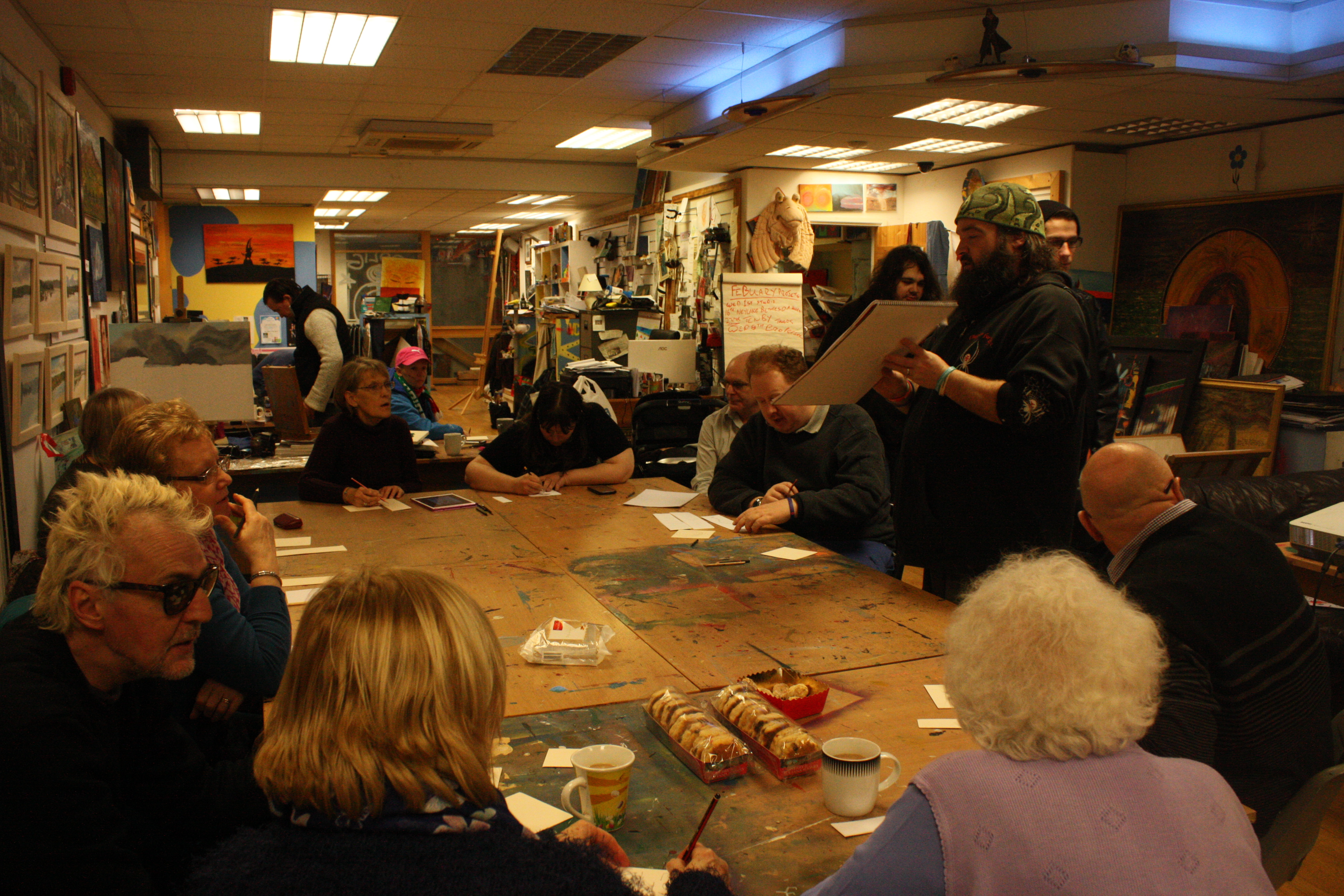

Celtic knots: Teaching generations young and old about art
THE VC GALLERY held a Celtic Knot workshop yesterday (Feb 1) funded by leader project PLANED, so people of all generations could come to socialise for the afternoon and express themselves through art.
With a friendly atmosphere and a smile to greet you at the door, the VC Gallery, which stands for Veterans and the Community, is a drop in centre on High Street in Haverfordwest for veterans, but also helps various groups of people within the community through art engagement.
The Gallery is a huge part of the community, and helps people with mental health problems such as depression and veterans with post traumatic stress disorder (PTSD), but also helps new mothers, people with learning disabilities, autism, and the socially excluded who have nowhere else to go.
Founder of the organisation, Barry John MBE, served in the armed forces for 24 years, and set up the organisation by himself when he left. Since then, Barry has helped thousands of people.

Barry John MBE and Steve Portwood: Showcasing dramatic symbolic paintings
Mr John said: “Every Wednesday we have a community art group that’s cross-generational, which involves lonely and socially isolated people.
“We try to create a hub where we can socialise and be creative, which is part of our pathway to inspire. We want to bring a wide range of Welsh art to the projects, and to be diverse.
“We’ve talked about historical Welsh artists and Welsh landscapes, and we want to be emotive with our art, which is why today we are looking at celtic and trial knots, as they have strong, intricate lines and patterns.
“We also can deliver some of the subject history along with its artistic intent.”
People of all ages and abilities attended the workshop, along with 93-year-old Irene and her neighbour, Carol.

Workshop regulars: 93-year-old Irene and her neighbour, Carol
Irene said: “The workshops give me company and gives me a chance to learn new things. It’s lovely!”
She added: “If it weren’t for Carol, I wouldn’t go anywhere or see anyone.”
Next week, the gallery will be hosting a show called ‘Compulsion to Paint’ on February 8, which showcases the fantastic work of Steve Portwood. This is to coincide with Bi-Polar Awareness Month, occurring this February, and demonstrates the struggle he has been through with his mental health.
Speaking to The Herald, Mr Portwood said: “I suffer with bi-polar and have done since I left the army. My work is a way of expressing how I feel and how I see bi-polar, and I’ve tried to incorporate other people’s feelings and how they see it in their mind.”
Some of Steve’s work will also be going on display at a show at Bro Cerwen later this month in aid of bi-polar awareness, and Steve hopes that his work will resonate with people who feel like same way.
“I hope it will help people with the emotions they are having,” he said.
Speaking about the gallery itself, Steve said: “You can come in here in any mood and speak to Barry. The gallery has picked me up when I’m thinking I’m worthless and can’t achieve anything, and when I use my art to express myself, it highlights the things that I can achieve.I feel like I’ve accomplished something and done something productive rather than go with the negaivity.”
The next workshop on February 8 will be held at the VC Gallery in Haverfordwest, from 12.30pm-2.30pm. For more information, you can visit their website or Facebook page at www.facebook.com/thevcgallery

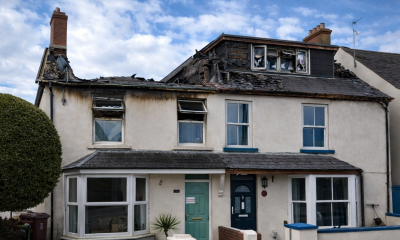
Two houses lost and a third badly smoke-damaged as villagers rally to support those affected
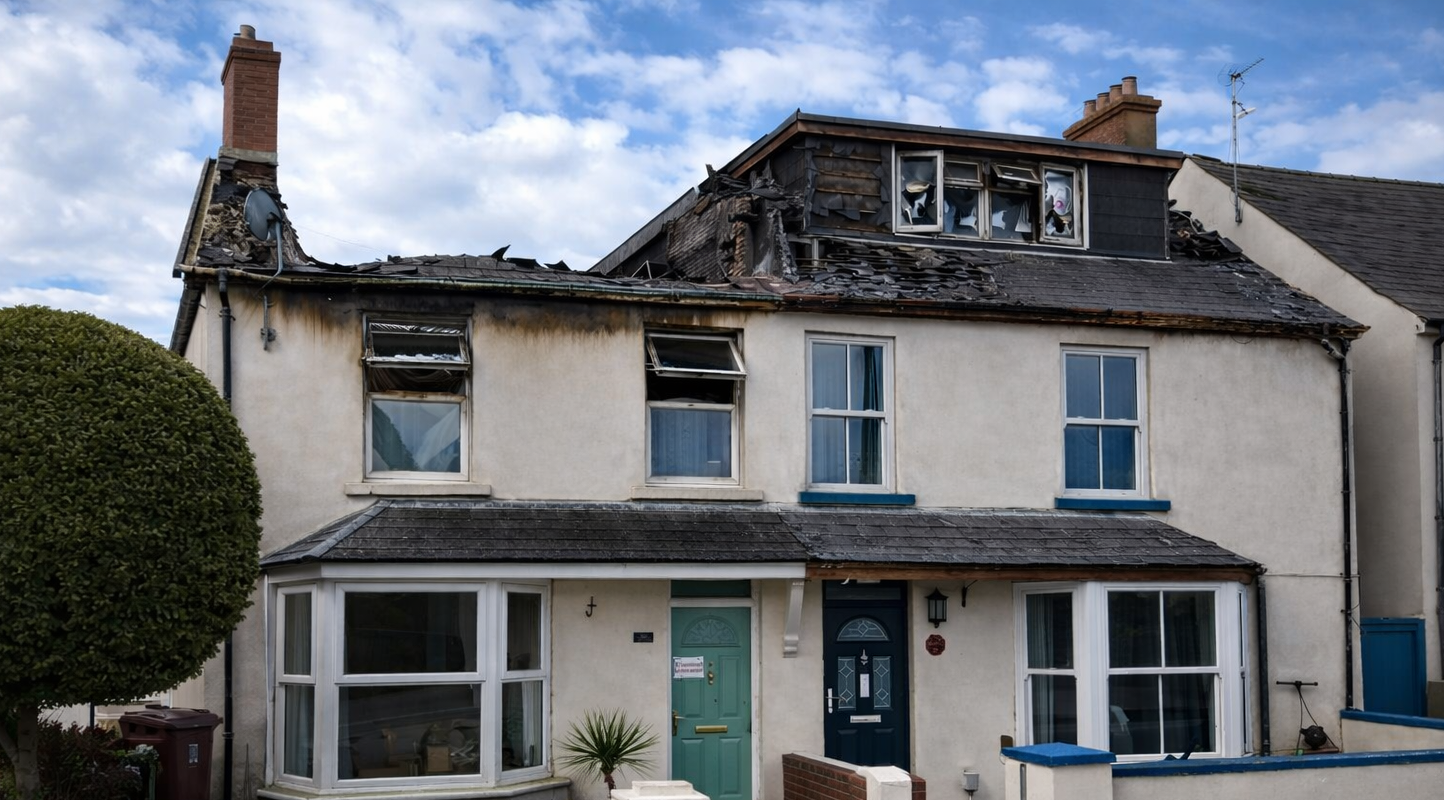
THREE families have been forced from their homes after a major fire tore through a terrace in Letterston, destroying two properties and leaving a third badly affected by smoke.
The blaze broke out at around 4:00pm on Wednesday (Apr 15), prompting a major emergency response from fire crews across west Wales.
Appliances were sent from Fishguard, Haverfordwest, Milford Haven, St Davids, Narberth, Carmarthen and Tumble as firefighters worked for hours to bring the incident under control.
Residents nearby said they first noticed what looked like a dark haze outside before realising smoke was pouring from the row of houses. As the seriousness of the situation became clear, people in neighbouring homes were told to get out.
Witnesses described seeing flames race through the roof spaces of the terrace, while windy conditions made the fire harder to contain. There were also reports of loud bangs as the blaze spread close to overhead power lines.

Fire crews remained at the scene into the evening, supported by utility workers dealing with the electricity supply. Some nearby homes were left without power until late that night.
By the time the fire was out, two houses had been completely gutted. A third remained standing but was left uninhabitable because of heavy smoke contamination inside.
Among those affected was a young family with a three-month-old baby. Although their house was not destroyed structurally, smoke damage is understood to have ruined furniture, clothing and other possessions, including items for the child.
All three households have since moved in with relatives or friends while they deal with the aftermath.

Despite the scale of the incident, nobody was injured.
The fire has shocked the village, but local people have quickly stepped in to offer help, with fundraising appeals launched to support those who have lost their homes and belongings.
How to help
Fundraising appeals can be found at:

gofundme.com/f/help-young-family-return-home-after-smoke-damage
gofundme.com/f/friends-house-destroyed-by-fire-f24y5
gofundme.com/f/the-families-effected-by-the-fire
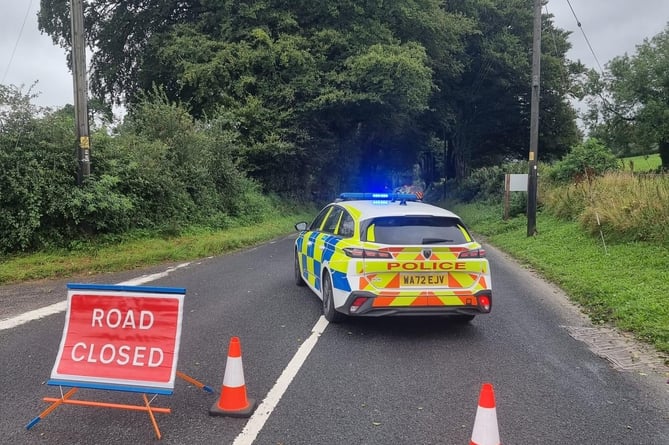
PEMBROKESHIRE and Carmarthenshire have been named among the worst-affected areas in England and Wales for accidental deaths, according to new figures from the Royal Society for the Prevention of Accidents.
Newly-published data shows Pembrokeshire recorded an accidental death rate of 55.18 per 100,000 people in 2023, with Carmarthenshire close behind on 55.15. Both figures are rounded to 55 and place the two west Wales counties in the top 10 highest local authority areas across England and Wales.
Pembrokeshire ranked eighth on the list, while Carmarthenshire was ninth.
The figures form part of RoSPA’s latest Annual Review of Accidents, which warns that preventable deaths and injuries are continuing to rise across the UK.
Wales as a whole recorded an accidental death rate of 44.25 per 100,000 people in 2023, far above the UK-wide figure of 33.97. Only Scotland recorded a higher national rate.
The report paints a worrying picture for Wales, where RoSPA says accidental deaths have risen by 43 per cent over the past decade and now claim more than 1,200 lives a year.
Falls remain the biggest single cause of accidental death. In Wales, 733 people died in falls in 2023, up from 560 the previous year. That equates to a fatal falls rate of 23.15 per 100,000 people across the country.
The local breakdown suggests falls are also a major factor in west Wales. Pembrokeshire recorded a falls death rate of 28.79 per 100,000, while Carmarthenshire stood at 27.31. Carmarthenshire also had a notably higher accidental poisoning death rate than Pembrokeshire.
Across the whole of the UK, RoSPA estimates around 23,000 people died in accidents in 2023, while almost 900,000 people were admitted to hospital because of accidental injuries in 2023–24.
Becky Hickman, chief executive of RoSPA, said too many families were suffering life-changing loss from incidents that could often have been prevented.
She said: “Accidents devastate lives in an instant.
“They are often sudden, violent, and shocking, leaving families and communities to cope with consequences that can last a lifetime.

“What makes this devastation even harder to bear is the knowledge that so many of these incidents are entirely preventable.”
RoSPA has called for stronger action from governments across the UK, including a national strategy to reduce accidental deaths and serious injuries.
Ahead of the 2026 Senedd election, the charity has also launched its Stronger, Safer Wales campaign, urging the next Welsh Government to treat accident prevention as a major public health priority.
The charity says the risks in Wales are particularly acute in areas such as falls, accidental poisonings, rural roads, machinery-related incidents and water safety.
Ms Hickman said: “Our Annual Review of Accidents shows we are still not doing enough to reduce avoidable harm, life-changing injuries and personal tragedies.
“From our roads to our workplaces, the homes we live in to where we spend our leisure time, people in Britain are at increasing and unacceptable risk of suffering a serious accident.”
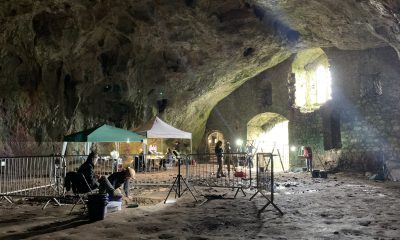
Five-year project beneath Pembroke Castle could transform understanding of prehistoric Britain
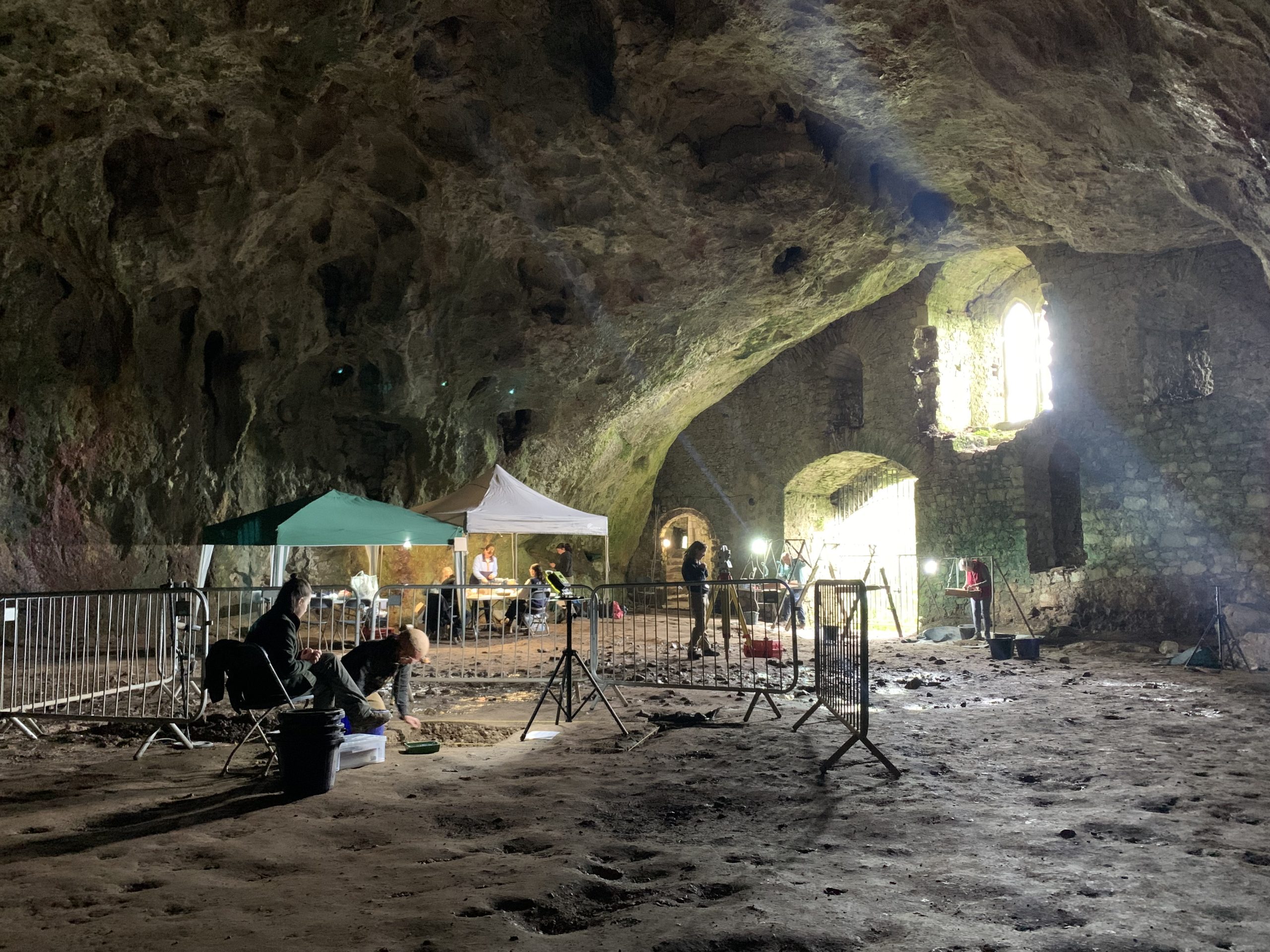
A MAJOR new archaeological project has been launched at Wogan’s Cave beneath Pembroke Castle after experts revealed the site may hold one of the most important prehistoric records in Britain.
The hidden cavern, tucked beneath the northern side of the medieval fortress, is now at the centre of a five-year exploration which archaeologists believe could rewrite part of the story of ancient Britain.
At the heart of the excitement is the discovery of hippopotamus bones dating back around 120,000 years — a striking sign that animals now linked with far warmer climates once lived in what is now west Wales.
Researchers say the cave has also produced remains of mammoth, woolly rhinoceros, reindeer and wild horse, along with evidence of repeated human occupation stretching back more than 100,000 years.
The new project will be led by the University of Aberdeen, with support from Pembroke Castle Trust, after fresh funding was secured for a detailed programme of excavation and analysis.

Lost world beneath the castle
For many years, Wogan’s Cave was thought to have been largely emptied by Victorian excavations, leading archaeologists to believe that little of major significance remained.
That assumption has now been turned on its head.
More recent work has shown that large areas of sediment survived intact, preserving a valuable archive of prehistoric life, changing climates and early human activity. Experts now believe the cave may contain evidence spanning several different periods of occupation, making it one of the most important sites of its kind in Britain.
The finds point to a landscape dramatically different from the Pembrokeshire seen today, with warmer periods supporting animals such as hippos and colder phases bringing species including reindeer and woolly rhinoceros.

Experts are particularly excited by signs that the cave may hold extremely rare evidence of early Homo sapiens in Britain, alongside traces of even earlier human occupation, probably by Neanderthals.
Scientific techniques
The five-year investigation is expected to use advanced scientific methods including high-precision dating and DNA analysis from bones and cave sediments.
Archaeologists hope this will help answer major questions about how prehistoric humans lived, how they responded to huge swings in climate, and how different groups may have used the cave over tens of thousands of years.

The project also promises to shine a new light on Pembroke Castle itself, which is already internationally famous as the birthplace of Henry Tudor.
Until now, the castle’s story has largely centred on its medieval significance. But the latest discoveries suggest the headland on which it stands was important to humans and animals for many thousands of years before the first stone walls were ever raised.
National importance
Castle staff have welcomed the new phase of work, saying the discoveries add an extraordinary new chapter to Pembroke’s already rich history.
There is also strong local importance, with finds from the cave expected to be curated and kept in Pembroke.
Wogan’s Cave has long fascinated visitors, but the latest announcement is likely to push it firmly into the national spotlight.
What was once seen as a largely exhausted chamber beneath a famous castle is now emerging as a prehistoric time capsule — one with the potential to reshape understanding of ancient Britain.
If the full promise of the site is realised, Pembroke may become known not only for its medieval past, but for preserving one of the deepest and richest records of prehistoric life yet discovered anywhere in these islands.


Community17 hours ago
Fire leaves Letterston families homeless after homes destroyed
Two houses lost and a third badly smoke-damaged as villagers rally to support those affected THREE families have been forced...

Community2 days ago
Hippo bones put Wogan’s Cave at centre of major new dig
Five-year project beneath Pembroke Castle could transform understanding of prehistoric Britain A MAJOR new archaeological project has been launched at...


Crime2 days ago
Man found staggering in street after brutal caravan attack
Victim suffered fractured wrist and suspected broken jaw after assault in Pembroke Dock A MAN was found staggering around Pembroke...

News3 days ago
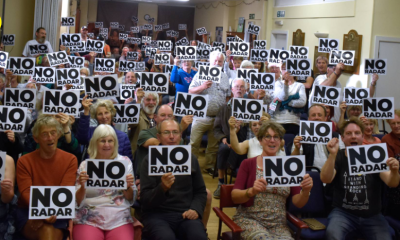
Labour rift erupts over DARC as campaigners say Morgan’s move is too little, too late
Anti-radar group says First Minister’s call for a pause falls far short of what angry Pembrokeshire residents are demanding A...

Business3 days ago
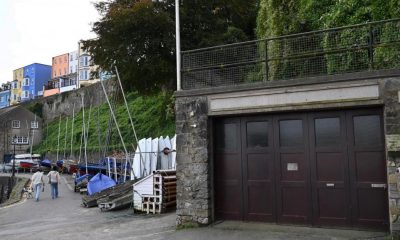
Tenby harbour RNLI building takeaway allowed after appeal
A REFUSED scheme for a takeaway food kiosk at a former lifeboat store in Tenby’s seaside harbour, has now been...

Community4 days ago
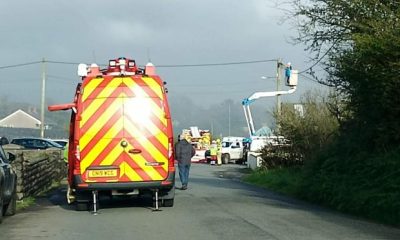
Family safe after major house fire in Letterston, community told
Memorial hall opened to help those affected after blaze in Station Road area A FAMILY escaped without injury after a...


News4 days ago
Haverfordwest County AFC escapes winding-up order but ordered to pay costs
Club avoided liquidation in case remained live until it came before a judge at the High Court in London A...


News4 days ago
Seal pup’s 120km swim ends in rescue and release
Young grey seal found weak at St Brides Bay after remarkable journey from Cornwall is now back in the wild...


Crime4 days ago
Woman who called for help spared jail over blade offence
Court hears Haverfordwest defendant was in severe mental distress and carrying razors to harm herself A HAVERFORDWEST woman who contacted...


Community4 days ago
Spitfire latest: Pembrokeshire flypast looks more likely this afternoon
THE LATEST public updates suggest the iconic Spitfire is now expected to leave RAF Valley at around 2:00pm today (Apr...
-
 Business5 days ago
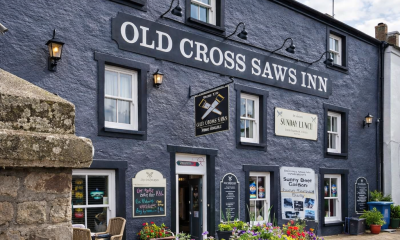
A proper Pembroke local: Inside the warm welcome of The Old Cross Saws Inn
-

 Sport6 days ago
Grand Slam win for Pembrokeshire rugby ace
-

 Crime7 days ago
Over 500 arrests at latest Palestine Action protest in London
-

 Community5 days ago
Doorstep warning issued after reports of suspicious callers in Pembrokeshire
-
 Business3 days ago
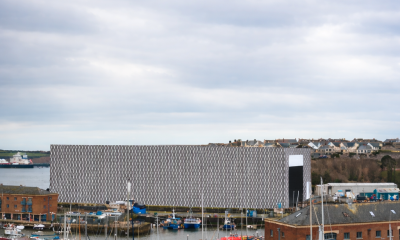
Milford Haven dry dock pitched as home for giant £480m superyacht yard
-

 Crime5 days ago
Romino’s licence revoked after illegal workers found and fire risks exposed
-

 Politics4 days ago
Welsh Lib Dems promise childcare boost, social care reform in manifesto launch
-

 News7 days ago
Reform attacks Plaid on spending and immigration ahead of Senedd poll