


Climate
Global floating offshore wind project pipeline grows by one-third over 12 months


A NEW report published today by RenewableUK shows that the total pipeline of floating offshore wind projects has grown significantly in the last 12 months in terms of capacity from 185 gigawatts a year ago to 244GW now – a 32% increase.
The number of projects has increased globally during that time from 230 to 285. The pipeline includes projects at any stage: fully operational, under construction, approved, in the planning system awaiting a decision or at an early stage of development.
The EnergyPulse Insights report was compiled by RenewableUK’s data analysts to coincide with the opening of our 2-day Floating Offshore Wind 2023 conference and exhibition in Aberdeen.
So far, 227 megawatts of floating wind are fully operational across 14 projects in 7 countries. Norway has the most with 94MW across 3 projects. The UK is second with 80MW (2 projects), Portugal has 25MW (1 project) and China is fourth with 19MW across 3 projects. Japan has 5MW (2 projects), Spain 2.225MW (2 projects) and France 2MW (1 project).
Globally, 46MW are under construction (3 projects), 576MW are consented or in the pre-construction phase (11 projects), 68GW are in the planning system or have a lease agreement (80 projects), and 175GW are in early development or applying for a lease (177 projects).


Nearly two-thirds of floating wind capacity announced so far worldwide are being developed in European waters (160GW), 14% is in the UK (35GW – of which 29GW is in Scottish waters). Outside Europe, projects are being developed mainly off the west coast of the USA, the southeast coast of Australia and South Korea.
Although Italy has the largest project pipeline (40,071MW), nearly all its 47 projects are at an early stage of development, with only one (90MW) submitted into the planning system so far.
Floating Offshore Wind Total Portfolio By Country (MW)
The report also shows that demand for floating foundations is expected to ramp up fast, with the potential for 472 in the UK by the end of 2032. There could be 1,369 floating foundations in Europe and 1,924 for projects globally by the end of 2032.

RenewableUK predicts that floating wind will represent well over half of the UK’s offshore wind generation by 2050, generating around £43.6bn in economic value and more than 29,000 jobs. It will also play a critical role in regenerating our coastal communities; with £4bn required to transform up to eleven ports across the UK into industrial hubs for mass roll-out of floating wind by the turn of the decade. There is up to £3.6bn in development funds ready to be released across 24GW of floating capacity with leasing secured in UK waters.
RenewableUK believes that the Government’s target of reaching 5GW of floating wind in UK waters by 2030 remains achievable, but the next CfD auction and future rounds must be underpinned by sustainable parameters in order to maximise deployment, drive down costs and incentivise investment in domestic supply chains. This year’s Contracts for Difference (CfD) auction failed to secure any new floating wind capacity, despite 250MW of floating wind capacity being shovel-ready.
RenewableUK’s Chief Executive Dan McGrail, Co-Chair the Floating Wind Taskforce said:

“This report shows that although the UK is a world leader in floating wind, other countries are eyeing the massive economic opportunity offered by this innovative technology and are determined to get a slice of the action. The international competition for investment is intensifying rapidly.
“We urgently need a step-change from our partners in Government to ensure that this cutting-edge industry can attract billions in investment to boost deployment and build up new supply chains, rather than focussing solely on a race to the bottom on prices.
“To ensure that the UK seizes the industrial benefits of developing state-of-the-art technology and revitalising ports around the country, we need to see sustainable prices to enable stepping-stone projects to go ahead in a successful auction next year, and every year going forward. Leveraging these projects will enable us to replicate the cost reductions we’ve seen in fixed-foundation offshore wind, as well as catalysing supply chain development. We’re determined to make the 2020s a decade of acceleration for floating wind”.


A FREE public screening of The People’s Emergency Briefing will take place at Small World Theatre, Cardigan, on Friday, June 26.
Doors will open at 6:30pm, with the 50-minute film followed by a facilitated community discussion.
The screening forms part of a growing UK-wide programme of events aimed at ensuring the public, community leaders and decision-makers are clearly informed about the climate and nature crisis, and what it could mean for communities across the country.
The film follows the National Emergency Briefing, held at Westminster Central Hall in November 2025, where more than 1,200 MPs, peers and leaders from business, culture, faith, sport and the media gathered to hear from leading experts on the UK’s exposure to climate and nature risks.
Introduced by Chris Packham CBE, the briefing examined the implications of climate and nature breakdown for food security, public health, infrastructure, the economy and national security, as well as evidence-based actions which could help reduce those risks.
That national event has now been adapted into The People’s Emergency Briefing, a public film being screened in communities across the UK, including more than 100 screenings in Wales.
Chris Packham said: “I’d encourage people everywhere to attend a screening of The People’s Emergency Briefing. It creates exactly the kind of honest local conversation we now urgently need, both about what these changes mean where we live, and about what we can do together to address them.”
Organisers say the Cardigan screening is particularly relevant given recent flooding on the Teifi, longer hot dry spells, stronger storms, heavier rainfall, biodiversity loss and concerns over regular pollution incidents.
Following the film, those attending will be invited to take part in a structured open discussion focusing on what positive changes can be made locally.
Local MP Ben Lake is expected to attend, along with Members of the Senedd, councillors and other community leaders who have been invited.
The discussion will be led by Jane Davidson, former Welsh Government minister for environment, sustainability and housing, who helped inspire and lead the Well-being of Future Generations (Wales) Act 2015 and the Wales Net Zero 2035 project.
Philip Hughes, one of the event organisers, said: “This is a great opportunity for people to come together, look at the evidence, and begin a more open and informed conversation about what it means for our community.

“We often hear the views of ‘Dave down the pub’, but this film gives evidence from top scientists, economists, doctors and security chiefs on why bolder action is now needed.”
Tickets for the Aberteifi screening are free, but booking is essential as space is limited.
To book, contact [email protected] or call 07787 197630.
More information about The People’s Emergency Briefing can be found at www.nebriefing.org/screening-map



A CALL for a five month breathing space for a wind turbine application which was previously withdrawn late last year over a lack of information on how it may affect bats, is expected to be turned down and the scheme refused.
In December of last year, in an application recommended for refusal at Pembrokeshire County Council’s planning committee, Constantine Wind Energy Ltd sought permission for a 76-metre-high wind turbine at Summerton Farm, Sageston.
Back in 2024, an application to replace a current 60.5m high turbine on the site with one up to 90 metres, or just under 300 foot, at the site was refused on the grounds its height and scale would have a detrimental impact on the visual amenity of the locality, with the additional clause of failing to comply with supplementary guidance.
A report for committee members on the latest application says the smaller turbine than previously proposed, representing a 16-metre increase in height from a previously granted turbine “would not be sufficient for it to become an overbearing feature in the landscape,” with no objections from either the Council Landscape Officer or Natural Resources Wales.
However, concerns were raised by the council ecologist that the applicant’s Preliminary Ecological Appraisal Report was incomplete, with a bat survey not included.
It was recommended for refusal on the grounds that appraisal report, and technical note, “do not adequately address the impact of the proposed wind turbine on bat activity in the area”.
At the December meeting, members heard the scheme had been temporarily withdrawn to deal with issues raised, the application now returning to the June meeting, again recommended for refusal.
A report for members ahead of the June meeting says the application was withdrawn from the December agenda to allow the applicant time for consideration of the Council Ecologist’s request for further survey work.
“Further consultation took place with Natural Resources Wales (NRW), the result being that NRW agree with the Council Ecologist’s stance that additional survey work is required.
“The applicant has submitted a request for a further deferral of the application to allow the necessary surveys to be carried out. The bat survey programme requires surveys over Spring, Summer and Autumn. The Spring survey was completed on May 14 and the Spring and Summer surveys will take place on July 14 and September 7 respectively.
“The applicant expects a report to be issued to the council for consultation before the end of September, with consultation with NRW and the council ecologist expected to be completed during October 2026.
“On the assumption that the proposal is considered acceptable the applicant expects that the application could be considered at the November 2026 planning committee meeting.

“Accordingly, the applicant requests deferral of the application to the November 2026 planning committee meeting to avoid the unnecessary costs, resources and timelines for a resubmitted application.”
The application is recommended to be refused at the June meeting of Pembrokeshire County council’s planning committee on the basis that “the Preliminary Ecological Appraisal Report and Technical Note do not adequately address the impact of the proposed wind turbine on bat activity in the area. As such, therefore, the proposal is contrary to the requirements [of planning policy].”

Experts say UK is ‘built for a climate that no longer exists’
WALES is being warned it cannot afford to wait to adapt to a changing climate, as high temperatures continue to affect communities across the country.
Climate experts and campaigners say Wales and the wider UK remain dangerously underprepared for worsening heatwaves, flooding, drought and pressure on food production.
The warning follows a major report by the Climate Change Committee, the UK’s independent climate advisory body, which states that the country is “built for a climate that no longer exists”.
The committee says climate change is already undermining the UK’s security and prosperity, with impacts expected to intensify rapidly over the coming decades unless urgent action is taken.
Bethan Sayed, Head of Politics at Climate Cymru, said: “The message is clear: Wales cannot afford to wait. We are already living with the impacts of a climate our infrastructure was never designed for, and things are only going to get worse.
“Our farmers are on the frontline, facing drought, flooding and growing uncertainty about what they can produce. At the same time, our towns and cities are not prepared for the levels of heat we are heading towards, putting lives at risk, especially among the most vulnerable.
“We know what needs to be done, from climate-resilient farming and water security to redesigning our communities to cope with heat and flooding.
“Across Wales, local groups are already taking action to try and protect themselves, but the question remains: will governments act with the urgency this moment demands?
“Delaying action will cost far more, in lives, livelihoods and public finances, than investing now to protect people and build resilience.”
The Climate Change Committee warns that by 2050 the UK could face significantly more extreme climate conditions.
Among the risks identified are up to 92% of homes overheating during severe heatwaves, river flows increasing by up to 45%, and summer droughts causing water shortages of more than five billion litres a day.
In Wales, many of those pressures are already being felt. Farmers are dealing with increasingly unpredictable weather, crop losses and rising costs, while communities face greater exposure to floods, heatwaves and water scarcity.

Campaigners say the issue is no longer only about cutting emissions, but also about preparing homes, public services, transport, farming and water systems for the climate impacts that are already locked in.
Despite growing evidence of the risks, adaptation efforts are not keeping pace with the scale of the challenge. Experts warn that without faster action, Wales risks avoidable damage to infrastructure, food systems, public health and local economies.
The committee says the UK must prepare for at least 2C of global heating by 2050, while recognising that 4C by the end of the century remains possible.
Climate Cymru said this means urgent, large-scale investment is needed across all sectors to protect people, strengthen communities and reduce the cost of future climate damage.



Community16 hours ago
RNLI lifeguards rescue beachgoers during busy heatwave weekend
FOUR PEOPLE RESCUED AS RIP CURRENTS AND OFFSHORE WINDS HIT PEMBROKESHIRE BEACHES RNLI lifeguards in Pembrokeshire rescued four people and...


Local Government16 hours ago
Council and school staff pay row could hit Pembrokeshire services
COUNCIL workers, carers and school support staff in Pembrokeshire could be drawn into a growing UK-wide pay dispute after GMB...

Health23 hours ago
Hywel Dda to hold second consultation on future of stroke services
A SECOND phase of public consultation is to be held on the future of stroke services across Hywel Dda University...


Community23 hours ago
Warning as algal blooms mistaken for sewage on Welsh coast
Beachgoers urged to avoid contact with suspicious foam and report pollution concerns NATURAL RESOURCES WALES has issued summer advice to...

News1 day ago
Yacht towed to safety after engine failure off Tenby
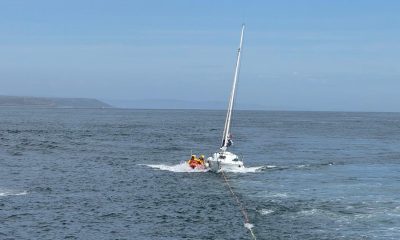
A YACHT was towed to safety by Tenby RNLI after suffering total engine failure around 15 miles south-east of the...


Crime3 days ago
Haverfordwest sex offender jailed over child abuse material
Registered offender used library computers to hide social media accounts A HAVERFORDWEST sex offender who used public library computers to...


Local Government3 days ago
Milford Haven school redevelopment moves a major step closer
£141.6m scheme could transform education in the town A MAJOR step forward has been taken in the long-awaited Milford Haven...


Crime3 days ago
Castlemorris man spared jail after knife confrontation over council tax debt
A CASTLEMORRIS man has avoided immediate custody after threatening enforcement officers with a knife during an early-morning visit over unpaid...


News3 days ago
Lifeboats and helicopter join search for missing person off Broad Haven
SEARCH teams carried out a major operation at Broad Haven after reports of a missing person. Little and Broad Haven...


News4 days ago
Multi-agency rescue after child falls on rocks while coasteering
Child airlift requested after four-metre fall near Lydstep A CHILD was rescued from rocks near Lydstep after falling around four...
-

 Health4 days ago
Paul Davies warns health board over Withybush and Bronglais services
-
 Crime6 days ago
Police tip-off leads to drink-drive ban for Pembrokeshire pensioner
-
Crime4 days ago
Carmarthenshire man sent to Crown accused of 33 historic sexual offences
-

 Crime5 days ago
Steynton motorist banned after drink-drive collision
-

 Crime6 days ago
Warrant issued for man accused of taking wild goldfinches
-
 Crime5 days ago
Dock man given suspended prison sentence for third drink-drive offence
-

 Crime6 days ago
Dock motorist fined £1,600 after four speeding offences
-

 Local Government6 days ago
Dennison code breach raises serious questions over common sense at County Hall