


Climate
Yellow weather warnings issued for Pembrokeshire as ice and snow forecast


Travel disruption likely as council activates emergency shelter measures
TWO yellow weather warnings for ice and snow have been issued for Pembrokeshire over the weekend, with hazardous conditions expected to affect travel across the county.
The first Met Office warning is in force until 10:00am on Saturday (Jan 3), with a second warning running from 3:00pm on Sunday (Jan 4) until 12:00pm on Monday (Jan 5). The alerts follow an earlier warning that was in place from midnight until midday on Friday (Jan 2).
Forecasters say icy conditions and snowfall could lead to delays to bus and rail services, while drivers are being urged to plan ahead and allow extra time for journeys, particularly on untreated rural roads and higher routes across north Pembrokeshire and the Preseli Hills.
The Met Office said between 1cm and 3cm of snow is likely in parts of the county, with higher ground potentially seeing accumulations of 5cm to 8cm. Wintry showers are expected to become more frequent overnight, with icy patches forming where surfaces remain untreated.
Pedestrians have also been warned that pavements and cycle paths could become treacherous or impassable, especially during the early morning and evening hours.

In response to the cold conditions, Pembrokeshire County Council has confirmed it will activate its Severe Weather Emergency Protocol (SWEP) from Friday (Jan 2) through to Sunday (Jan 4). The measure allows emergency accommodation to be provided for known rough sleepers during periods of extreme weather.
The council is urging members of the public to report anyone sleeping rough so they can be offered emergency shelter over the weekend.









A PETITION call to Pembrokeshire councillors, which raises concerns at the “hefty funds” needed to support its commitment to net zero, will be heard at full council.
Last July, councillors agreed to set up a group to review its own decision to declare a climate emergency some seven years ago.
In May 2019, the council declared a climate emergency following a notice of motion by Cllr Joshua Beynon calling on the authority to back the global consensus that climate change poses a risk to the well-being of future generations.
He had urged county councillors to back a motion to take “bold, decisive action” to fight “truly, catastrophic” climate change, with the council to committing to becoming a zero-carbon local authority by 2030.
At the July 2025 meeting of Pembrokeshire County Council, a successful notice of motion by the late Cllr Mike Stoddart called for the establishment of a working group to review that decision.

That led to a recent petition, by Lynda Duffill of West Wales Climate Coalition, which attracted 725 signatures, calling on the council to reaffirm its Declaration of a Climate Emergency, and retain the ambition to deliver Net Zero Council operations by 2030.
That petition was considered at the October 2025 meeting of full council; members agreeing the working group be asked to ensure the petition is included as evidence in its consideration of the matters referred to it by the council resolution in July 2025.
That has now led to a further petition, concerned at a potential increase in council tax from a re-affirmation of a Declaration of a Climate Emergency.
The latest e-petition, on the council’s own website, created by Carolyn Ellis, reads: “We call upon all elected members of Pembrokeshire County Council to support and to take seriously the working group tasked with the review of the ‘climate emergency’ called in 2019 (by the-then 21-year-old councillor Joshua Beynon) and to question the hefty funds needed to spend on ‘net zero’.
“We refer to the recent petition by the West Wales Climate Coalition which purports to speak for the residents and council tax-payers of Pembrokeshire.
“There is potentially a far higher number of residents who do not share this unsubstantiated view and who are extremely concerned about the potential for huge hikes in council tax, especially if this tax is linked in future to the carbon efficiency of homes and businesses.
“This was hinted at as a possible lever for encouraging ‘compliance’ with decarbonising homes in the ‘Better Homes, Better Wales, Better World’ report. Therefore, not only could we be faced with more taxes, but also inevitable deterioration in service provision by PCC.”

The current petition ran to March 26 and attracted 753 signatures.
Any petition of between 100 and 499 signatures triggers a debate at one of the council’s overview and scrutiny committees, and any over 500 a debate at full council.

AN APPEAL against a refused scheme for a Pembrokeshire ‘battery box’ unit to provide electricity storage during off-peak times, has been lodged.
In an application refused by Pembrokeshire County Council in February, AMP Clean Energy sought permission for the construction and operation of a micro energy storage project at St Daniel’s Hill and St Daniel’s Drive, Pembroke.
That application was one of many AMP has submitted in the county.
A supporting statement accompanying the application said AMP’s battery boxes import electricity from the local electricity network when demand for electricity is low or when there are high levels of renewable energy available, exporting it back during periods of high demand to help address grid reliability issues prompted by an increase of intermittent (wind and solar) generation of the electricity system.
AMP Clean Energy says each box, which takes up roughly two car parking spaces, stores 800kWh of electricity, giving the potential to power 200 homes for four hours where there is a disruption to supply.
The statement added: “The UK’s electricity system was traditionally dominated by a small number of large power stations fuelled by fossil fuel (namely coal and natural gas). However, the system is now becoming increasingly supplied by intermittent sources of renewable energy such as wind and solar power.
“Renewable power generation does not always match when the demand for electricity is highest. To overcome this, we need a more flexible energy system that allows us to shift renewable energy to the periods of the day when the demand for power is at its greatest.”
The application was refused on the grounds of potential noise impact on residents, it would “be wholly at odds with the established character and appearance of the area, eroding its rural qualities and introducing an incongruous and visually discordant element into the landscape,” and potential highway safety impacts through “driver distraction and encroachment into established sightlines”.
Since that refusal, AMP has lodged an appeal with Planning and Environment Decisions Wales (PEDW).

The appeal disputes the significance of any noise impact, and says the proposed installation is “compact, low-lying, and no more visually prominent than standard roadside utility cabinets commonly found across Pembrokeshire,” with the applicant “more than happy to provide wooden fencing as an alternative to screen the equipment and help it blend in better with the surrounding environment”.
Of the potential highway safety reason, it says: “The claim there will be an impact to highways safety is completely speculative and not based on any evidence whatsoever. This reason should be dismissed.”
The appeal will be heard at a later date.

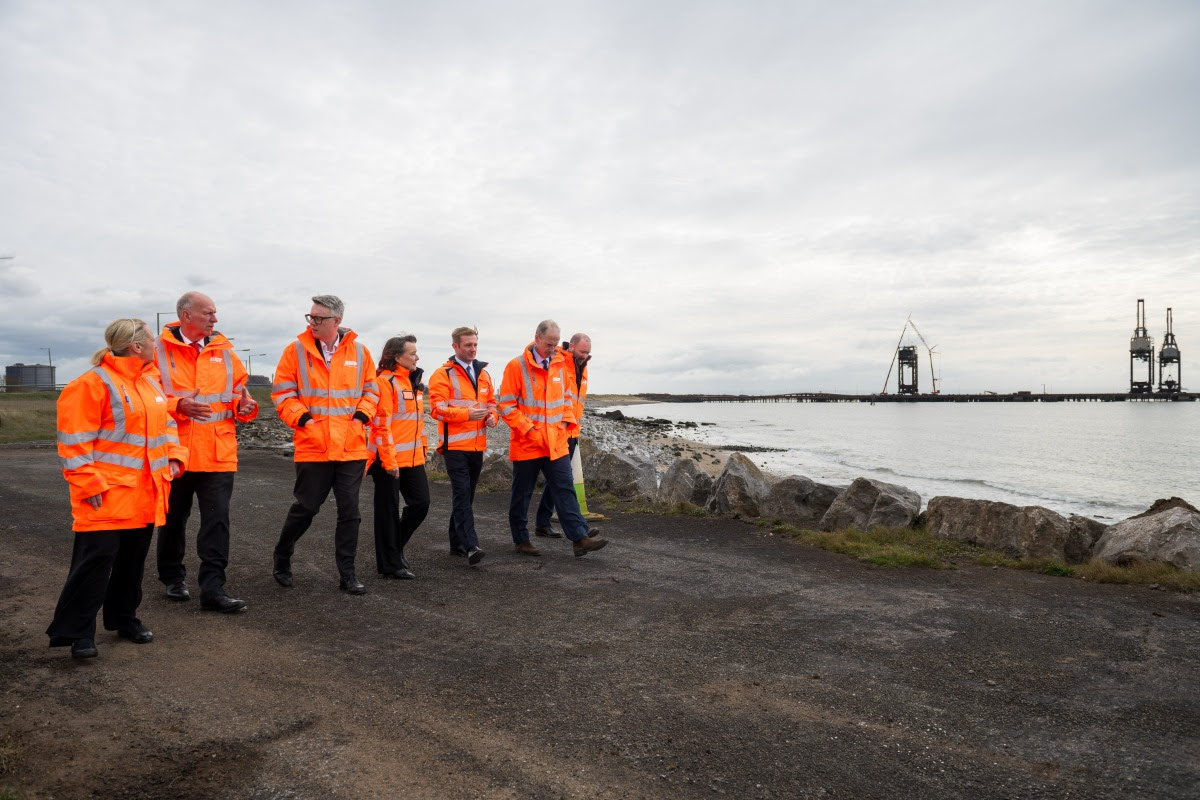
New government-backed deal with ABP reinforces Port Talbot’s central role in Celtic Sea wind plans
PORT TALBOT has been firmly established as the “cornerstone” of the UK’s floating offshore wind ambitions in the Celtic Sea, following a major agreement between the UK Government and Associated British Ports.
The deal confirms government support for the development of large-scale port infrastructure at Port Talbot, enabling manufacturing, assembly and deployment of floating wind turbines for gigawatt-scale projects.
The announcement strengthens Port Talbot’s position as the primary industrial hub for the emerging sector.
Henrik L. Pedersen, Chief Executive of Associated British Ports, said the development would “establish the port as a cornerstone of the Celtic Sea floating offshore wind industry.”
Clear role for Port Talbot
The agreement, subject to final regulatory approval, will support the delivery of major offshore wind projects awarded through the latest Celtic Sea leasing round.

Government ministers visiting the site described the development as a key step in building the UK’s clean energy future.
Energy Secretary Ed Miliband said the project would help Wales “storm ahead in floating offshore wind,” supporting thousands of jobs and driving economic growth.
Secretary of State for Wales Jo Stevens added that the investment would “further cement Port Talbot as a hub of the industries of the future.”
Milford Haven still waiting for detail
The latest announcement comes just days after questions were raised about Milford Haven’s role within the wider Celtic Freeport.
While Port Talbot’s position as a manufacturing and assembly hub is now clearly defined, there has still been no detailed breakdown of what activity will be based in Pembrokeshire.
Industry figures continue to point to Milford Haven’s strengths in operations, maintenance, logistics and servicing of offshore wind projects.
However, no formal commitments have yet been made.
Industry backing grows
Developers involved in Celtic Sea wind projects welcomed the progress at Port Talbot, describing it as essential infrastructure for delivering future schemes.
Ocean Winds said strengthening port infrastructure was “essential” to ensuring regional ports can support the rollout of offshore wind.
The Crown Estate also described the move as a key step towards unlocking the economic potential of the Celtic Sea, which could create thousands of jobs across Wales and beyond.
Growing pressure for answers
With Port Talbot now firmly positioned at the centre of construction and deployment, attention is likely to turn to how other ports—including Milford Haven—fit into the wider strategy.
For Pembrokeshire, the question remains unchanged:
As billions of pounds flow into the Celtic Sea over the coming decade, will Milford Haven secure a defined share of that investment—or continue to wait for clarity?
Pictured above:
From left to right: Cabinet Secretary for Economy, Energy and Planning, Rebecca Evans; David Rees MS for Aberavon; Minister for Energy Consumers, Martin McCluskey; Secretary of State Jo Stevens; Ashley Curnow, Divisional Port Manager (ABP); Julian Walker, Chief Commercial Officer and Regional Director (ABP), Mike Goddard, Head of Programme, Future Port Talbot (ABP)



News15 hours ago
St Davids Cathedral marked Easter Sunday with full day of worship
FROM dawn vigil to choral evensong, the cathedral welcomed worshippers for one of the most important days in the Christian...


Crime17 hours ago
Neyland man spared immediate jail over aggravated vehicle taking
Defendant given a suspended prison sentence after magistrates heard the offence was serious enough to cross the custody threshold KRISTIAN...


Health1 day ago
Crumbling NHS faces £1bn repairs bill in Wales
Senedd election promises collide with the harsh reality of ageing hospitals, fire safety concerns and a maintenance crisis stretching across...


News2 days ago
Emergency services respond to incident in Haverfordwest town centre
EMERGENCY SERVICES were called to an incident in Haverfordwest town centre on Saturday morning (Apr 4), with police and ambulance...

News2 days ago
Teenager intervenes after bridge incident
A TEENAGER was left shaken after stepping in to help a young woman in distress on Clay Lanes bridge in...


Crime4 days ago
Driver spared jail after crash killed young couple
A PEMBROKE DOCK driver who caused the deaths of a young couple in a road crash has been given a...


Entertainment4 days ago
BBC unveils major new Welsh dramas with Tenby set for prime-time spotlight
New crime series Old Town Murders and supernatural thriller The Witch Farm will both be filmed and set in Wales...


Health4 days ago
No jobs for new paramedics in Wales as graduates told to apply for technician roles
Students trained at public expense urged to take lower-grade jobs as anger grows over NHS workforce planning NEWLY qualified paramedics...


News5 days ago
Health minister refuses to act on Withybush despite 15,000-signature petition
Senedd pressure grows as Welsh Government declines to intervene over surgery fears THE WELSH GOVERNMENT has refused to step in...


Business5 days ago
Fishguard to Wexford rail tunnel plan backed by Elon Musk firm
Six-hour London to Dublin service proposed in £32bn project ahead of Senedd election PLANS for a rail tunnel linking west...
-

 News3 days ago
Accommodation providers in Wales will be required to register under new law
-
Business5 days ago
Fishguard to Wexford rail tunnel plan backed by Elon Musk firm
-

 Entertainment3 days ago
From Milford Haven to the world: The story of The Evolution Experience
-
Entertainment4 days ago
BBC unveils major new Welsh dramas with Tenby set for prime-time spotlight
-

 Charity7 days ago
RSPCA calls for stronger animal welfare measures as Welsh Labour launches manifesto
-

 News6 days ago
Labour promises 48-hour GP access as manifesto faces questions over delivery
-

 Crime6 days ago
Driver trapped after crash while nearly four times over drink-drive limit
-

 Business5 days ago
Refusal over Pembrokeshire shepherd hut let goes to appeal