


News
Be proud of yourselves



Emma Black, Lyn Davies, Brian Griffiths (branch treasurer), Emma Peace, Penny Drew (branch president) Sophie Pierce, Sybil Edwards (Branch chairperson) Caroline Willis (Branch secretary) Pauline Lloyd, Phyllis Morgan and Serena Wilson
‘YOU should be proud of yourselves’ Serena Wilson, Cystic Fibrosis Community and Fundraising manager for the West, told Pembrokeshire CF branch members and their supporters at the branch’s annual lunch at Wolfscastle Country Hotel.
She added: “The branch, which was set up 37 years ago by Sybil Edwards and the late Grace Lloyd, is one of the Trust’s longest running and most successful branches. The CF Trust relies heavily on the support of people like you for 90% of our income comes from voluntary contributions so without you, we would not be where we are today.
“The branch has helped us to achieve incredible things and through our ‘Fighting for Life Unlimited’ campaign we will continue to fight until all those living with CF can live a life untroubled by Cystic Fibrosis.”
Taking up the Life Unlimited theme CF patient and branch member Sophie Pierce who has raised thousands of pounds for the work of the Trust said that she did not feel that her life was limited in any way and that it was not good to focus on the negative. Through the work of the Trust we know that around half of those currently living with CF will survive past 40.
It is thought that a baby born today with Cystic Fibrosis, using treatments already available, could have a near normal life expectancy.

‘Look how far Cystic Fibrosis has come in terms of positive developments over the years.’ she said. ‘Think how far we can still go. By being positive we can give hope to those families, patients and carers who are affected. This is what drives me to fundraise.’
Following on last year’s successful sponsored Snowdon climb Sophie is currently arranging a climb to take place on Snowdon on June 5. A bus from Haverfordwest will go to and from Llanberis on the day, leaving Haverfordwest at 4.30am (all part of the adventure, she says). It costs £15 with a required pledge of £50 (or more)
Branch chairperson Sybil Edwards thanked Serena and Emma Black, CF Community Fund Raising Manager for Wales for making the journey to meet the branch members, everyone present for their support, treasurer Brian Griffiths for collecting in the money and most particularly the branch’s dedicated president Mrs Penny Drew for once again organising the lunch which raised a splendid £1100.


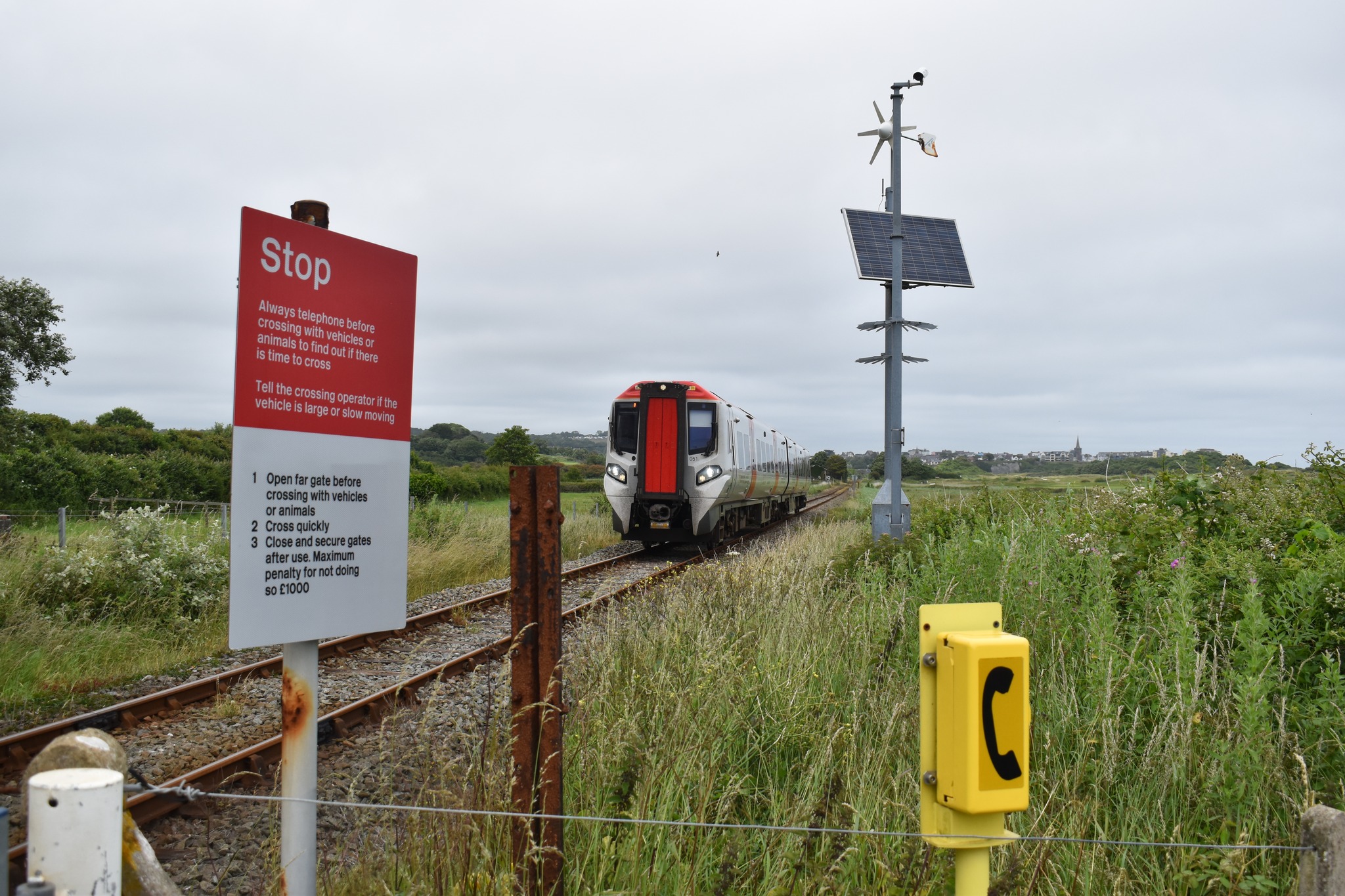
New analysis links worsening disruption to heavier rainfall and repeated trouble spots on the network
RAIL passengers in Wales are facing growing delays and cancellations as flooding increasingly hits the network, according to new analysis based on Network Rail data.
Figures obtained through the Freedom of Information Act suggest flood-related disruption affecting services in Wales has risen by around 256 per cent compared with the mid-2010s.
Between 2022 and 23 December 2025, services affecting passengers in Wales generated an average of around 2,366 passenger delay minutes a year due to flooding. That compares with an average of 664 a year between 2014 and 2017.
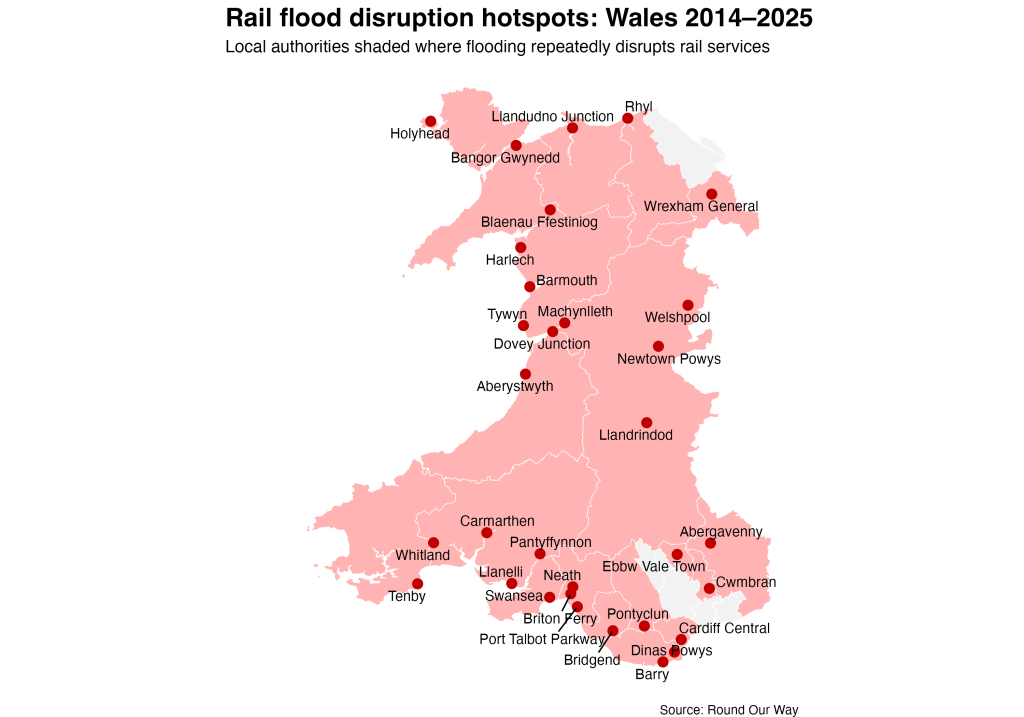
The analysis, carried out by climate not-for-profit Round Our Way, says train operators serving towns and cities across Wales, including Great Western Railway, CrossCountry, Transport for Wales and Avanti West Coast, have all been affected.
The worst disruption has been concentrated around a number of repeat trouble spots on the rail network, including Machynlleth, Cardiff Central, Bridgend, Bangor and Pontyclun, where flooding has repeatedly interrupted services.

Round Our Way said its analysis of Network Rail cancellation data suggests flood-related disruption is placing increasing strain on the rail network as periods of extreme rainfall become more common.
The group said the figures show not only more major disruption events, but also a worsening day-to-day baseline, with even quieter periods now causing more passenger delay than in previous years.
Gemma Plumb, a meteorologist at Weather Change, said: “It’s clear that train users are seeing more and more disruption to their journeys as a result of heavy rain and flooding, which is hugely frustrating for people who rely on the train network to get around.
“We know that climate change is leading to more extreme weather, including more intense rainfall. This is because a warmer atmosphere can hold more moisture, so when it rains, it rains more.”

Sofie Jenkinson, co-director at Round Our Way, said the rail network appeared to be under “persistent weather stress” as climate change began to have more regular effects.
She said: “This causes significantly more delays to train passengers. But it is also a problem for rail operators, particularly the large inter-city train operators running services into regions of the country that are worst hit by flooding, like the South West, Scotland and Wales.
“The significant rise in delays shows the increased impact of extreme weather caused by climate change, raising concerns about safety beneath the surface of our creaking rail infrastructure for passengers and operators alike.”

Round Our Way said Britain was not adequately prepared for the effects of climate change on everyday infrastructure and called for long-term investment to make the rail network more resilient.
The group pointed to wider warnings from climate experts that rising global temperatures are likely to increase the intensity of rainfall, putting more pressure on ageing transport systems.
Network Rail data used in the study covers the period from 1 April 2014 to 23 December 2025 and relates to incidents classed as flood-related disruption.
A train is recorded as cancelled if it fails to stop at one or more planned stations. Full cancellations are classed as trains that completed less than half of their intended journey, while part cancellations are those that ran at least half, but not the full route, or missed one or more planned stops.

Johnston forecourt hits 194.9p while wide price gaps and rush to fill up pile pressure on motorists across the county
DIESEL prices in Pembrokeshire are edging dangerously close to £2 a litre, with the BP forecourt in Johnston on the A4076 displaying 194.9p per litre.
The latest surge has sparked a rush at some filling stations across the county, as motorists hunt for pumps that have not yet caught up with the steep increases. The Herald understands some forecourts have temporarily run dry as drivers fill up early to avoid paying even more, rather than because of any wider supply issue. That picture fits with national comments from the AA, which said it had seen no evidence of widespread shortages or any increase in breakdowns caused by vehicles running out of fuel.
Pictures sent to The Herald show just how sharply prices now vary across Pembrokeshire.
At Johnston, diesel was 194.9p per litre and petrol 157.9p. At Robeston Wathen, diesel was 187.9p and petrol 155.9p. At Square and Compass, diesel was 183.7p and unleaded 151.7p. In Milford Haven, the Gulf station on North Road was displaying diesel at 179.7p and petrol at 148.7p, while Tesco Milford Haven showed diesel at 181.9p and unleaded at 149.9p. In St Davids, Ocean Haze was also showing diesel at 187.9p, with petrol at 155.9p.
Based on those prices, there is a 15.2p-per-litre gap between the highest and lowest diesel prices pictured — a difference of more than £9 on a 60-litre fill.
The local spike reflects a sharp rise across the UK. RAC data showed average petrol prices reached 152.01p a litre on March 30 — the highest level in 28 months — while diesel climbed to 181.2p, its highest point since December 2022. The RAC said that, compared with the start of the Iran conflict, it was costing £10.55 more to fill a typical family petrol car and £21.35 more for a comparable diesel vehicle.
RAC head of policy Simon Williams said the “financial strain” on motorists “continues to build”, while RAC Foundation director Steve Gooding warned prices at the pumps appeared to be on a “one way trajectory”.
The AA’s latest weekly update, based on government data, put average UK petrol at 148.78p a litre and diesel at 176.42p, up from 144.16p and 166.88p the previous week.
The pressure is being felt well beyond private motorists. In West Wales, the wider rural economy is especially exposed because so many people rely on vehicles for work, deliveries and day-to-day life.
The Farmers’ Union of Wales said rising fuel and heating oil prices were placing “additional pressure on rural communities” and increasing the risk of theft. In a March statement, the union said red diesel had risen from about 67p a litre in February to around 109p in mid-March, while heating oil had in many cases more than doubled from around 60p to about £1.30 a litre. It also noted that 74 per cent of homes in Ceredigion are off the gas grid, leaving many households particularly vulnerable to sudden price shocks.
The haulage sector has also warned of the knock-on effect. Swansea Bay News reported that Llanelli-based Owens Group said soaring diesel costs had added around £64,000 a week to its fuel bill. Founder Huw Owen said: “We felt it as a company straight away. With a fleet our size, we burn a tanker of fuel a day. We used to order fuel a week or even a fortnight in advance — now we’re negotiating prices day by day.”
The same report quoted Road Haulage Association representative Geraint Davies warning that higher transport costs would feed through into prices more widely because “everything we buy is moved by road at some point.”

For households, tradespeople, delivery drivers and rural businesses in Pembrokeshire, the latest rise is another heavy blow. In a county where so many people depend on their vehicles every day, sharp increases at the pumps are felt quickly and widely.
One thing is clear: drivers are shopping around harder than ever, and when prices are moving this fast, delaying a fill-up by even a day can come at a cost.
Photo caption:
Johnston prices: Diesel reached 194.9p per litre at the BP forecourt on the A4076 (Pic: Herald)

Man accused of multiple breaches of Sexual Harm Prevention Order after hearing at Aberystwyth Magistrates’ Court
A SEX offender has been remanded in custody after appearing in court accused of breaching a Sexual Harm Prevention Order on seven separate occasions.
Stewart Alderton, aged 44, currently of HMP & YOI Parc, Bridgend, appeared before Aberystwyth Magistrates’ Court on Tuesday (Mar 31).
The charges allege that Alderton breached a Sexual Harm Prevention Order imposed at Mold Crown Court on November 17, 2021.
It is alleged that at an address in Wylcwm Close, Knighton, on June 18, 2025, and again on December 14, 2025, he deleted TikTok chat strings, phone applications, web artefacts and web history, and also carried out a factory reset on a device, all said to be contrary to the terms of the order.
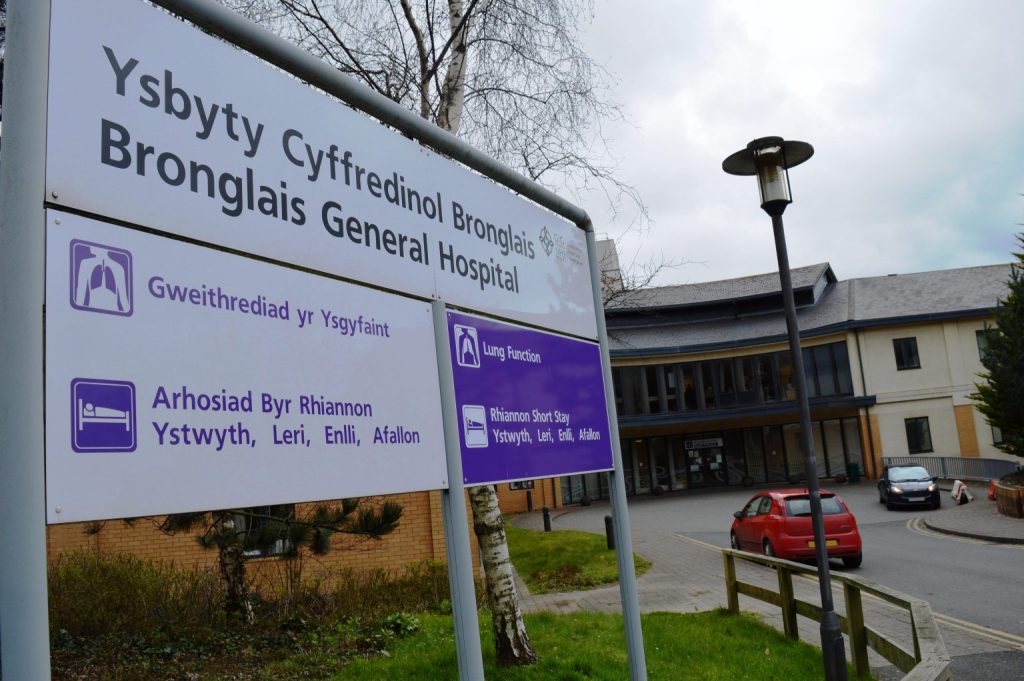
A further allegation states that on February 16, 2026, at Bronglais Hospital, he failed to notify police of an internet-enabled device within the required three days.

No pleas were entered.
The case was adjourned for a plea hearing at Aberystwyth Magistrates’ Court at 2:00pm on Wednesday (Apr 1).
Alderton was remanded in custody.



News2 hours ago
Diesel nears £2 a litre in Pembrokeshire as drivers scramble for cheaper fuel
Johnston forecourt hits 194.9p while wide price gaps and rush to fill up pile pressure on motorists across the county...


News22 hours ago
St Davids Cathedral marked Easter Sunday with full day of worship
FROM dawn vigil to choral evensong, the cathedral welcomed worshippers for one of the most important days in the Christian...


Crime23 hours ago
Neyland man spared immediate jail over aggravated vehicle taking
Defendant given a suspended prison sentence after magistrates heard the offence was serious enough to cross the custody threshold KRISTIAN...


Health2 days ago
Crumbling NHS faces £1bn repairs bill in Wales
Senedd election promises collide with the harsh reality of ageing hospitals, fire safety concerns and a maintenance crisis stretching across...


News2 days ago
Emergency services respond to incident in Haverfordwest town centre
EMERGENCY SERVICES were called to an incident in Haverfordwest town centre on Saturday morning (Apr 4), with police and ambulance...

News2 days ago
Teenager intervenes after bridge incident
A TEENAGER was left shaken after stepping in to help a young woman in distress on Clay Lanes bridge in...


Crime4 days ago
Driver spared jail after crash killed young couple
A PEMBROKE DOCK driver who caused the deaths of a young couple in a road crash has been given a...


Entertainment4 days ago
BBC unveils major new Welsh dramas with Tenby set for prime-time spotlight
New crime series Old Town Murders and supernatural thriller The Witch Farm will both be filmed and set in Wales...


Health4 days ago
No jobs for new paramedics in Wales as graduates told to apply for technician roles
Students trained at public expense urged to take lower-grade jobs as anger grows over NHS workforce planning NEWLY qualified paramedics...


News5 days ago
Health minister refuses to act on Withybush despite 15,000-signature petition
Senedd pressure grows as Welsh Government declines to intervene over surgery fears THE WELSH GOVERNMENT has refused to step in...
-

 News3 days ago
Accommodation providers in Wales will be required to register under new law
-
 Business6 days ago
Fishguard to Wexford rail tunnel plan backed by Elon Musk firm
-

 Entertainment4 days ago
From Milford Haven to the world: The story of The Evolution Experience
-
Entertainment4 days ago
BBC unveils major new Welsh dramas with Tenby set for prime-time spotlight
-

 Charity7 days ago
RSPCA calls for stronger animal welfare measures as Welsh Labour launches manifesto
-

 News7 days ago
Labour promises 48-hour GP access as manifesto faces questions over delivery
-

 Crime6 days ago
Driver trapped after crash while nearly four times over drink-drive limit
-
 Business6 days ago
Refusal over Pembrokeshire shepherd hut let goes to appeal